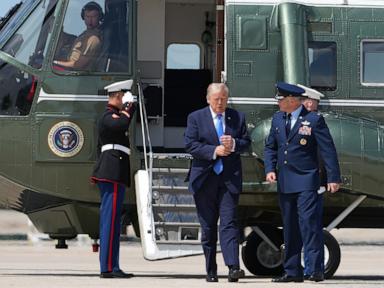
Every cable news anchor and aviation blogger is clutching their pearls over the Federal Aviation Administration launching an investigation into why a commercial flight departed just as a helicopter carrying Donald Trump approached the runway. The lazy consensus is predictable. People are screaming about systemic failure, overworked controllers, protocol breaches, and political interference in the national airspace.
They are looking at the wrong thing entirely.
I have spent two decades analyzing the operational bottlenecks of busy terminals, and I have watched millions of dollars in technology get blamed for human friction that technology can never fix. The mainstream outrage treats air traffic management like a frictionless video game where planes glide along invisible tracks under omniscient supervision. That is a fairy tale told by people who have never stepped foot inside a TRACON facility during a Friday afternoon rush.
The near miss wasn't a sign of a broken system. It was a symptom of an impossible math problem we demand our airspace handle every single minute of every single day.
The Myth of the Immaculate Separation
Let us define terms before we tear down the panic. Air traffic control is not a bubble-wrapping service. It is a pacing mechanism. The primary directive of any controller is spacing and flow, not absolute, zero-risk insulation from reality. When a VIP movement enters a congested corridor, the operational tempo shifts from routine sequencing to high-stakes chess.
The media wants you to believe that a clearance to roll down a runway is an act of divine certainty. It is not. It is an authorization based on current visual sightings, transponder readouts, and projected vectors.
Imagine a scenario where a tower controller is managing simultaneous departures, intersecting arrivals, ground vehicles, and a restricted-airspace presidential entourage moving at variable speeds. The margins for human judgment compress from miles to seconds. When an investigation starts, everyone scrambles to find a scapegoat to satisfy the public appetite for heads on spikes.
Did a controller issue a premature takeoff clearance? Possibly. Was that clearance given within the legal boundaries of operational discretion given the conflicting data on scope screens? Almost certainly.
The dirty little secret of modern aviation is that safety margins are built precisely because humans make mistakes. The system worked because a disaster did not happen. Treating a close proximity event as a catastrophic failure misdiagnoses the disease.
Why VIP TFRs Break the Brain of Terminal Control
Temporary Flight Restrictions are designed to protect high-ranking officials, but they introduce a toxic variable into terminal sequencing: rigidity.
Commercial aviation runs on predictability. Arrival streams and departure banks are calculated down to the decimal. Introduce a moving bubble of restricted airspace around a VIP helicopter, and you throw a wrench into a finely tuned engine. Controllers are forced to squeeze normal traffic into narrowing gaps between restricted zones.
When you compress the available airspace, you increase cognitive load exponentially. A tower controller is not just tracking planes; they are managing a psychological pressure cooker.
I have seen operations blow millions on automated runway status light systems and surface detection gear, thinking hardware solves fatigue. It does not. Hardware only gives controllers better information faster, which sometimes just means they realize they are trapped in a tight spot a few seconds earlier.
The real scandal isn't that a commercial plane rolled down the tarmac near a presidential helicopter. The scandal is that we pretend our airspace can absorb the disruption of VIP movements without severe degradation to baseline efficiency and safety buffers.
The Uncomfortable Truth About Risk
Here is what nobody in the pundit class wants to admit: absolute safety in aviation is a marketing slogan, not an engineering reality.
If we wanted zero runway conflicts involving VIP movements, the solution is brutally simple. Shut down the entire airport for an hour on either side of the arrival. Ground everything. Clear the skies completely.
Do you know why we do not do that? Because the economic cost would be astronomical. The ripple effects through the national airspace system would cancel flights from coast to coast, stranding tens of thousands of passengers and costing airlines millions in fuel and crew reassignments.
So, we compromise. We thread the needle. We rely on human controllers to eyeball and calculate acceptable risks in real time. Most of the time, the math works out. Occasionally, it gets tight enough to trigger an FAA review and a media feeding frenzy.
When you demand maximum throughput and absolute VIP security simultaneously, you are asking for contradictory outcomes. You cannot bend physics and human attention spans past a certain breaking point without occasionally flirting with the margins.
Stop calling for wholesale firings every time the margins get tight. Fix the infrastructure, respect the cognitive limits of the people wearing the headsets, and stop acting surprised when the machine groans under the weight of its own complexity.