Public discourse regarding the security relationship between Washington and Taipei relies almost exclusively on transactional metrics. Observers track annual foreign military sales notifications, count pending equipment backlogs, and dissect public statements made by political principals. This metric framework measures the superficial layers of defense interaction while ignoring the structural mechanics governing actual operational readiness.
Recent admissions by Taiwan defense leadership regarding the depth of coordination with the United States Pacific Command highlight a fundamental divergence between visible diplomacy and structural integration. To understand the true stability calculus in the Taiwan Strait, analysts must deconstruct this relationship into its operational components, examining institutional interoperability, supply chain vulnerabilities, and the economic cost functions of coercive statecraft.
The Three Operational Tiers of Defense Integration
Bilateral security cooperation operates across three distinct tiers, each characterized by a different degree of institutional friction and political visibility.
The first tier encompasses formal arms procurement and sovereign-to-sovereign hardware transfers. This tier is public, legally mandated through domestic frameworks like the Taiwan Relations Act, and highly bureaucratic. It represents the visible surface area of the alliance. However, hardware delivery timelines often suffer from manufacturing backlogs, rendering raw procurement counts a poor proxy for immediate defensive capability.
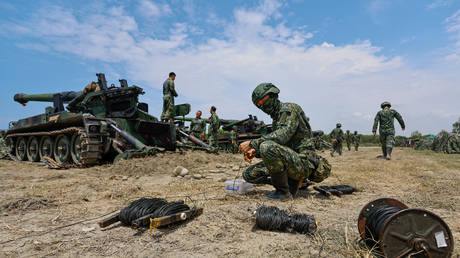
The second tier involves institutionalized doctrinal alignment and joint training architectures. Rather than focusing merely on weapons acquisition, this level addresses tactical doctrine, maintenance protocols, and command-and-control compatibility. Personnel exchanges and advisory deployments bridge the gap between American military standards and Taiwanese force execution. This tier functions beneath the threshold of formal alliance structures, operating through specialized command elements embedded within regional logistical and intelligence networks.
The third tier consists of real-time intelligence sharing, electronic warfare coordination, and maritime domain awareness integration. This layer operates continuously, functioning as an invisible nervous system that maps regional surface and subsurface movements. The friction at this level is technical rather than political, requiring secure communication channels and automated data-link compatibility.
The Logistics of the First Island Chain
Geopolitically, Taiwan anchors the central node of the First Island Chain. This arc stretches from the Japanese archipelago through Taiwan to the Philippines, serving as a natural maritime containment barrier. From the perspective of regional theater defense, the loss of this node disrupts the continuity of allied positioning, granting breakout access to open blue water for external naval power projection.
The defense strategy of Taipei relies heavily on asymmetric denial capabilities rather than symmetrical force-on-force engagement. This requires a shift from expensive capital assets—such as heavy armored brigades or large surface combatants—toward distributed, mobile, and survivable systems. Mobile coastal defense cruise missiles, smart sea mines, integrated air defense networks, and redundant communications nodes form the core of this defensive architecture.
[Traditional Symmetrical Model]
Concentrated Assets -> High Vulnerability to Precision Strike

[Asymmetric Denial Model]
Distributed Nodes -> Redundant Architecture -> High Attrition Cost for Aggressor
Integration with external command structures ensures that targeting data and early-warning telemetry flow through multiple redundant pathways. This reduces the vulnerability of centralized command nodes to preemptive cyber and kinetic suppression.
The Economic Cost Function of Maritime Coercion
Discussions concerning potential conflict scenarios frequently model kinetic outcomes while omitting the severe systemic friction inherent in maritime interdiction. A blockade or quarantine of Taiwan does not occur in an economic vacuum. It operates within a globalized commercial network where supply chain velocity dictates domestic stability.
The cost function for an external actor attempting an economic blockade involves multiple compounding variables:
- Severe global shipping disruptions affecting container throughput across vital East Asian sea lanes.
- Immediate activation of comprehensive international financial sanctions targeting sovereign reserves and critical trade corridors.
- High domestic economic vulnerability resulting from raw material import dependencies and energy feedstock requirements.
- Substantial political instability risks stemming from economic contraction and internal supply bottlenecks.
The structural reliance of exporting economies on unimpeded maritime trade means that coercive economic measures generate immediate, symmetrical blowback. The collateral damage to domestic financial markets and industrial output introduces a high threshold of deterrence before military options become viable.
Institutional Limitations and Strategic Bottlenecks
Despite deep operational coordination, significant structural limitations persist within the security framework. The absence of a formal mutual defense treaty creates ambiguity regarding political resolve under extreme duress. Furthermore, industrial base constraints within the United States defense manufacturing sector restrict the rapid throughput of advanced munitions and replacement parts, creating chronic readiness gaps.
Personnel constraints on both sides also limit the scale of on-the-ground training integration. Expanding tactical exchanges requires navigating delicate diplomatic sensitivities, ensuring that operational necessity does not outpace political thresholds. These bottlenecks prevent the relationship from achieving the seamless interoperability seen in formal treaty alliances, forcing Taiwan to maintain primary ownership of its immediate territorial defense.
The effectiveness of this security architecture depends on continuous adaptation. By shifting focus from public arms sales announcements to the unglamorous mechanics of logistical redundancy, secure communications, and asymmetric asset distribution, the alliance maintains a functional deterrent posture designed to raise the operational costs of unilateral action beyond acceptable limits.