The map of the world looks solid on a screen, but for the captain of a Very Large Crude Carrier (VLCC) navigating the Strait of Hormuz, the world is a fragile, twenty-one-mile-wide strip of blue. On one side, the jagged coast of Iran. On the other, the United Arab Emirates and Oman. Between them lies the carotid artery of the global energy market. One-fifth of the world's liquid petroleum passes through this needle’s eye every single day. If that artery gets pinched, the world doesn't just feel a headache. It goes into cardiac arrest.
Economics is often treated as a series of spreadsheets and sanitized data points. We talk about "market volatility" and "supply chain disruptions" as if they are weather patterns we can simply observe from a window. But the reality is far more visceral. When a political leader sets a deadline on a geographic chokepoint, they aren't just making a policy statement. They are placing a thumb on the scales of every household budget from Mumbai to Munich.
The Architect of Uncertainty
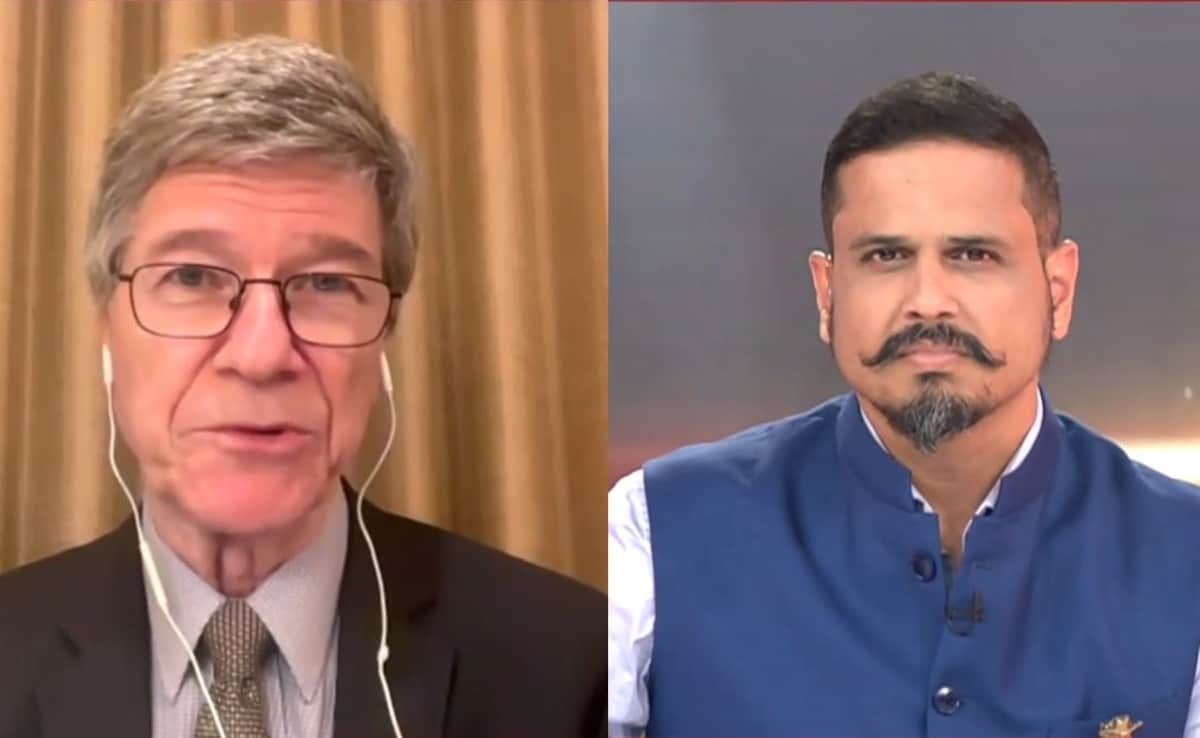
Recently, the global conversation shifted from cautious observation to high-stakes anxiety. Donald Trump’s rhetoric regarding a "deadline" for the Strait of Hormuz has sent a shiver through the institutions that usually pride themselves on having a plan for everything. Lord Meghnad Desai, a veteran economist whose career has been defined by deconstructing the mechanics of global trade, didn't mince words when he sat down with NDTV. He looked at the strategy—or the lack thereof—and saw something deeply destabilizing.
Desai’s critique wasn't just about partisan disagreement. It was about the fundamental nature of how a superpower interacts with the rest of the world. He described a man operating without a traditional playbook, a leader who treats international maritime law and delicate geopolitical balances like a real estate negotiation where the loudest voice wins.
But the sea doesn't care about the loudest voice.
The Strait of Hormuz is not a place where you can afford to "wing it." To understand the stakes, consider a hypothetical floor manager at a manufacturing plant in Ohio or a small-scale delivery driver in Bengaluru. They don't track the daily movement of tankers. They don't know the names of the islands in the Persian Gulf. Yet, their entire livelihood is tethered to the transit of those ships. When the "unstable" nature of a deadline is introduced into this ecosystem, the first thing that dies is predictability. Without predictability, investment freezes. When investment freezes, the person at the end of the line loses their job.
The Geometry of a Crisis
Why is this specific strip of water so terrifying to economists? To answer that, we have to look at the sheer volume of dependency.
- The Flow: Roughly 20 million barrels of oil per day.
- The Bottleneck: The shipping lanes are only two miles wide in each direction.
- The Alternative: There are almost no viable land-based bypasses that can handle that volume.
If a deadline passes and a conflict erupts, or if the Strait is closed, the price of crude doesn't just go up by a few dollars. It spikes. We are talking about a vertical line on a graph. This isn't just about the "rich getting richer." It’s about the cost of fertilizer for a farmer, which determines the price of bread for a family. It’s about the cost of plastic for medical supplies. It’s about the very electricity powering the device you are using to read this.
Lord Desai pointed out that Trump’s approach lacks the "robust" (to use a term he might find too generous for the situation) structural support of a diplomatic coalition. It is a solo act in a theater that requires an ensemble. When a leader sets a deadline without a clear off-ramp or a defined set of strategic objectives, they aren't playing chess. They are playing a game of chicken with a tanker that takes three miles just to come to a full stop.
The Psychology of the Market
Markets are essentially giant piles of human nerves. They react to fear much faster than they react to logic. When an economist calls a leader "unstable" and "without a strategy," they are signaling to the world’s central banks that the old rules no longer apply.
Think about the way you feel when you’re driving behind someone who keeps tapping their brakes for no reason. You can’t get a rhythm. You become hyper-vigilant. You start to pull back, creating distance, slowing down the entire flow of traffic behind you. Now imagine that driver is in charge of the most powerful military and economy on earth, and the "road" is the primary source of the world’s fuel.
Desai’s alarm stems from the fact that Trump’s deadlines often appear to be arbitrary markers rather than the result of a coordinated push for a specific treaty or concession. If the deadline is reached and nothing happens, the credibility of the superpower wanes. If the deadline is reached and force is used, the global economy enters a dark room with no flashlight.
The "human element" here is the exhaustion of the global citizen. For years, the world has operated on the assumption that while leaders might bicker, the fundamental plumbing of global trade—the sea lanes, the banking swaps, the postal unions—would remain functional. That assumption is being dismantled. We are moving into an era where the plumbing itself is being used as a weapon of leverage.
A Strategy of Chaos
Is there a method to the madness? Some supporters argue that unpredictability is the strategy itself. The idea is that if your opponent doesn't know what you’ll do next, they are forced to stay on their toes. But there is a difference between being a "wild card" in a poker game and being a "wild card" in a nuclear-armed world with a fragile supply chain.
Lord Desai’s assessment suggests that the "unstable" tag isn't just an insult; it’s a technical diagnosis of a policy framework. A stable policy is one where if 'A' happens, 'B' will follow. It allows businesses to plan for five years into the future. Trump’s deadline-heavy approach creates a permanent 'Present Tense.' Everyone is stuck waiting for the next tweet, the next headline, the next shift in tone.
This state of limbo has a price. It’s called a "risk premium." Insurance companies charge more to cover ships. Banks charge more to lend money. These costs are invisible to the average person until they see the receipt at the gas pump or the grocery store. We are all paying a "chaos tax" every time a deadline is tossed into the ring without a plan to manage the fallout.
The Ghost in the Machine
We often talk about "The Economy" as if it’s a sentient machine that lives in a skyscraper in New York. It isn't. The economy is just the sum total of every decision we make—whether to buy a car, whether to start a business, whether to save for a rainy day.
When Lord Desai speaks about the lack of strategy, he is talking about the erosion of the ground beneath our feet. He is reminding us that the "Top Economist" isn't just worried about numbers. He is worried about the social contract. He is worried about what happens when the people who run the world stop pretending that the rules matter.
The Strait of Hormuz is a physical place, but it’s also a symbol. It’s the point where the abstract world of high-level politics meets the physical world of steel, oil, and salt water. It’s where a single word from a podium in Washington D.C. can ripple across the Indian Ocean and end up as a shuttered factory in a small town thousands of miles away.
Consider the silence that follows a major announcement. That silence isn't peace. It’s the world holding its breath. It’s the captain of that VLCC looking at the horizon, wondering if today is the day the shipping lane becomes a battleground. It’s the trader in Singapore staring at a screen, waiting for a signal that never comes. It’s the realization that we are all passengers on a ship where the person at the wheel has decided that the map is optional.
The deadline looms. The water in the Strait remains choppy, reflecting a sun that doesn't care about trade routes or political legacies. We wait, not for a solution, but for the next moment of impact. The real story isn't the deadline itself. It’s the slow, steady grinding of gears as a world built on order tries to survive a season of intentional disorder.
Darkness falls over the Gulf, and the lights of the tankers flicker like a nervous pulse.