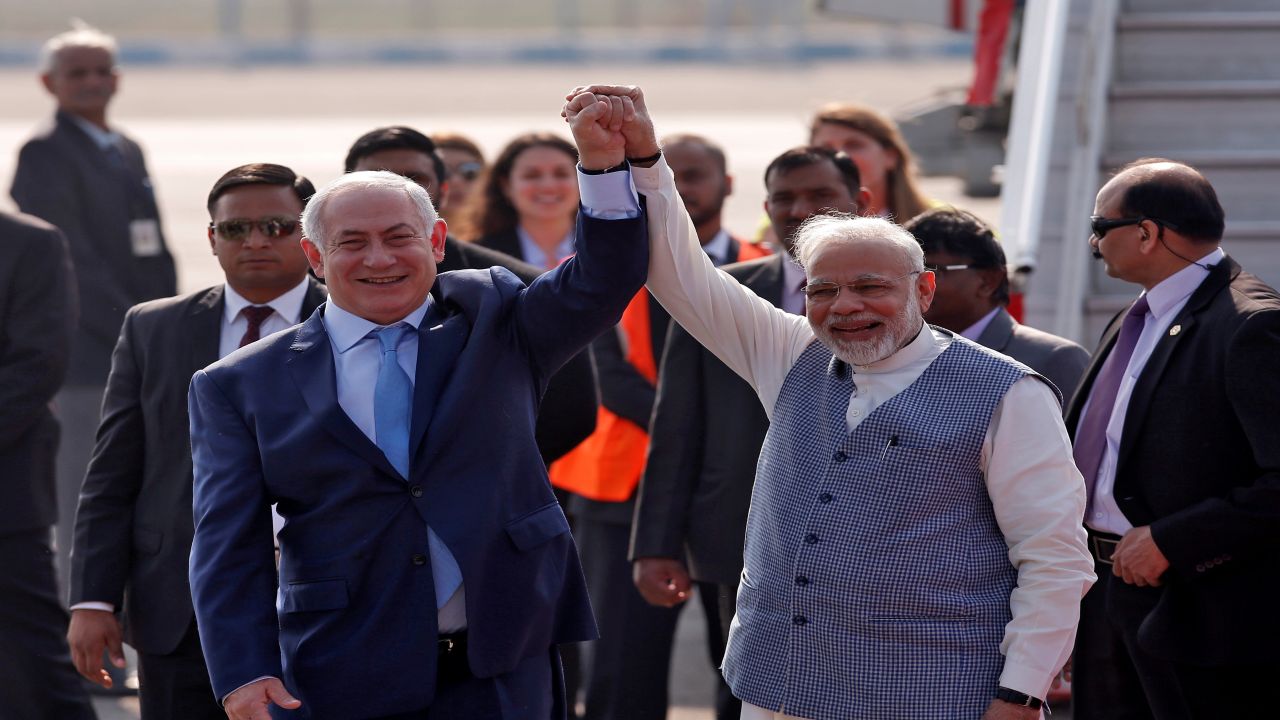
The transformation of India-Israel relations from clandestine cooperation to a formalized strategic partnership is not merely a diplomatic shift; it is a calculated execution of "de-hyphenation" policy that decoupled India’s ties with Israel from its historical commitment to the Palestinian cause. This structural realignment, accelerated since 2014, operates on a high-density feedback loop between defense procurement, agricultural technology, and intelligence integration. By moving beyond the "buyer-seller" model, the two nations have built a specialized ecosystem where Israeli high-end innovation meets Indian industrial scale, creating a unique bilateral cost-function that competitors find difficult to replicate.
The Triad of Strategic Interdependence
The partnership functions through three distinct operational pillars. Each pillar addresses a specific deficiency in India’s domestic infrastructure while providing Israel with the geographic and economic depth it lacks.
1. The Defense-Technology Pipeline
India remains the largest buyer of Israeli military hardware, but the relationship has evolved into co-development. The primary value driver here is the integration of Israeli "brainware"—sensors, guidance systems, and EW (Electronic Warfare) suites—into Indian platforms.
- Air Defense Architecture: The development of the Barak-8 (MRSAM) represents a deep integration of the DRDO and Israel Aerospace Industries. This is not a shelf-purchase; it is a joint intellectual property venture.
- Precision and Intelligence: The reliance on Israeli UAVs (Heron and Searcher) and precision-guided munitions (SPICE bombs) provides India with a qualitative edge in border management. The "intelligence-to-action" latency is reduced by Israeli data-processing algorithms adapted for Himalayan and desert terrains.
- Small Arms Localization: Through ventures like PLR Systems, Israel Weapon Industries (IWI) has localized the production of Tavor and Masada firearms, fulfilling "Make in India" requirements while securing Israel’s supply chain longevity.
2. The Hydro-Agrarian Security Framework
Water scarcity is a systemic risk to India’s internal stability. Israel’s mastery over the water cycle—specifically desalination and micro-irrigation—serves as a critical risk-mitigation tool for the Indian state.
- Micro-Irrigation as Macro-Strategy: Companies like Netafim have moved from selling equipment to managing "Water-as-a-Service" models in states like Karnataka and Maharashtra. This shifts the capital expenditure (CAPEX) burden from the farmer to a more sustainable operational expenditure (OPEX) model.
- Centers of Excellence (CoE): There are currently over 30 CoEs across India. These function as localized R&D hubs where Israeli agronomy is "tropicalized" for Indian soil conditions. This creates a bottom-up diplomatic goodwill that stabilizes the high-level political alliance.
3. Cyber and Intelligence Fusion
Beyond hardware, the partnership is defined by the exchange of signals intelligence (SIGINT) and cyber-defense protocols. For India, the threat of asymmetric warfare and cross-border terrorism necessitates a preemptive doctrine. Israel’s Unit 8200-derived commercial sector provides the tools for high-volume data analysis and perimeter security.
The Mechanics of De-hyphenation
Historically, India’s West Asia policy was a zero-sum game. To support Israel was seen as an abandonment of the Arab world. The current strategy inverted this by treating bilateral relationships as independent variables.
The logic follows a simple probability distribution:
- The Gulf monarchies (UAE, Saudi Arabia) increasingly view Israel as a technology partner and a hedge against regional rivals.
- India, by strengthening ties with both the UAE and Israel simultaneously, positioned itself as the central node in the I2U2 (India, Israel, UAE, USA) grouping.
- This creates a "Trans-Arabian Corridor" that competes directly with China’s Belt and Road Initiative, specifically the maritime routes through the Suez Canal.
Quantifying the Value Exchange
The economic relationship is heavily weighted toward defense and high-tech, which creates a specific trade deficit profile. However, the "real" value is found in the transfer of intangible assets.
- R&D Arbitrage: Israel spends roughly 5% of its GDP on R&D. India provides the human capital and the massive testing grounds (user base) required to refine these technologies.
- Supply Chain Resilience: In a post-globalization era, Israel views India as a "secondary manufacturing base." In the event of a regional conflict in the Levant, Indian production lines for Israeli-designed tech ensure the survival of Israeli defense firms.
Critical Bottlenecks and Risk Factors
The partnership is not without structural friction. Three primary bottlenecks threaten the current growth trajectory:
- Bureaucratic Asymmetry: The speed of Israeli innovation often outpaces the Indian procurement cycle. The "Request for Proposal" (RFP) process in India can take years, during which Israeli tech generations may have already shifted twice.
- The Russia Factor: India’s historical and ongoing reliance on Russian hardware creates integration challenges. Merging Israeli avionics with Russian airframes requires complex middleware, increasing the "integration tax" on new projects.
- End-User Monitoring: U.S. technology components within Israeli systems often require Washington’s approval for export to India. This creates a trilateral dependency where the U.S. holds a "kill switch" over certain aspects of the India-Israel partnership.
The Semiconductor and Innovation Nexus
The next phase of this partnership is moving into the foundational layers of technology: semiconductors and AI. As the world moves toward "trusted geographies" for chip manufacturing, Israel’s design prowess and India’s "Semicon" incentives provide a natural fit.
The ISMC (International Semiconductor Consortium), which includes Israeli participation, targets the 65nm analog gear—essential for automotive and power electronics. This isn't about competing with TSMC on 3nm chips; it's about securing the "industrial backbone" of the next decade.
Strategic Execution: The Haifa Port Pivot
The acquisition of the Haifa Port by the Adani Group is the most significant physical manifestation of this alliance. It transforms the relationship from a series of transactions into a permanent stake in each other’s infrastructure.
- Geopolitical Signaling: An Indian entity controlling a strategic Mediterranean gateway signals to Mediterranean powers (and China) that India is no longer a passive observer in West Asian waters.
- Logistical Integration: The port serves as the terminal point for the proposed rail link from the UAE through Saudi Arabia and Jordan. This "land bridge" bypasses the geopolitical volatility of the Persian Gulf and the Bab el-Mandeb Strait.
The strategy for the next five years must focus on institutionalizing these ties so they are resistant to leadership changes. This requires moving beyond high-profile state visits and into the deep-tissue integration of "Track II" diplomacy: university exchanges, joint venture incubators, and standardized cyber-security protocols. The goal is to move from a "strategic partnership" to a "strategic inevitability" where the technical and economic costs of decoupling become prohibitively high for both nations.
Priority should be placed on the "Start-Up Bridge" initiatives, specifically in the realms of quantum computing and dual-use AI. While the defense hardware generates the headlines, the software-defined warfare of the future will be won or lost in the ability of Bangalore and Tel Aviv to synchronize their coding environments. India must accelerate its "Green Channel" for Israeli tech startups, bypassing traditional tender processes in exchange for immediate technology transfer and local manufacturing rights. This is the only way to close the capability gap with regional competitors while maintaining the strategic autonomy that defines India's current global posture.