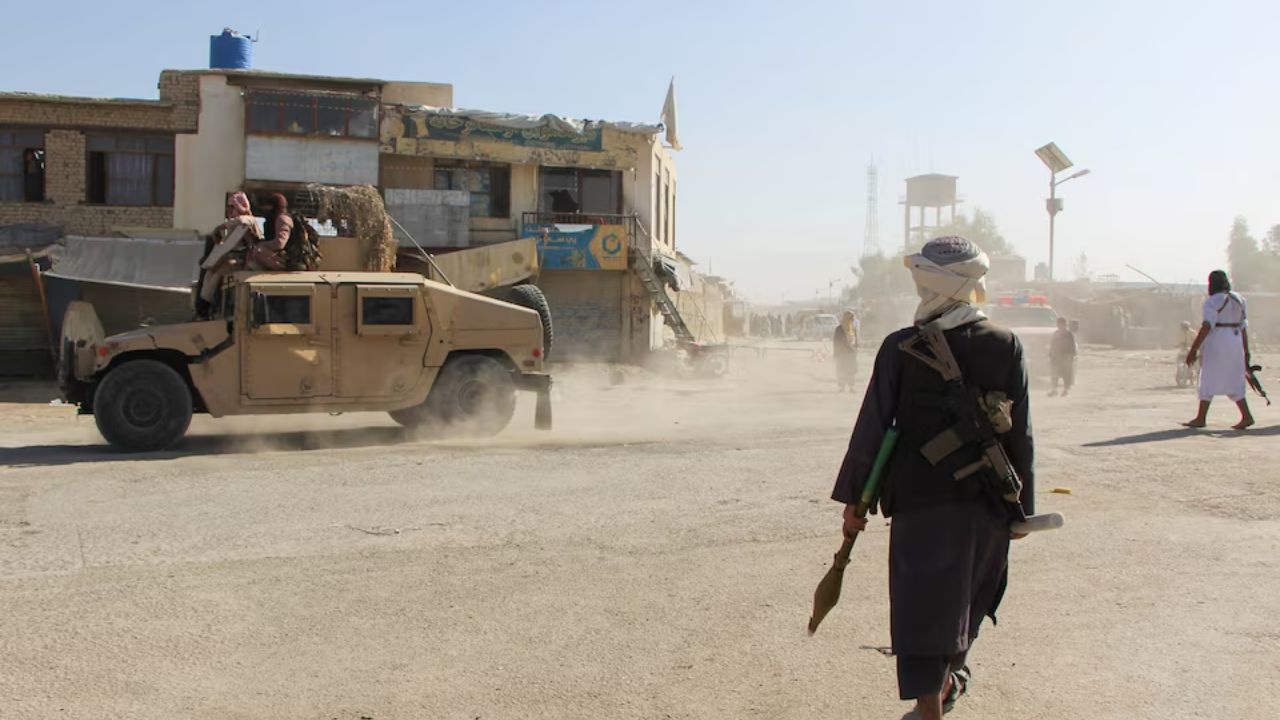
The air at the Kharlachi border crossing doesn't smell like politics. It smells of scorched diesel, ancient limestone dust, and the sharp, metallic tang of unspent adrenaline. When the first mortar shell arcs over the jagged spine of the Hindu Kush, it doesn't announce a diplomatic shift. It announces a frantic scramble for cover.
In Islamabad and Kabul, men in pressed suits and polished waistcoats trade stern press releases about "unprovoked firing" and "territorial integrity." But on the ground, in the rugged creases of the Kurram district, the reality is much louder. It is the sound of a shopkeeper slamming a corrugated iron shutter. It is the sight of a shepherd driving his flock into a ravine, his eyes fixed on the ridgeline where the Taliban’s white flags flutter against a bruised sky.
This is not a new story, but it is a deteriorating one. For decades, the Durand Line—the 1,600-mile frontier carved by a British bureaucrat’s pen in 1893—has been less of a wall and more of a scar. It refuses to heal.
The Ghost in the Mountains
Consider a man we will call Dawar. He is a hypothetical composite of the thousands who live in the shadow of the Kurram Pass, but his fear is entirely real. Dawar owns a small patch of land where the soil is more rock than earth. To him, the border isn't a line on a map; it is the graveyard of his cousins and the barrier to his trade.
When the Pakistani military reports that they are "responding effectively" to Afghan Taliban fire, Dawar hears the thunder of heavy artillery from the nearby ridges. He knows the rhythm. The Afghan side initiates, perhaps over a dispute about a new checkpoint or a patch of forest. The Pakistani side retaliates to "teach a lesson."
In the middle sits Dawar.
The latest flare-up isn't just a skirmish; it is a symptom of a massive, grinding geopolitical gear-shift. When the Taliban retook Kabul in 2021, the Pakistani establishment expected a grateful neighbor. They expected a brother-in-arms who would help secure the western flank. Instead, they found a movement that views the border as a colonial fiction and the Pakistani state as an inconvenient obstacle.
A Marriage of Necessity and Spite
The tension is fueled by a bitter irony. Pakistan spent years navigating the complexities of the Afghan insurgency, often at a staggering domestic cost. Now, the very group they once engaged with as a "strategic asset" is the one pulling the trigger at Kharlachi.
The friction usually boils down to three invisible pressures:
- The Fence: Pakistan has spent hundreds of millions of dollars sprawling chain-link and barbed wire across the mountains. The Taliban, who see the entire Pashtun heartland as a single entity, view this fence as an insult. They tear it down. Pakistan puts it back up.
- The TTP Factor: The Tehrik-i-Taliban Pakistan (TTP) uses the Afghan side as a sanctuary. When they cross over to attack Pakistani outposts, Islamabad demands action. Kabul offers excuses.
- The Ego of the Outpost: Often, these battles start because a single soldier on a lonely peak decides to move a stone or dig a trench ten yards too far to the left.
The rhetoric from the Pakistani Foreign Office is always the same: We seek peace. We value our brothers. But we will not be bullied. The Taliban's response is equally scripted: We are defending our soil against overreach.
But listen closely to the silence between the explosions. That is where the tragedy lives. The Kharlachi crossing is a lifeline for onions, tomatoes, and medical supplies. When the guns bark, the trucks stop. Perishable goods rot in the heat. Families who have lived on both sides of the line for centuries find themselves separated by a sudden, violent curtain of lead.
The Anatomy of a Skirmish
Imagine the sequence. A summer afternoon in Kurram. The heat is oppressive, shimmering off the rocks. A Pakistani construction crew begins work on a fence repair. High above, on a ridge that has changed hands a dozen times in a century, an Afghan commander watches through binoculars. He sees a provocation. He doesn't call a ministry; he orders a machine gunner to open up.
The first burst kicks up dust near the workers.
They run. Within minutes, the radio nets are alive with frantic coordinates. The Pakistani army, a professional force with a long memory, brings up the heavy armor. This isn't a police action. It is a localized war.
The "unprovoked" nature of these attacks, as cited by the Pakistani military, points to a lack of central command within the Taliban. In Kabul, the leadership might want trade to flow. They need the revenue. But in the provinces, the local commanders are kings. They fought for twenty years to expel one superpower; they aren't about to take orders from a neighbor they feel is trying to fence them in like cattle.
The Human Toll of High Stakes
We often talk about "border security" as if it’s a math problem. If we add more sensors and more boots, we get more safety.
The reality is more like a chemistry experiment gone wrong. The more pressure you apply to a porous, ancient crossing, the more heat you generate. The people of Kurram are caught in a permanent state of "almost-war."
They have become experts in the caliber of incoming fire. They can tell a mortar from a rocket-propelled grenade by the whistle it makes. Children in these villages don't play at being doctors or pilots; they play at being the ones who survive the night.
The cost isn't just in the lives lost—though every soldier and civilian buried in that rocky soil is a debt that can never be repaid. The cost is in the death of the future. Every time the Kharlachi gate closes, a student misses an exam in Peshawar. A grandmother misses a surgery. A merchant loses his life savings as his cargo of fruit turns to mush in the sun.
A Cycle Without a Circuit Breaker
The most terrifying aspect of the current standoff is the absence of an exit ramp.
In the past, there was a sense that "cooler heads" would prevail. But who are the cooler heads now? The Taliban are governed by a theological certainty that makes compromise look like apostasy. Pakistan is governed by a military necessity that makes retreat look like a surrender of sovereignty.
The border is becoming a graveyard of expectations.
Pakistan's "effective response" is a tactical necessity. You cannot allow your territory to be shelled without answering. But every shell sent back across the valley is a seed for the next day's grudge. It is a loop of violence that feeds on itself, sustained by the Thin Air of the mountains and the thick pride of the men who hold them.
The world watches the borders of Ukraine or the Middle East with bated breath, but the Kurram district remains a "forgotten" front. It is a place where the 19th century meets the 21st in a spray of shrapnel.
The Last Light on the Ridge
As evening falls over the Kurram Pass, the firing usually dies down. The mountains reclaim their predatory silence. The smoke from the mortars drifts into the clouds, indistinguishable from the mist.
Dawar, our hypothetical farmer, emerges from his cellar. He looks at his fields. He looks at the ridge. He knows that tonight he might sleep, but he also knows that the "peace" is only a pause for reloading.
The tragedy of the Pakistan-Afghanistan border isn't found in the official statements of "unprovoked fire." It is found in the weary eyes of the men who have to live there, watching the horizon, waiting for the next flash of light to tell them their world is about to break again.
There are no winners in the Kurram Pass. There are only those who are still standing when the dust finally settles into the cracks of the earth, waiting for the wind to blow it all away.
A single, stray goat wanders across the "no-man's land," oblivious to the snipers and the sensors. It grazes on a patch of grass that belongs to neither nation and both. It is the only creature on the border that truly understands the futility of the fence.
The sun dips below the peaks, casting a long, jagged shadow that stretches across both countries, erasing the line entirely for a few brief hours of darkness.
Would you like me to research the specific casualty figures from the most recent Kurram district clashes to add more factual weight to this narrative?