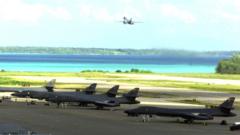
The missile strike targeting the joint UK-US naval support facility on Diego Garcia represents more than a localized flare-up in the Chagos Archipelago. It is a structural break in global security. For decades, this remote coral atoll served as the invisible backbone of Western power projection, a "stationary aircraft carrier" tucked safely away from the messy reach of Middle Eastern and Eurasian theater ballistic missiles. That safety has vanished. While the Foreign Secretary denounces the "reckless" nature of the Iranian-linked strikes, the underlying reality is far more clinical. We are witnessing the functional democratization of precision-strike technology, and the West’s most vital logistics hub is now officially within the "red zone."
The attack involved long-range munitions that bypassed existing regional detection grids, raising immediate questions about the efficacy of current Aegis Ashore and ship-born interceptor systems when faced with saturated flight paths. Diego Garcia is no longer a sanctuary. It is a target. The diplomatic fallout is significant, but the tactical shift is what should keep planners awake at night.
The Myth of the Untouchable Atoll
Diego Garcia’s value was always its isolation. Located roughly 1,000 miles from the nearest landmass, it allowed the United States to launch B-2 Spirit and B-52 bombers into Iraq, Afghanistan, and the Persian Gulf with total impunity. It was the logistics node that didn’t need to worry about its own defense. That strategic luxury is dead.
The recent launch proves that Iranian missile doctrine has evolved beyond mere regional harassment. By demonstrating the capability to range the Chagos Islands, Tehran—and by extension, its proxies—has signaled that no base in the Indian Ocean is off-limits. This isn't just about Iran's own inventory. It is about the proliferation of solid-fuel motors and sophisticated guidance packages that allow relatively low-cost assets to threaten multi-billion dollar infrastructure.
Military analysts have long warned about the "First Island Chain" in the Pacific, but we have ignored the "Blue Hole" in the Indian Ocean. If Diego Garcia is compromised, the entire US Central Command (CENTCOM) and Africa Command (AFRICOM) architecture loses its most stable footing. The Foreign Secretary’s rhetoric about "reckless threats" misses the point. The threats aren't reckless; they are calculated, surgical, and designed to prove that the British Indian Ocean Territory is a liability as much as an asset.
Chagos and the Sovereignty Trap
We cannot discuss the security of the base without addressing the political ground it sits on. The timing of this escalation is a nightmare for the Foreign Office. While the UK recently reached a "principled agreement" to hand sovereignty of the Chagos Islands back to Mauritius, the base at Diego Garcia was supposed to remain under UK-US control for at least another 99 years.
This strike complicates that handover. If the base requires an massive influx of Patriot batteries, Terminal High Altitude Area Defense (THAAD) systems, and expanded electronic warfare units, the footprint of the military installation will grow. A larger footprint contradicts the promise of a "limited" military presence intended to coexist with Mauritian sovereignty.
Mauritius now finds itself in a precarious position. Do they want to inherit a territory that is a primary target for Iranian or proxy missiles? The diplomatic leverage has shifted. Opponents of the deal in Westminster will argue that the strike proves the UK must maintain absolute, undivided control over the entire archipelago to ensure a "security bubble." Meanwhile, critics of the base will argue that the facility now brings more risk than protection to the region.
The Technical Reality of the Strike
The hardware used in the attack tells a story of rapid industrialization. Preliminary debris analysis suggests a variant of a medium-range ballistic missile (MRBM) utilizing a maneuverable reentry vehicle (MaRV). This is not the "scud-style" technology of the 1990s.
Why Interception Failed
Standard missile defense relies on predictable trajectories. When an incoming threat can adjust its flight path in the terminal phase, the math changes.
- Atmospheric Skipping: Using the upper atmosphere to extend range and confuse radar.
- Sensor Saturation: Launching enough cheap decoys to overwhelm the processing power of an Aegis destroyer.
- Electronic Masking: Utilizing localized jamming to hide the missile's final approach.
The cost-exchange ratio is currently tilted heavily in favor of the attacker. A missile costing $2 million can threaten a hangar housing a $2 billion stealth bomber. On Diego Garcia, where space is at a premium and assets are packed tightly together, a single successful "leaker" through the defense grid causes catastrophic damage.
The Shadow of the Global South
There is a broader geopolitical game afoot. By striking at Diego Garcia, the Iranian-led "Axis of Resistance" is testing the resolve of the Indian Ocean Rim Association (IORA) nations. Countries like India, Australia, and South Africa are watching closely. For India, the militarization of its "backyard" by non-state actors or Middle Eastern powers is a direct challenge to its own regional hegemony.
New Delhi has maintained a delicate balance, partnering with the US on the "Quad" while keeping its own energy ties to Tehran. This strike forces a choice. If India moves to help secure the waters around Chagos, it risks its "strategic autonomy." If it stays silent, it allows a precedent where the Indian Ocean becomes a free-fire zone for anyone with a long-range launcher.
Logistics Under Fire
The real impact isn't just the physical damage to the runways or fuel bladders. It is the insurance and risk profile of the entire supply chain. Diego Garcia is the primary refueling point for the US Navy’s Prepositioning Ships (MPS). These massive vessels hold the tanks, ammunition, and food required to start a war anywhere in the Eastern Hemisphere.
If these ships are no longer safe at anchor in the Diego Garcia lagoon, the US military must rethink its entire "expeditionary" model. Moving these assets to Western Australia or deeper into the Pacific adds days, if not weeks, to response times. The "reckless" strike has effectively slowed down the Western response capability by thousands of miles.
The Problem of Hardening
You cannot easily "harden" a coral atoll. On a mainland base, you can dig deep into granite or spread assets out over hundreds of miles. On Diego Garcia, you have a narrow strip of land. Everything is exposed.
Increasing the defenses requires more personnel. More personnel require more housing, more water desalination, and more food. This creates a feedback loop of vulnerability. The more you defend the base, the bigger the target becomes. The UK government's focus on "denouncing" the act is a PR band-aid on a gaping strategic wound.
The Intelligence Failure
How did a missile of this class reach the Chagos Islands without being intercepted earlier in its flight path? This points to a significant gap in the "sensor-to-shooter" loop. The Indian Ocean has long been a "black hole" for constant satellite surveillance compared to the South China Sea or the Levantine coast.
The attackers exploited this blind spot. They used a flight corridor that avoided the most dense concentrations of Allied radar. This level of planning suggests a state-level intelligence capability, likely aided by satellite data shared within the burgeoning Russia-Iran-China security bloc. The West is no longer the only power with eyes in the sky.
The Financial Burden of Protection
The Foreign Secretary hasn't mentioned the bill. Upgrading the integrated air and missile defense (IAMD) of Diego Garcia will cost billions of pounds. In a time of tightening UK defense budgets and a US Navy stretched thin across three theaters, the money has to come from somewhere.
We are likely looking at:
- Permanent deployment of at least two guided-missile destroyers (DDGs) on constant station.
- Installation of permanent sensor arrays on neighboring islands, which will trigger fresh sovereignty disputes.
- Expanded subterranean storage for critical munitions, a massive engineering challenge on a sinking atoll.
This is the "tax" of the new reality. Isolation used to be free. Now, it is the most expensive commodity in the world.
A New Map of Power
The geography of the 21st century is being rewritten by the range of a solid-fuel motor. The British government can issue as many statements as it wants, but the maps in the War Rooms have already changed. The Indian Ocean is no longer a transit zone; it is a front line.
For the civilian world, this means higher shipping costs and increased volatility in energy markets. For the military, it means the end of the "sanctuary" era. If a remote island in the middle of the ocean can be hit, then the concept of a "safe" rear area is a relic of the past. The Foreign Secretary’s denunciation is the sound of an old world order trying to talk its way out of a new world’s reality.
The missiles didn't just hit a runway; they punctured the illusion that distance equals safety. British and American planners must now decide if they are willing to turn the Chagos Islands into a fortress at any cost, or if the "Indo-Pacific" strategy is already dead in the water.
Stop looking at the diplomatic cables. Watch the movement of the heavy lift ships and the deployment of the radar batteries. That is where the real story is written. The era of the untouchable base is over, and the scramble to secure the Indian Ocean has only just begun.