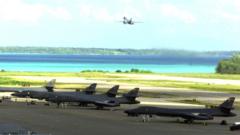
The sea mist off the Gare Loch doesn't just settle. It clings. It turns the massive, grey bulks of the Faslane Naval Base into ghosts. On a standard Tuesday night, the air usually carries nothing but the faint, metallic scent of the Clyde and the low hum of a facility that never truly sleeps. It is a place of absolute stillness and terrifying potential. This is the home of the UK’s nuclear deterrent, a fortress built on the premise that some gates must never be breached.
Then came the rattling of the fence.
It wasn't a coordinated strike. There were no black-clad paratroopers or cinematic explosions. Instead, the high-stakes security apparatus of His Majesty’s Naval Base Clyde found itself staring at a singular, flesh-and-blood enigma: a 44-year-old Iranian man.
Security isn't just about concrete and barbed wire. It is a psychological membrane. When an unauthorized individual attempts to cross that line, the vacuum of information fills instantly with every dark possibility the mind can conjure. Is he a scout? A lost soul? A distraction?
The Weight of the Silent Sentinels
To understand why a man at a fence causes ripples through the highest corridors of power, you have to look at what lies behind the wire. Faslane is not a typical office. It is the berth for Vanguard-class submarines. These vessels are the silent, submerged insurance policy of a nation. They carry the weight of history and the burden of the future.
When the alarms triggered at 12:30 AM, the response was a well-oiled machine of escalation. The Ministry of Defence Police didn't see a "story." They saw a breach of the Sovereign Space. They saw a variable that didn't belong in a landscape defined by rigid constants.
The man was intercepted before he could reach the inner sanctum. He didn't have a clearance badge. He didn't have a valid reason for being there. What he had was a nationality that, in the current geopolitical climate, acts like a lightning rod for suspicion.
The Invisible Geography of Suspicion
Identity is a strange thing in the eyes of the law. To the police, he was a 44-year-old male of Iranian descent. To the investigators, he was a puzzle box. In a world where "Grey Zone" warfare—the subtle, deniable acts of provocation between nations—is the new norm, an Iranian man at a British nuclear base is never just a man at a fence.
Logic dictates we look for patterns. We look for the "why" behind the "what." But the reality of high-level security is often much more tedious and tense than a spy novel. It involves hours of sterile interrogation rooms, the clicking of recording devices, and the slow, methodical checking of digital footprints.
Police Scotland and the Ministry of Defence Police (MDP) had to move fast. They worked under the shadow of the Terrorism Act, a piece of legislation designed for exactly these moments of profound uncertainty. It allows the state to hold a person, to pause the world, and to ask: Who are you, and what is your intent?
The Fragility of the Fence
Consider the pressure on the boots on the ground. The Ministry of Defence Police officers are trained to be invisible until they are essential. They spend years staring at screens and patrolling perimeters where nothing ever happens. Until it does.
The human element of security is the most vulnerable and the most resilient. An automated sensor can tell you that a fence has been shaken. It cannot tell you the look in a man's eyes. It cannot discern between a desperate migrant seeking a place to belong and a sophisticated actor seeking a place to destroy.
This man, whose name remained shielded by the early shroud of the investigation, became a symbol of the friction between two worlds. On one side, the hyper-secure, nuclear-capable West. On the other, the volatile, shifting reality of the Middle East. The fence at Faslane is where those two tectonic plates touched for a brief, shivering moment in the dark.
The Aftermath of a Non-Event
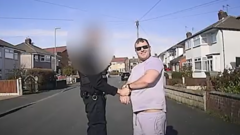
By the time the sun rose over the Loch, the man was in custody. The headlines began to trickle out, dry and factual. "Man Arrested." "Iranian National." "No Threat to Public."
But the "no threat" part is a conclusion reached only after a feverish race against the clock. It ignores the adrenaline that spiked in the hearts of the night shift. It ignores the phone calls made to London in the small hours of the morning. It ignores the way every other base in the country tightened its grip on its own perimeter just in case this was part of something larger.
Statistics tell us that most "breaches" are the result of mental health crises, accidental trespassing, or misguided protests. Yet, the system cannot afford to assume the most likely outcome. It must prepare for the worst one. This is the exhaustion of the sentinel: the requirement to treat every rattling fence as the start of the end of the world.
The Shadow in the Room
We live in an age of hyper-transparency, yet the most important things still happen in the dark. The arrest of this man reminds us that the peace we enjoy is a managed state. It is a garden kept by people who are willing to be harsh when the gate is touched.
The man from Iran is now a data point in a file. He is a case number. Whether he was a confused traveler or something more calculated, he has already achieved one thing: he proved that the membrane is being tested. He reminded a nation that its most secluded corners are still visible to the rest of the world.
As the mist lifts from the Gare Loch, the submarines remain. They are indifferent to the drama at the fence. They represent a scale of power that dwarfs the individual. But the individual is the only thing that can start the machine. One person. One fence. One moment where the silence of the night is broken.
The fence stands. The guards return to their screens. The man sits in a cell, his motivations known only to him and the people whose job it is to ensure those motivations never become actions. The world moves on, but the perimeter is a little more conscious than it was the night before.
The water of the Clyde is deep, dark, and holds its secrets well. Sometimes, the most important stories are the ones that end with a click of handcuffs and a return to the quiet, rather than a bang.