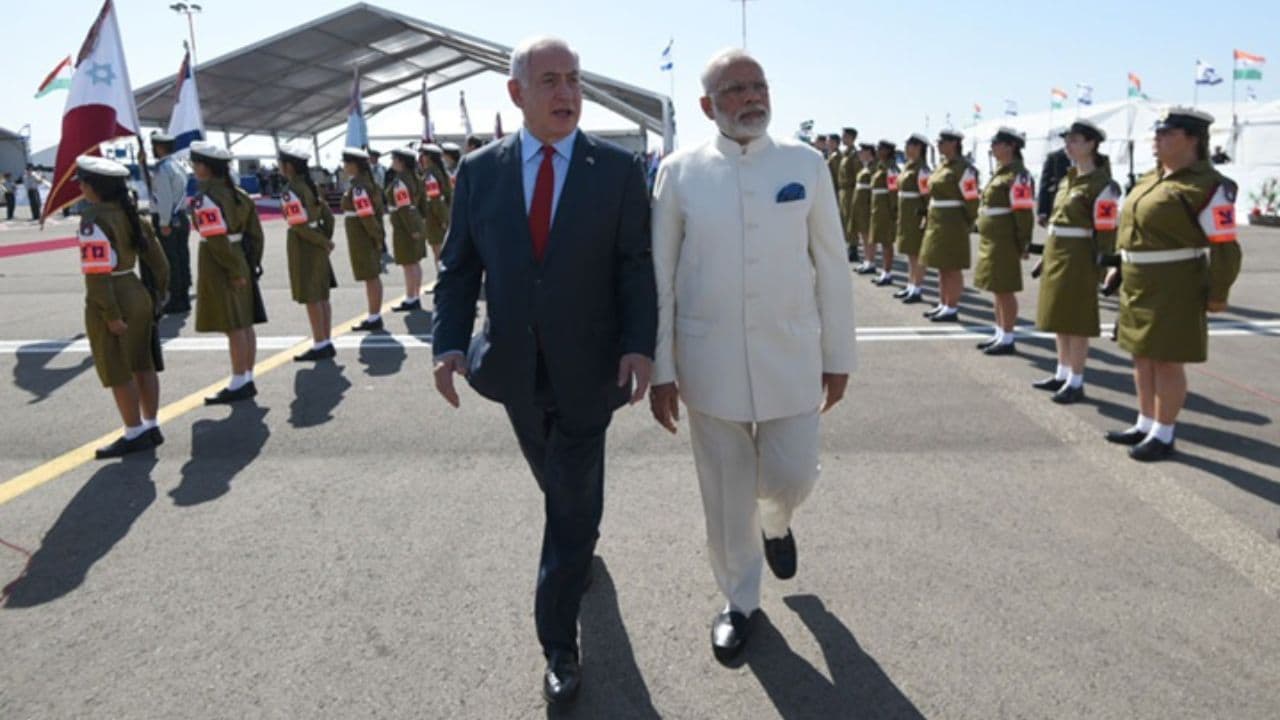
The tarmac at Ben Gurion Airport didn't just shimmer from the heat; it hummed with the vibration of a tectonic shift. When the door of the Air India jet swung open, the man stepping into the Mediterranean light wasn't just a Prime Minister. Narendra Modi was a pioneer walking a tightrope. For seventy years, Indian leaders had treated Israel like a whispered secret—a partner kept in the shadows to avoid offending neighbors or unsettling domestic blocks.
That era ended with a single footfall.
This wasn't a "state visit" in the way bureaucrats define the term. It was a public embrace. By the time Benjamin Netanyahu met him on that red carpet, the air was thick with the scent of jasmine and the salt of the sea, but also something more industrial: the smell of jet fuel and high-stakes ambition. They didn't just shake hands. They signaled the birth of a "special strategic partnership," a phrase that sounds like dry policy until you realize it is actually a marriage of survival.
The Geography of Hunger
To understand why a leader from New Delhi would fly 2,500 miles to a tiny strip of land on the Mediterranean, you have to look past the flags. You have to look at the dirt.
India is a giant with a recurring nightmare: thirst. With nearly 1.4 billion people, the country faces a water crisis that could cripple its future. Israel, conversely, is a nation that mastered the art of squeezing life from stones. It is a laboratory disguised as a country.
Consider a farmer in the Vidarbha region of Maharashtra. He watches the sky for a monsoon that might not come, or might come with enough violence to drown his seeds. To him, "diplomatic elevation" means nothing. But "drip irrigation" means everything. Israel's expertise in water recycling—they reuse nearly 90% of their wastewater—is the hidden engine of this trip.
This partnership isn't built on shared poetry; it’s built on shared scarcity. When Modi and Netanyahu walked barefoot on the beach at Olga, they weren't just enjoying the surf. They were standing next to a Gal-Mobile water desalination jeep. It was a prop, yes, but a prop that told a story. It said: We have the technology to turn the ocean into a drinkable resource, and you have the scale to change the world with it.
The Invisible Shield
While the public narrative focused on agriculture and "Start-up India," a different conversation happened behind closed doors, away from the cameras. This is the realm of the invisible stakes.
India lives in a difficult neighborhood. Its borders are jagged lines drawn through some of the most volatile terrain on earth. To maintain its sovereignty, India needs more than just soldiers; it needs eyes that never blink and shields that never fail.
Israel has become India’s silent guardian. From the Phalcon AWACS—the "eyes in the sky" that monitor enemy movements—to the Barak-8 missile defense systems that protect Indian warships, the military bond is the bone and muscle of this relationship. It is a transaction of trust. You don't buy a missile system from someone you don't plan on standing next to when the sky turns dark.
The elevation to a "strategic" level means India is no longer a customer. It is becoming a co-creator. They are moving from "Buyer-Seller" to "Developer-Partner." This shift is subtle but massive. It means Israeli tech will be infused into the "Make in India" initiative, creating a hybrid DNA of Middle Eastern audacity and Indian industrial scale.
The Ghost of the Non-Aligned Past
For decades, India played a cautious game of "non-alignment." It was a policy of being friends with everyone and truly close to no one. It was safe. It was also, in many ways, stagnant.
By visiting Tel Aviv without a simultaneous stop in Ramallah, Modi performed a geopolitical lobotomy. He decoupled India's relationship with Israel from the Israeli-Palestinian conflict. It was a brave, some would say ruthless, admission that India’s national interest can no longer be held hostage by the complexities of another region's history.
This doesn't mean India abandoned its support for a Palestinian state. It simply meant that India stopped pretending its survival didn't depend on Israeli innovation.
The critics screamed. They spoke of "historical betrayals" and "shifting moral ground." But in the hallways of power in New Delhi, the response was a quiet, firm focus on the numbers. Trade between the two nations had grown from $200 million in 1992 to over $4 billion. You cannot feed a population on the nostalgia of 1950s diplomacy.
A Tale of Two Start-ups
If you strip away the motorcades and the ceremonial dinners, the visit was really about two cultures that view themselves as "start-up nations."
Israel is a tiny, hyper-concentrated burst of energy. It is a country that thrives on chutzpah—that specific brand of audacity that refuses to accept "no" for an answer. India is a massive, sprawling, complex democracy that is trying to leapfrog centuries of development through sheer digital willpower.
When these two energies collide, the result is a specific kind of alchemy.
Think about the cybersecurity centers in Bangalore. They are being fortified by Israeli protocols. Think about the pulses and vegetables growing in the "Centers of Excellence" across Haryana and Rajasthan. Those aren't just crops; they are the result of Israeli scientists working alongside Indian agronomists.
The "special strategic partnership" is a fancy way of saying that these two nations have realized they are the bookends of a new Asian axis. One provides the brainpower for the prototype; the other provides the muscle for the mass production.
The Human Core of the Deal
Statistics are cold. Agreements are paper. But the human element is what makes this narrative stick.
There is a small community in India—the Bene Israelis, the Baghdadi Jews, the Cochini Jews—who have lived in India for two millennia without a single instance of anti-Semitism. That is a point of pride for India. When Modi met with Moshe Holtzberg, the young boy who survived the 2008 Mumbai terror attacks, it wasn't just a photo op.
It was a bridge.
In that moment, the "strategic partnership" became a shared grief and a shared resolve. It acknowledged that both nations face the same shadowy threat of extremism. It turned a defense contract into a blood pact. It reminded the world that while India and Israel are separated by geography and religion, they are joined by the scars of history and the hunger for a future where their children don't have to look over their shoulders.
The visit lasted forty-eight hours. The repercussions will last forty-eight years.
As the sun set over the Mediterranean on the final evening, the two leaders stood together, looking out at the water. They were an unlikely pair: a son of a tea-seller from Gujarat and a polished commando-turned-politician from Jerusalem. Yet, they spoke the same language—the language of the pragmatist.
The world watched as they signed the MoUs and toasted to their health. But the real story wasn't in the ink. It was in the realization that India had finally stepped out of the shadow of its own hesitation. It had decided that its destiny was too important to be managed by the fears of the past.
The tide had come in. And for the first time in history, India and Israel were sailing it together.
The red carpet has long since been rolled up. The jets have flown back to their respective capitals. But in the quiet labs of Tel Aviv and the dusty fields of Gujarat, the work continues. It is the work of turning "special" into "standard" and "strategic" into "successful."
India didn't just find a partner in Israel. It found a mirror.
One reflects the ambition of the small; the other reflects the potential of the vast. Together, they are rewriting the map of the 21st century, one drop of water and one line of code at a time.
The tightrope has been crossed.
The silence is broken.
The saffron and the blue are no longer strangers.