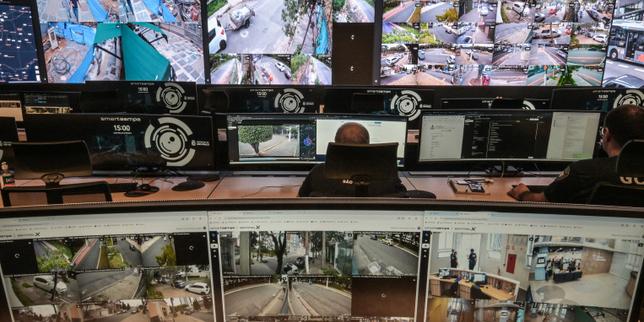
The screen does not blink. It hums with the quiet, persistent arrogance of a machine that never sleeps, rendering the city of Sao Paulo into a grid of green geometries and blinking pixels. Millions of lives compressed into heat signatures and motion vectors. In the control centers, the atmosphere smells of stale coffee and ozone, a sterile cathedral built to worship the illusion of total safety.
I remember the first time I stood beneath one of those steel armatures, watching the heavy black dome of a camera pivot with an oily, silent mechanical sigh. It felt like protection. It felt like someone was finally paying attention to the chaos pressing in from the alleys and avenues. But protection, like beauty, depends entirely on who is holding the mirror.
Sao Paulo wears its massive surveillance apparatus like a heavy coat in the middle of summer. It is an ambitious promise cast in concrete and fiber optics, an attempt to wrap a sprawling, chaotic metropolis in an unblinking digital embrace. City officials point to the sprawling web of thousands of high-definition eyes with immense pride. They talk about algorithms predicting danger, of license plates scanned in milliseconds, of a digital shield thrown over the vulnerable streets.
Yet, walk the pavement beneath those metal sentinels, and the grand narrative begins to fray at the edges.
Consider a Tuesday night in the bustling district of Pinheiros. A corner shop owner named Carlos pulls down his corrugated metal shutters while a street-level dome camera glares down at the sidewalk. His shop has been broken into twice this year. Each time, the police arrived hours later, took statements, and filed reports that dissolved into administrative ether. When Carlos asked about the footage captured by the city’s expensive electronic eye mounted twenty feet above his door, he was met with a shrug. The camera was recording, yes. But the feed was either unmonitored in real-time, obscured by a frond of jacaranda leaves, or bogged down by software that struggled to parse the messy, overlapping reality of human movement.
This is the central contradiction of the digital panopticon. It is immense, expensive, and loud in its announcements of security, yet remarkably fragile when confronted with the gritty unpredictability of urban life.
Proponents argue that numbers do not lie. They point to falling crime statistics in specific pilot zones or the rapid identification of stolen vehicles whisked away on major thoroughfares. Statistics, however, possess a convenient elasticity. When a camera is installed on a brightly lit commercial avenue, crime often does not vanish; it simply drifts three blocks away into the unmonitored shadows of a narrower residential street. The machine records the displacement and calls it a victory, while the residents around the corner learn to listen more closely to the sound of breaking glass.
There is a deeper, quieter cost to this obsession with omnipresent vision. It alters the psychology of the street. When every corner claims to watch you, the city ceases to be a shared public commons and becomes an open-air enclosure. Citizens are subtly conditioned to trade spontaneity for compliance. The invisible tax of constant observation is not paid in currency, but in the slow erosion of civic trust. If the state believes you are a potential threat until proven otherwise, you eventually begin to view the state not as a protector, but as an adversary with a very good lens.
Behind the glowing monitors, technicians wrestle with the sheer weight of data. Information streams in faster than human minds can contextualize it, forcing a heavy reliance on automated analytics that are notoriously prone to misinterpreting human nuance. A sudden stumble on a subway platform, a group of teenagers laughing too loudly in a plaza, a man running because he is late for a bus—these ordinary moments of urban existence are frequently flagged as anomalies, dragging emergency responders into a dizzying dance of false alarms.
The machine sees everything, yet understands nothing. It captures the geometry of an action stripped of its history, its context, and its soul.
As the sun sets over the concrete horizon, casting long, bruised shadows across the avenues of Sao Paulo, the red and green indicator lights on the camera housings continue to blink in the dark. They are monuments to our eternal panic, glowing testaments to the desperate human desire to control the uncontrollable through technology.
The city breathes beneath them, messy, resilient, and stubbornly opaque, refusing to be reduced to a string of binary code.