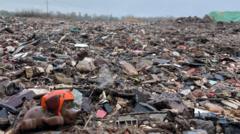
You’re paying for it. Whether you realize it or not, your hard-earned tax money is currently being diverted from schools, hospitals, and road repairs to clean up mountains of rotting trash. This isn't just about a few stray bin bags left on a street corner. We're talking about massive, industrial-scale illegal waste sites—some the size of football pitches—operated by organized crime groups who pocket the profits and leave the public to deal with the toxic aftermath.
It’s a massive failure of the current system. For years, the "polluter pays" principle has been the gold standard of environmental law. It sounds great on paper. If you mess it up, you fix it. But when the polluter is a shell company that vanishes overnight or a career criminal with no intention of following a court order, that principle falls apart. Now, the government is stepping in with millions in public funds because the environmental risks have become too high to ignore.
The Massive Scale of the Waste Crisis
Illegal dumping has evolved. It’s no longer just a guy with a white van looking to avoid a tip fee. It’s a sophisticated business. Criminals rent out large warehouses or plots of land under false pretenses, fill them to the rafters with construction debris, plastics, and hazardous materials in a matter of weeks, and then disappear.
When they leave, they leave behind a ticking time bomb. These sites are notorious fire hazards. They leach chemicals into the groundwater. They attract vermin. In many cases, the cost to clear a single site can run into the millions. Because the original landowners often don't have the funds to clear the mess—or were victims of the scam themselves—the burden shifts to the Environment Agency and, by extension, you.
The sheer volume is staggering. We’re seeing a trend where the state has to intervene simply because the private sector can’t or won't. If a site sits for too long, the environmental damage becomes exponential. It’s a classic "damned if you do, damned if you don't" scenario for the government. If they don't pay to clear it, the local community suffers. If they do pay, they’re essentially subsidizing the "business model" of the criminals who created the mess.
How the Scams Actually Work
The process is chillingly simple. A "businessman" approaches a landowner or a commercial real estate agent. They offer to rent a site for something seemingly benign, like "logistics" or "vehicle storage." They might even pay several months of rent upfront in cash to keep questions at a minimum.
Once they have the keys, the gates open to a fleet of heavy goods vehicles. These trucks carry waste collected from legitimate businesses that think they're paying for legal disposal. The criminals charge a lower rate than official landfill sites because they have zero overhead. They aren't paying landfill tax. They aren't treating the waste. They’re just stacking it.
Within a month, the site is full. The "tenant" stops answering the phone. The landowner walks into their property to find 10,000 tons of mixed waste and a cleanup bill that exceeds the value of the land. At this point, the Environment Agency steps in, but they’re often chasing ghosts. The paper trail leads to nowhere.
Why Current Enforcement is Failing
If you’re wondering why we don't just arrest these people and take their assets, you're not alone. The reality is that environmental crime is often seen as a "soft" crime compared to drug trafficking or violent offenses. The sentences are shorter. The profit margins are nearly as high.
- Underfunded Monitoring: The agencies responsible for oversight have seen their budgets squeezed for a decade. They can't be everywhere at once.
- Legal Loopholes: It’s too easy to set up a waste-carrying business with very little vetting.
- Landfill Tax Disparities: As taxes on legal waste disposal rise to meet green goals, the incentive for illegal dumping grows.
When the government announces a multimillion-pound "cleanup fund," it’s an admission of defeat. It means the legal system failed to prevent the crime and failed to recover the costs from the perpetrators. It’s a reactive sticking plaster on a gaping wound. We’re essentially paying a "crime tax" because our regulatory borders are porous.
The Environmental Toll Nobody Mentions
It’s not just an eyesore. Many of these illegal dumps sit near watercourses or on top of sensitive aquifers. When rain hits a massive pile of unregulated waste, it creates "leachate"—a toxic soup of heavy metals, ammonia, and organic pollutants. This seeps into the soil.
Then there are the fires. Illegal waste sites are prone to spontaneous combustion due to the heat generated by decomposing organic matter. These aren't normal fires. They burn deep. They release dioxins and other nasty particulates into the air, forcing local residents to stay indoors for days or weeks. When the fire service arrives, the water used to douse the flames carries even more pollutants into the local environment. It’s a total disaster from every angle.
Fixing a Broken System
Throwing money at the cleanup is a temporary fix. It solves the immediate problem of a specific site but doesn't stop the next one from popping up ten miles down the road. To actually stop the drain on the public purse, the strategy has to shift toward prevention and aggressive asset seizure.
We need to make it impossible for these groups to profit. This means tighter controls on who can hold a waste carrier license. It means using technology like drones and satellite imagery to spot sites before they become mountains. Most importantly, it means the government needs to treat waste crime as the organized, high-level felony that it actually is.
Local authorities also need more power. Right now, many councils are hesitant to take action because they’re afraid of being stuck with the bill. If the central government guarantees cleanup costs only after a site has reached a certain size, it’s already too late. Action needs to be swift and early.
What You Can Do
The best way to protect your tax money is to be a vigilant neighbor. If you see a sudden influx of heavy trucks entering a warehouse or a farm field at odd hours, report it. Don't assume someone else has it covered.
If you're a business owner, do your due diligence. Don't just go with the cheapest waste disposal quote. If the price seems too good to be true, it’s probably because your waste is headed for an illegal dump. You have a "duty of care" to ensure your waste is handled legally. If it ends up in a criminal dump and can be traced back to you, you could be the one facing a massive fine—even if you thought you were acting in good faith.
The era of turning a blind eye to the "trash man" needs to end. Every ton of waste dumped illegally is a direct theft from the public services you rely on. Demand better enforcement and stop letting criminals treat the country as their personal, tax-funded landfill.
Check the Environment Agency’s public register before hiring any waste removal service. Make sure they have a valid license. Get a waste transfer note. It’s the only way to ensure you aren't accidentally contributing to the very problem that's draining your local budget.