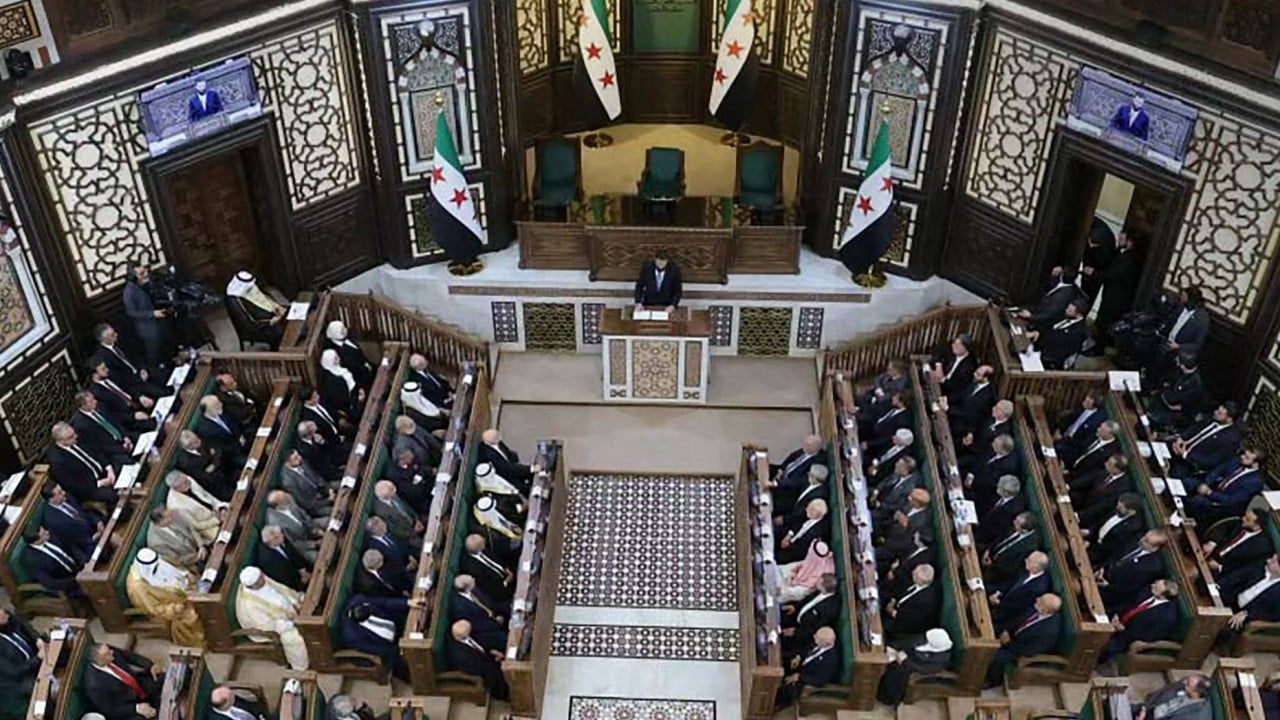
The newly formed Syrian parliament convened its first session after the dramatic collapse of the Assad regime, marking a symbolic break with decades of totalitarian rule. While international observers focused on the optics of a new legislative body meeting in Damascus, the true test lies in whether this assembly can wield actual power or if it will merely mask a deeper struggle among rival military factions. Syria’s immediate future depends not on the speeches delivered in the parliament chamber, but on whether these lawmakers can assert authority over the armed groups currently holding the country's geography.
The Mirage of Legislative Authority
For more than half a century, the Syrian parliament operated as a rubber-stamp institution. It existed to legitimize the decrees of the presidency and maintain a facade of democratic pluralism. The current convening of lawmakers is being hailed by transitional figures as the birth of a sovereign legislature. However, the reality on the ground presents a far more chaotic picture. In related news, we also covered: The Architecture of Loyalty inside Mar-a-Lago.
Power in post-Assad Syria remains highly fragmented. The various factions that participated in the overthrow of the regime—ranging from Islamist coalitions to localized civil councils and ethnic militias—still hold the actual levers of control. They run the checkpoints, manage local economies, and command the loyalty of thousands of armed fighters.
A parliament sitting in Damascus cannot pass laws that magically enforce themselves across idlib, Aleppo, or the oil-rich regions of the east. Without a unified national army or a centralized police force loyal to the civilian transition government, the legislature's decrees are currently suggestions. The primary challenge for these new lawmakers is not drafting a constitution, but negotiating a monopoly on the legitimate use of force with the warlords who made their victory possible. Al Jazeera has analyzed this fascinating subject in extensive detail.
The Economic Trap Awaiting the Transition
While political restructuring dominates the headlines, Syria’s catastrophic economic reality is the underlying threat that could derail the entire transitional process. The country faces hyperinflation, a destroyed infrastructure network, and a complete lack of foreign reserves.
Estimated Costs for Immediate Stabilization
+-------------------------+--------------------+
| Sector                  | Immediate Need     |
+-------------------------+--------------------+
| Electrical Grid Repair  | $12 Billion        |
| Water & Sanitation      | $4.5 Billion       |
| Healthcare Subsidies    | $3.2 Billion       |
| Civil Service Payroll   | $1.8 Billion       |
+-------------------------+--------------------+
The new parliament must immediately address how to fund the state apparatus without the traditional revenues that the old regime secured through illicit networks and foreign patrons. International aid is contingent on political stability and human rights guarantees, creating a catch-22 situation. Western donors are hesitant to release billions of dollars in reconstruction funds until they see a stable, inclusive government. Yet, the government cannot achieve stability without the funds necessary to provide basic services to a desperate population.
The Question of State Employee Payrolls
One of the most critical decisions facing the legislative body is how to handle the millions of civil servants who worked under the previous administration. Cutting them off entirely to purge the system of Assad loyalists risks throwing millions of families into starvation and creating a massive pool of recruits for a counter-insurgency. Conversely, continuing to pay them drains the empty treasury and rewards individuals who helped sustain the dictatorship.
Regional Powers and the Battle for Influence
Syria does not exist in a vacuum, and its new parliament is already a battleground for regional proxy influence. The sudden vacuum left by the collapse of the previous regime has forced neighboring countries to recalibrate their strategies rapidly.
- Turkey seeks to secure its southern border and manage the return of millions of refugees while ensuring that Kurdish nationalist groups do not solidify an autonomous enclave in northeastern Syria.
- Gulf States are looking to counter Iranian influence by offering financial lifelines to Sunni factions within the new legislative framework.
- Western Powers are focused on counter-terrorism and preventing the resurgence of extremist cells that thrive in ungoverned spaces.
Lawmakers in Damascus are already facing intense lobbying from these external actors. Decisions regarding future trade agreements, border security arrangements, and the management of national resources will likely be heavily influenced by which foreign capitals are funding specific political blocs within the parliament.
The Accountability and Reconstruction Dilemma
Perhaps the most divisive issue before the new parliament is transitional justice. There is an understandable and overwhelming demand for accountability after decades of torture, forced disappearances, and war crimes. Thousands of families want justice for relatives who vanished into the military prison system.
Yet, pursuing a hardline policy of total lustration—similar to the de-Baathification policy implemented in Iraq after 2003—could tear the country apart before it can rebuild. The state apparatus relies on bureaucrats, engineers, judges, and technocrats who were forced to maintain ties with the Baath party simply to survive or keep their jobs. If the parliament bans everyone associated with the former ruling structure from participating in the new state, the institutional memory of the country will be erased overnight, leading to a total collapse of basic administration.
The parliament must find a delicate balance between prosecuting high-level war criminals and offering amnesty to lower-level functionaries who are essential for keeping the water running, the electricity on, and the schools open. This is not a philosophical debate. It is a matter of administrative survival.
The coming weeks will reveal whether this new assembly can move beyond symbolic speeches and tackle the brutal logistics of governance. If they fail to establish control over the armed factions and stabilize the economy, the parliament building in Damascus will become nothing more than a theater, while the real future of Syria continues to be decided by gunmen in the provinces.