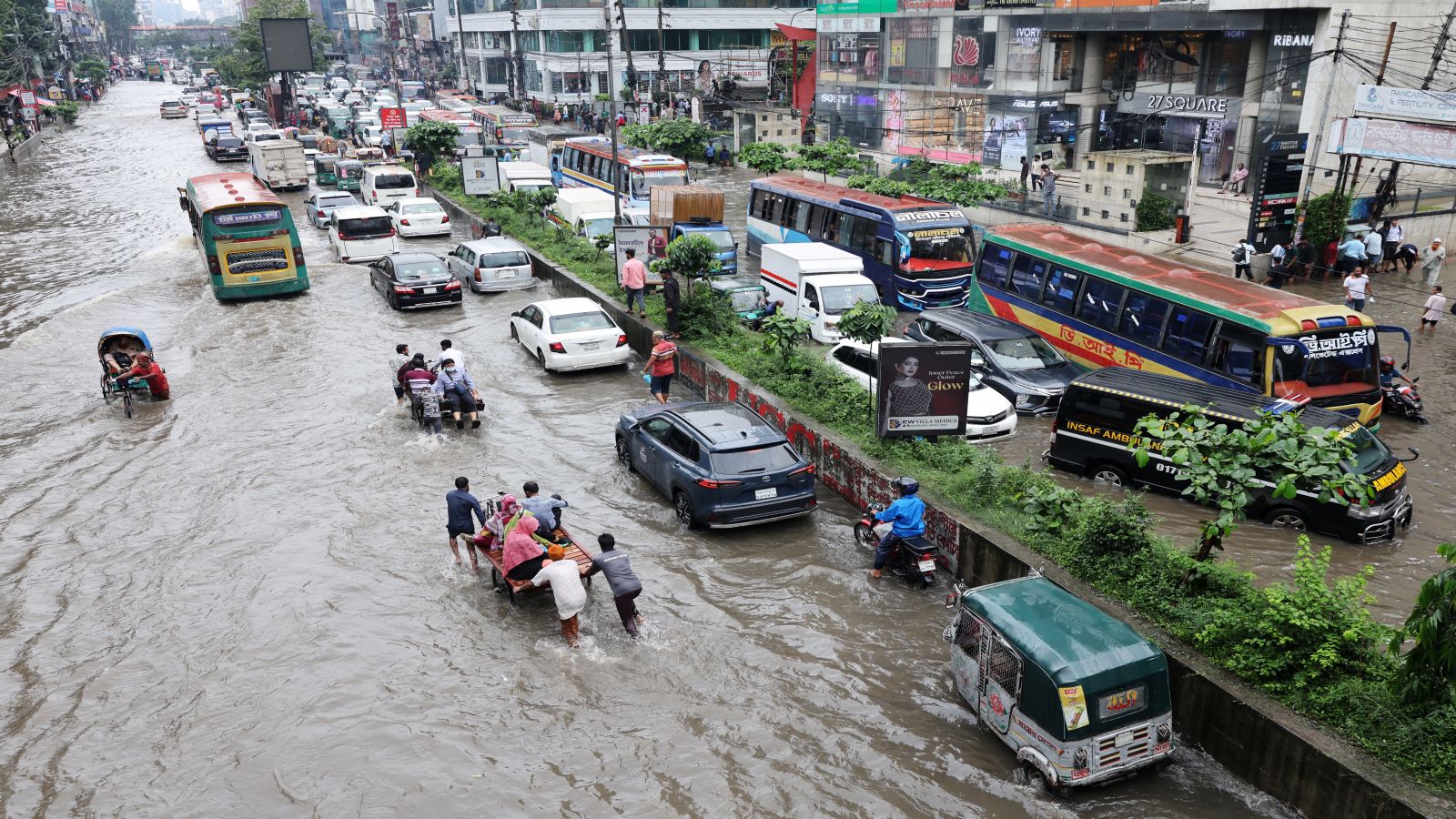
The sound of water in a city is supposed to be a luxury. It is the gentle lap of a lake in a public park, the synchronized dance of a downtown fountain, or the rhythmic drip of a rooftop garden after a light summer shower. But in Dhaka, the water does not sing. It growls.
Imagine standing on a concrete balcony, watching the street beneath you dissolve. It happens in minutes. The grey tarmac disappears under a swirling, tea-colored tide. Plastic bottles, stray sandals, and oil slicks bob along what was, an hour ago, a bustling artery of the world’s most densely populated metropolis. You smell it before you see the full scale of it—a pungent, suffocating mixture of damp earth, stagnant drainage, and gasoline. You might also find this similar story interesting: The Map That Bleeds And The Silence We Mistake For Peace.
This is not a coastal village facing a tropical cyclone. This is the heart of Bangladesh’s capital, a mega-city of over twenty million people, choking on an excess of its own lifeblood.
Across the country, the great rivers—the Padma, the Jamuna, the Meghna—have breached their banks. They are swallowing villages whole, turning vast swathes of rural green into a unified, terrifying mirror of sky. More than 250,000 families are currently displaced, marooned, or watching the foundations of their lives slowly turn to mud. But when the rivers overflow, the crisis does not stay in the fields. It marches straight into the concrete jungle. As extensively documented in latest coverage by NPR, the results are widespread.
The Anatomy of a Drowning Giant
To understand why a modern capital city can be paralyzed by a heavy downpour, you have to look beneath the concrete. Dhaka is a city built on a delta, a fragile network of wetlands and natural canals known locally as khals. Historically, these canals acted as the city’s lungs and arteries, absorbing the monsoon rains and guiding the excess water safely into the surrounding rivers.
They are gone now.
Driven by an insatiable appetite for real estate, developers have paved over the wetlands. The khals have been filled with garbage, choked by concrete foundations, and erased from the map. When the clouds open up, the water has nowhere to go. The soil cannot absorb it because the soil is buried under layers of asphalt. The drainage system, built for a city a fraction of this size, backfires.
Consider a hypothetical resident named Rahat. He is a rickshaw puller in his late forties, with sinewy legs and a face lined by decades of hard labor under the subcontinental sun. For Rahat, a flooded street is not a statistical inconvenience reported on the evening news. It is a physical battlefield.
When the water reaches his knees, his livelihood stops. Pulling a heavy passenger through two feet of murky water requires an agonizing amount of physical strength. The hidden potholes beneath the surface become invisible traps. One wrong move, one submerged open manhole, and his rickshaw capsizes, destroying his only source of income and risking severe injury.
Yet, Rahat cannot afford to sit out the storm. If he does not work, his family does not eat. So he pushes forward, his feet submerged in a toxic soup of urban runoff, risking skin infections and waterborne illnesses just to earn a few hundred taka.
A Quarter of a Million Tragedies
The numbers coming out of the flood-affected regions are staggering. Two hundred and fifty thousand families translates to well over a million human beings. It is easy to let a number that large wash over you. It becomes an abstract data point, a headline to be skimmed before clicking away to something less depressing.
To feel the weight of that number, you have to shrink your perspective.
Look at a single homestead in the rural districts surrounding the capital. Here, the rising river is a slow-motion home invasion. First, the courtyard turns to mud. Then, the water creeps over the raised earthen plinth of the house. The family moves their meager belongings—a sack of rice, a few changes of clothes, a cherished television set—onto wooden beds, propping the furniture up on bricks as the water continues to rise.
Eventually, the bricks run out.
The family is forced to abandon their home, crowding onto a makeshift bamboo raft or a crowded rescue boat. They leave behind their livestock, their submerged crops, and the investments of a lifetime. They head toward the highlands, toward the crowded flood shelters, or toward the perceived safety of Dhaka.
But as they arrive in the capital, they find a city that is itself under water. The irony is cruel. The very place people flee to for refuge is struggling to keep its head above the surface.
The High Cost of Stagnant Water
The immediate danger of a flood is obvious—drowning, the destruction of infrastructure, the immediate loss of shelter. But the true terror of an urban flood begins after the rain stops, when the water refuses to leave.
Stagnant water is a ticking clock.
Within forty-eight hours, mosquitoes begin to breed in the warm, still pools left behind in residential alleys. Dhaka is already plagued by dengue fever, a painful and potentially fatal viral disease. The floods act as an accelerant, turning every waterlogged street corner into a nursery for disease vectors.
Then there is the drinking water crisis. When the floodwaters rise, they contaminate the underground aquifers and the shallow tube wells that millions rely on for clean water. The city’s water supply authority struggles to maintain purity. Suddenly, getting a glass of clean water becomes a daily struggle. Diarrhea, cholera, and typhoid follow the water like shadow companions.
The economic ripple effects are equally devastating. Daily wage laborers cannot reach their workplaces. Markets are flooded, causing the price of fresh vegetables and essential commodities to skyrocket. The supply chains that feed the city’s massive garment factories—the backbone of the national economy—are disrupted. Trucks carrying export goods are stranded on flooded highways, missing crucial shipping deadlines.
The Resilience Myth
There is a phrase you hear often in international media when disasters strike South Asia: "resilience." The people of Bangladesh are praised for their ability to smile through adversity, to rebuild their homes out of the wreckage time and every time, to adapt to the harshest conditions on Earth.
It is time to retire that word.
Calling a population resilient can be a convenient way to shifting responsibility. It reframes a systemic failure of urban planning and climate governance as a heroic trait of the victims. Rahat the rickshaw puller does not want to be resilient. He wants a functioning drainage system. The family displaced by the overflowing river does not want to show fortitude; they want embankments that hold and a global community that takes climate change seriously.
Bangladesh contributes a negligible fraction of global greenhouse gas emissions, yet it stands on the absolute front line of the climate crisis. The melting Himalayan glaciers to the north and the rising sea levels in the Bay of Bengal to the south create a pincer movement, squeezing the country from both ends. The monsoons are becoming more erratic, delivering weeks worth of rain in a matter of days.
This is not a natural disaster. It is a man-made collision between global climate neglect and local urban mismanagement.
Tracing the Light
Despite the grim reality, the human spirit in Dhaka does not simply dissolve in the floodwaters. There is an informal network of humanity that activates the moment the streets go under.
You see young university students forming human chains to guide pedestrians away from open manholes. You see neighbors throwing ropes from balconies to help stranded strangers cross a raging torrent in a narrow alley. Shopkeepers open their doors to offer dry shelter to street children, and community kitchens spring up overnight, cooking massive pots of khichuri to feed those who have lost their kitchens to the tide.
This solidarity is beautiful, but it is a tourniquet on a wound that requires major surgery.
The solutions are known, though implementing them requires immense political will and massive investment. The lost khals of Dhaka must be reclaimed from illegal encroachers, dredged, and reopened. The city must invest in modern, high-capacity pumping stations and separate its storm drainage from its sewage system. On a national level, river dredging must be prioritized to increase the water-carrying capacity of the major rivers during the peak monsoon season.
Until then, the city waits for the clouds to clear, knowing that the next storm is always just over the horizon.
The sun eventually breaks through the grey canopy over Dhaka, casting a brilliant, blinding light across the flooded avenues. The water reflects the neon signs of billboards, the colorful paint of the stranded buses, and the anxious faces of millions peering out of windows. The city looks breathtakingly beautiful from a distance, like a floating Venice of the East. But step closer, lower your eyes to the waterline, and you see the truth. The city is not floating. It is holding its breath, praying that the water recedes before the air runs out.