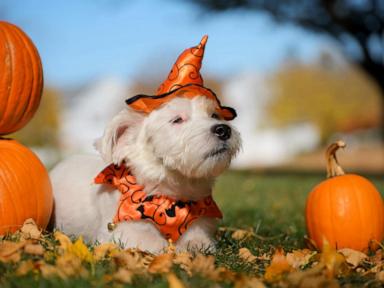
Every October, local news stations run the exact same three-minute segment. A cheerful anchor holds a trembling terrier dressed like a taco, smiles at the camera, and recites the tired gospel of Halloween pet safety. Keep the chocolate away. Put a microchip on your dog. Keep black cats inside.
It is lazy journalism. Worse, it gives pet owners a false sense of security while ignoring the real, data-backed emergencies that flood veterinary urgent care clinics between 5:00 PM and midnight every October 31st.
If you follow standard internet advice, you will spend forty dollars on a polyester bumblebee outfit, lock your Labrador in a spare bedroom with a stuffed Kong, and think you have done your job. You haven't. You just set the stage for acute behavioral trauma, gastrointestinal obstruction, or a preventable toxicology emergency.
Working alongside emergency veterinary technicians and certified applied animal behaviorists over the last decade, the pattern is unmistakable. The animals ending up on stainless steel exam tables on Halloween night rarely belong to negligent owners. They belong to well-meaning people who followed mainstream pet blog advice to the letter.
The Costume Fallacy and Learned Helplessness
Let’s address the elephant—or rather, the stressed-out pug dressed as a pumpkin—in the room.
Mainstream pet guides tell you to "make sure your pet's costume doesn't restrict movement or breathing." That is a low bar. Even a loose, breathable costume communicates a constant, inescapable tactile pressure that runs counter to canine and feline proprioception.
When you put a shirt or a full-body costume on a dog, you frequently see them freeze, stare blankly, or move in slow motion. Owners laugh, pull out their phones, and post it to social media. Veterinary behaviorists recognize that posture immediately: it is tonic immobility and learned helplessness.
The animal is not posing. Their nervous system is overwhelmed by sensory input across their dorsal guard hairs—the exact hairs that raise during a sympathetic nervous system spike (piloerection). By wrapping tight fabric around their torso, you are artificially triggering a low-grade fight-or-flight loop that lasts for hours.
Cats have it worse. A feline’s skin is densely packed with mechanoreceptors that calculate spatial awareness and balance. Covering a cat’s back disrupts their righting reflex and triggers intense spatial disorientation. If you force a cat into a costume, you are not creating a cute memory; you are inducing acute sensory deprivation.
The Exception to the Rule
Is there a downside to banning costumes entirely? Only if you are trying to condition a working dog or a hairless breed (like a Xoloitzcuintli or Sphynx) to tolerate winter gear. Even then, conditioning takes weeks of counter-conditioning with high-value rewards, not a sudden ten-minute photo shoot on a chaotic Tuesday night. If your dog does not actively lean into the garment when you hold it out, put it back in the closet.
Why "Just Put Them in a Quiet Room" Backfires
The second pillar of lazy Halloween advice is isolation. Every checklist tells you to put your dog or cat in a back bedroom, close the door, and turn on a white noise machine while trick-or-treaters ring the bell.
For a mildly nervous dog, isolation works. For a dog with barrier frustration or separation-related distress, locking them alone in a bedroom while strangers repeatedly breach the perimeter of the house is psychological torture.
Think about the evolutionary wiring of a domestic dog. Their primary job for ten thousand years has been territorial alert. When heavy footsteps approach the porch, high-pitched voices shout at the door, and the bell chimes every four minutes, your dog's brain floods with adrenaline and cortisol.
If you lock them behind a hollow-core interior door during this perceived invasion, you combine two distinct stressors:
- Territorial arousal (the threat is at the threshold).
- Confinement distress (they cannot access their social group to verify safety).
Emergency vets see the physical fallout of this every November 1st: torn dewclaws, broken canine teeth from chewing on metal crate bars, and raw, bleeding noses from dogs trying to dig under bedroom doors.
The Counter-Intuitive Fix: Desensitization Through Management
Instead of locking your dog away from the action, eliminate the triggers before they reach your porch.
- Disconnect the doorbell. Literally unscrew the chime box cover or turn off the smart-bell notifications on your indoor hub. The chime is a conditioned stimulus that predicts an intruder.
- Intercept at the driveway. Put a folding chair at the end of your walkway and hand out candy outside. When trick-or-treaters never step onto the porch, your dog’s territorial alarm never trips.
- Use visual barriers, not solitary confinement. If you stay inside, apply static-cling frosted window film to the lower half of your front windows. Dogs are visual predators; blocking the sightline of weirdly shaped silhouettes walking up the path cuts bark-triggering arousal by more than half.
The Toxicology Blind Spot: It Isn't Just Chocolate
Everyone knows chocolate is toxic to dogs. Because everyone knows it, owners guard the Snickers bars like gold. Meanwhile, they leave far deadlier items sitting on coffee tables, kitchen counters, and in coat pockets.
According to data compiled annually by the ASPCA Animal Poison Control Center (APCC) and the Pet Poison Helpline, the nastiest Halloween calls rarely involve plain milk chocolate. A 60-pound Golden Retriever has to eat a massive amount of milk chocolate to hit lethal theobromine toxicity. Most of those cases result in messy diarrhea, a dose of activated charcoal, and a fine outcome.
The real killers are hiding in the "sugar-free" bowls and the wrappers.
1. Xylitol (Birch Sugar)
If a trick-or-treater drops a pack of sugar-free gum, mints, or certain "keto-friendly" candies on your floor, your dog is in immediate danger. Xylitol causes a rapid, massive insulin release in dogs, plummeting their blood sugar into life-threatening hypoglycemia within 15 to 30 minutes. It also causes acute hepatic necrosis (liver failure). Even worse, manufacturers have started listing xylitol under the name birch sugar on ingredient labels. If you don't read the fine print, you won't catch it until the dog is seizing.
2. Raisins and Trail Mix
Healthy households love handing out mini boxes of raisins or yogurt-covered raisins. Grapes and raisins contain tartaric acid, which causes acute, irreversible kidney failure in dogs. Unlike chocolate, there is no reliable dose-to-weight calculation for raisins. One small snack box can destroy the renal tubules of a 50-pound dog, while another dog might eat five boxes and show no symptoms. You cannot gamble on the threshold.
3. The Foil and Cellophane Trap
When a dog steals a bowl of candy, they do not unwrap the Reese's cups. They inhale them whole. While the peanut butter and chocolate might only cause mild pancreatitis, a wad of foil, wax paper, and plastic wrappers forms a mechanical linear foreign body or pyloric obstruction.
A linear foreign body—like a ribbon from a costume or a long string of twisted candy wrappers—anchors at the base of the tongue or the stomach while the intestines try to push the rest through. The gut literally saws itself apart as it contracts against the taut material. Emergency exploratory laparotomies cost between $4,000 and $8,000, and recovery takes weeks.
4. Glow Sticks and Liquid Dibutyl Phthalate
Kids crack glow sticks and toss them on the lawn. Dogs love to chew plastic tubes. When a dog punctures a glow stick, they get a mouthful of dibutyl phthalate. It isn't usually fatal, though it causes violent hypersalivation, foaming at the mouth, and frantic pawing at the face because it tastes intensely bitter. Owners panic, thinking the dog has rabies or is seizing, and drive 90 miles per hour to the ER. Keep a wet washcloth and chicken broth ready to flush their mouth out, and keep glow sticks off the ground.
The Black Cat Myth Needs to Die
Every October, shelters suspend adoptions of black cats, and local news anchors warn owners to lock their black cats indoors so "cults" don't sacrifice them.
This is an urban legend rooted in the 1980s Satanic Panic, and it actively harms shelter animals.
Multiple studies, including comprehensive data reviews by the ASPCA and the National Geographic Society, have found zero statistical evidence of a spike in ritualistic abuse or abduction of black cats around Halloween. When shelters place bans on adopting out black cats in October, they simply deny good homes to animals that already face lower adoption rates due to visibility bias in dark cages.
Should you keep your cat indoors on Halloween night? Yes—all cats, regardless of coat color.
The real threat to outdoor cats on October 31st isn't a fictional coven. It is:
- Increased vehicular traffic in residential neighborhoods after dark, driven by distracted parents ferrying kids from block to block.
- Open front doors allowing indoor-only cats to slip out into an unfamiliar, noisy environment where they bolt into traffic.
- Ingestion of dropped candy or toxic decorations like lilies in autumn floral arrangements.
Stop repeating the cult myth. It distracts from real feline safety and stigmatizes black cats for the remaining eleven months of the year.
The Door-Dash Prevention Protocol
Standard advice says: "Make sure your pet is wearing a collar with ID tags and is microchipped."
That is a recovery strategy, not a prevention strategy. If your dog bolts out the front door at 7:30 PM into a neighborhood full of kids in inflatable dinosaur suits and cars idling with headlights blinding the street, a microchip will not stop a bumper.
You need physical airlocks.
Professional boarding facilities and high-volume shelters use a double-gate system so an animal can never pass directly from an enclosure to the outside world. You can replicate this in five minutes using a tension-mounted baby gate or an exercise pen (X-pen).
Set up a semi-circle with an X-pen around the inside of your front foyer. When you open the front door to greet trick-or-treaters, your dog is physically blocked from reaching the threshold, even if they push past your legs.
If you don't own a gate, put a slip lead or a flat collar and leash on your dog before 5:00 PM, and tether the leash to your belt loop or a heavy piece of furniture away from the door. A dog wearing a leash inside the house is vastly easier to grab than a slick-coated dog darting through your ankles.
What People Get Wrong About Calming Aids
Walk into any big-box pet store in late October, and you will see endcaps stacked with "calming chews," CBD oil, and pheromone diffusers. Owners buy them at 4:00 PM on Halloween, feed them to their dog at 5:30 PM, and wonder why their dog is still panting and shaking at 7:00 PM.
Here is the pharmacological reality most pet brands won't print on the front of the bag:
- Nutraceuticals (L-theanine, chamomile, tryptophan) require loading. Feeding a single calming chew an hour before a major stressor is like taking a single vitamin C tablet after you already have the flu. These compounds need days or weeks of consistent administration to measurably alter neurotransmitter baselines.
- Pheromone diffusers (Adaptil, Feliway) have narrow spatial limits. A plug-in diffuser covers roughly 500 to 700 square feet in a room with closed doors. If you plug it into an open-concept living room while the front door is opening every three minutes, the synthetic pheromones dissipate instantly. Spraying the pheromone onto a bandana or a specific blanket 15 minutes before guests arrive is far more targeted.
- Over-the-counter sedatives can worsen noise phobia. Never give your dog acepromazine (a common legacy sedative still prescribed by out-of-date clinics) for Halloween stress. Acepromazine is a tranquilizer, not an anxiolytic. It paralyzes the dog's motor responses while leaving their sensory perception and panic fully intact. The dog looks calm because they can't move, while their brain is experiencing pure terror.
If your pet suffers from genuine noise phobia or stranger anxiety, call your veterinarian two weeks before Halloween and ask about situational anxiolytics like trazodone, gabapentin, or Sileo (dexmedetomidine oromucosal gel).
And here is the catch with prescription meds: you must do a trial dose on a normal day. Medications metabolize differently in every animal. A dose of trazodone that relaxes one dog might cause paradoxical agitation (dysphoria) in another. You do not want to discover your dog reacts poorly to a sedative at 8:00 PM on a holiday when your regular vet is closed.
Rethinking the Entire Evening
You do not owe the neighborhood a picturesque Halloween display at the expense of your animal’s welfare.
The status quo treats pets like props in a human holiday—accessories to be dressed up, paraded around the block with the kids, and expected to tolerate crowds of screaming strangers in masks. Dogs and cats do not understand holidays. To them, Halloween is simply an evening where the rules of their territory are violently suspended, strange creatures invade their porch, and toxic food rains onto the floor.
Ditch the costume. Unplug the doorbell. Put a bowl of candy at the end of the driveway with a sign, turn off your porch light, and spend the evening on the couch watching a movie with your dog.
Your pet doesn't care about the spirit of the season. They care about predictability, safety, and survival. Give them that, and you won't spend your November 1st sitting in a veterinary ER waiting room.