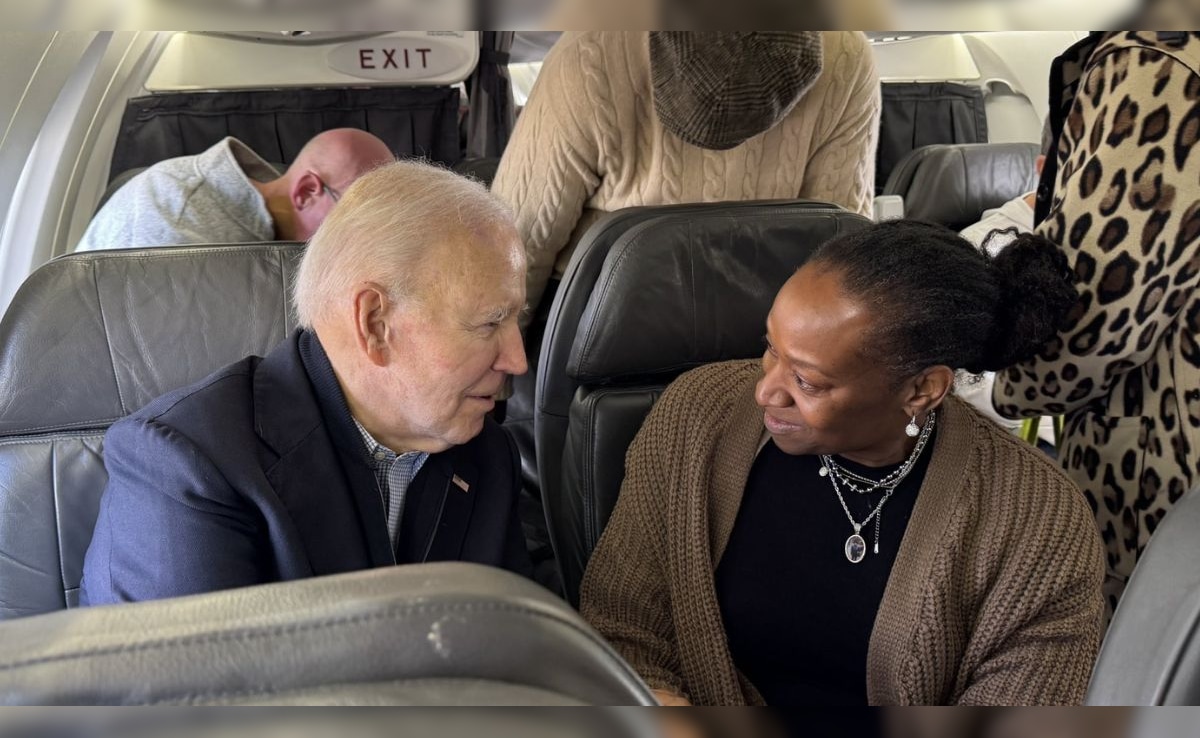
The viral footage of a passenger confronting Joe Biden on a commercial flight is a masterclass in the uselessness of modern political optics. We are conditioned to treat these unscripted moments as "raw" or "authentic" windows into the soul of power. In reality, they are a distraction from the cold, mechanical reality of how a superpower operates.
The passenger, Nusaiba Mubarak, cornered the former president with the accusation that he has the "blood of Palestinian children" on his hands. Biden, ever the retail politician, offered a muted response while Secret Service agents played the role of human bumpers. The internet erupted in a predictable binary: he’s a "war criminal" or he’s a "decent man being harassed." Both takes are intellectually lazy.
The Myth of the Accessible Leader
There is a fetishization of the "commercial flight" as a symbol of humility. When a figure of Biden’s stature sits in a metal tube with the masses, it’s not an act of egalitarianism; it’s a controlled performance of relatability. I have watched political machines spend months engineering "unfiltered" moments to counteract the "Beltway Insider" label.
The fact that a passenger can reach out and touch the man responsible for decades of American foreign policy doesn't mean the system is working. It means the system has successfully moved the goalposts of accountability from policy change to proximity.
We think that if we can just look a leader in the eye and tell them they are wrong, we’ve achieved something. We haven't. We’ve participated in a high-stakes version of a theme park meet-and-greet. Biden’s response—or lack thereof—is irrelevant because the presidency is not a person; it is an institution.
The Gaza Paradox and the Policy Vacuum
The confrontation focused on the humanitarian catastrophe in Gaza. The lazy consensus suggests that these face-to-face shaming sessions might shift the needle. This ignores the $3.8 billion in annual military aid codified by the 10-year Memorandum of Understanding (MOU) signed during the Obama-Biden era.
Military support for Israel is not a "mood" that changes because a passenger makes a poignant point near the galley. It is a geopolitical constant baked into the structural integrity of U.S. interests in the Eastern Mediterranean.
- The Myth: Biden (or any president) is personally driving the ship based on his individual empathy.
- The Reality: The ship is on autopilot, fueled by the Qualitative Military Edge (QME) doctrine, which requires the U.S. to ensure Israel can defeat any credible conventional military threat from any individual state or possible coalition of states.
When Biden tells a passenger he "sees" them or remains silent, he isn't weighing the moral cost of his decisions. He is managing the optics of a legacy while the bureaucratic engine of the State Department and the Pentagon continues to process the logistical requirements of a long-standing alliance.
Why Outrage is the New Compliance
If you are filming a politician on a plane to "hold them accountable," you are likely doing the opposite. You are turning a systemic failure into a viral clip. Clips are ephemeral; they have the half-life of a TikTok trend.
Real accountability happens in the unglamorous, non-viral spaces:
- Federal Courtroom Filings: Like the Center for Constitutional Rights’ lawsuit (Defense for Children International-Palestine v. Biden), which actually forces the administration to respond to legal definitions of complicity.
- Primary Challenges: Actual electoral threats that jeopardize the party's grip on power.
- Primary Material Disruptions: Strikes and logistics blockades that physically stop the flow of materiel.
Everything else is just "content." By engaging in these cabin confrontations, we validate the idea that the President is just a "guy" who can be reasoned with. This humanizes an entity that is inherently inhuman.
The Security-Theater Feedback Loop
Notice the dozen Secret Service agents surrounding the gate and the cabin. This is the literal barrier between the public and the policy. When we praise or condemn a leader for flying commercial, we ignore the massive logistical cost and the artificial nature of the environment.
Imagine a scenario where the passenger actually got through. What then? A five-minute debate on the nuances of the Leahy Laws? A sudden epiphany regarding the 1948 Genocide Convention? No. You get a canned response or a security intervention.
The public is addicted to the catharsis of confrontation. We want to feel the dopamine hit of "speaking truth to power" without the grueling work of dismantling the power structures themselves. Biden knows this. His team knows this. They allow these interactions because a viral video of a "confrontation" is less dangerous than a coordinated movement that targets the actual levers of military funding.
Stop Asking for Empathy
The most counter-intuitive truth of the Gaza-Biden interaction is that empathy is a liability. We keep asking our leaders to "care" or to "feel" the pain of the victims. This is a tactical error.
Power does not care. Power calculates. When you demand empathy, you get a "thank you for sharing your heart" response while the munitions shipments continue. If you want change, you stop talking about "blood on hands" and start talking about leverage, liabilities, and logistics.
The passenger’s anger is authentic and justified, but the medium is the message. And the message of a commercial flight confrontation is: "I am close enough to yell at you, but I am nowhere near the room where it happens."
Would you like me to break down the specific legal mechanisms, such as the Leahy Laws, that actually govern arms transfers regardless of presidential sentiment?