Mainstream science journalism just discovered that people 3,000 years ago burned animals to appease their gods. Stop the presses. Call the Pulitzer committee.
If you read the latest wave of headlines claiming a new Chinese study suggests animal sacrifice was part of ancient Sanxingdui rituals, you might think archaeologists just cracked the Da Vinci Code of the Bronze Age. They didn't. The headline writers took a nuanced, forensic chemical analysis of burnt bone fragments and flattened it into the most predictable, sanitized cliché in archaeology.
Calling Sanxingdui’s sacrificial pits "sites of animal offering" is like calling the Manhattan Project "a chemistry experiment." Technically true. Completely missing the point.
Having spent years tracking how Bronze Age material culture gets translated—and mangled—for public consumption, I have watched lazy consensus ruin some of the greatest archaeological discoveries on earth. When researchers run Fourier-transform infrared spectroscopy (FTIR) and collagen degradation tests on calcined bone fragments from Sichuan’s Sanxingdui ruins, they aren't looking for a cute Sunday school story about farmers burning pigs for rain. They are staring at the forensic remains of an organized, industrial-scale state panic—or a violent regime collapse.
Here is why the standard "animal sacrifice" narrative is dead wrong, what the chemistry in those pits actually proves, and why you are asking the wrong questions about China’s strangest lost civilization.
The "Ritual" Trap in Archaeology
There is an old, bitter joke among field archaeologists: whenever you dig up something weird and you have no idea what it was used for, label it "ritual."
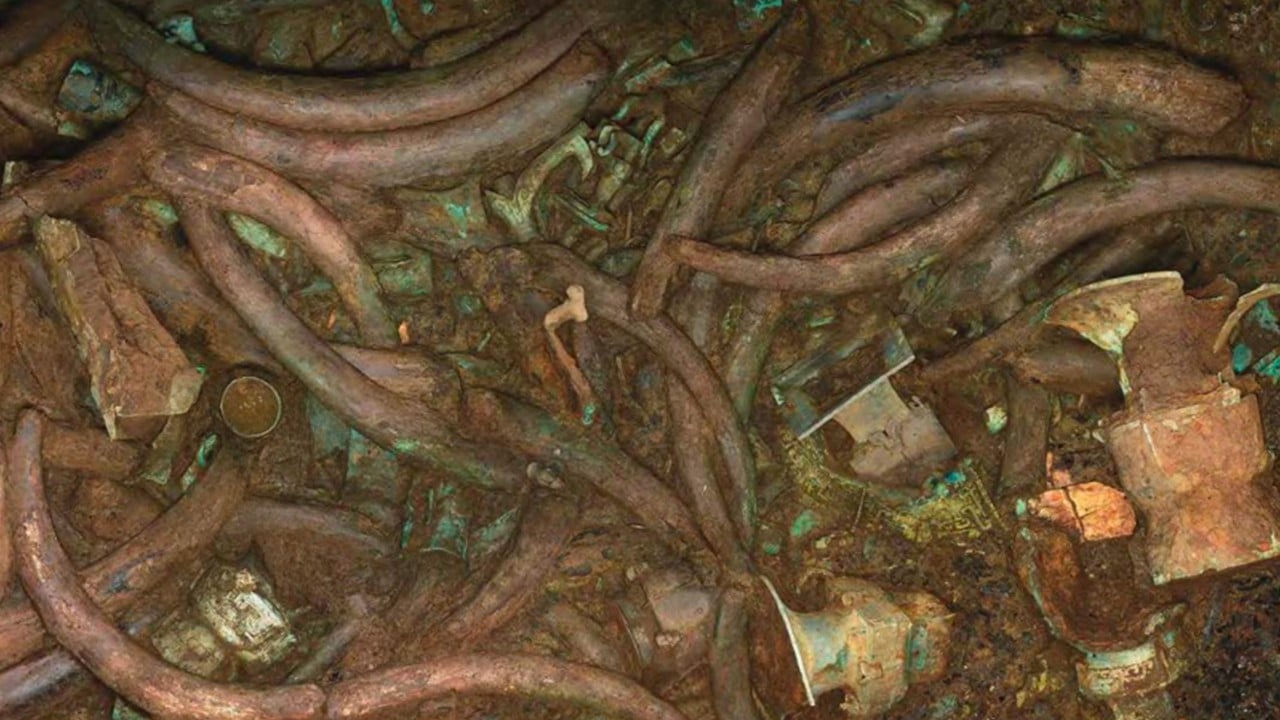
It is an intellectual escape hatch. Once an artifact or a pit gets stamped with the word ritual, critical inquiry stops. The public nods, imagines people in robes chanting around a fire, and clicks to the next tab. The recent coverage surrounding the Sanxingdui bone analysis falls straight into this trap. Yes, researchers analyzed burnt animal bones—pigs, cattle, sheep—found inside the famous sacrificial pits (specifically Pits 3 through 8, excavated in recent years alongside the iconic Pits 1 and 2 from 1986). Yes, the thermal alteration shows the animals were burned at high temperatures alongside smashed bronze masks, elephant tusks, and jade blades.
So what? Every Bronze Age society on earth burned livestock. The Shang Dynasty, Sanxingdui’s contemporaries to the northeast in the Yellow River valley, slaughtered thousands of cattle, dogs, horses, and humans in standardized, bureaucratic rituals documented on oracle bones.
If you focus on the presence of animal sacrifice at Sanxingdui, you are looking at the least interesting variable in the equation. The real anomaly isn't that they burned animals. It is how they burned them, what they burned them with, and why they buried the entire treasury of their kingdom in the same hole.
What the Forensic Chemistry Actually Reveals
To understand why the mainstream framing fails, you have to look at the mechanics of thermal alteration on bone—specifically, calcination versus charring.
When meat is roasted for a communal feast or a standard temple offering, bone temperatures rarely exceed 300°C to 400°C. The bone chars, turns black or dark brown, and retains much of its organic collagen matrix. You can still extract decent DNA or isotopic data from it, and the bone stays structurally recognizable.
In the Sanxingdui pits, the forensic data tells a radically different story. The bone fragments are heavily calcined—white, chalky, brittle, and fractured into tiny splinters. Calcination happens when bone is exposed to sustained, open-flame temperatures exceeding 600°C to 800°C. At that heat, all organic collagen burns away completely, leaving only recrystallized hydroxyapatite (the mineral component of bone).
Think about the logistics required to hit 800°C in an open pit during the Bronze Age. That doesn't happen by tossing a pig carcass onto a campfire. That requires massive quantities of dry hardwood, deliberate airflow management, and hours of continuous stoking.
Now factor in the rest of the pit's contents. They didn't just burn animals. They took monumental bronze trees standing nearly four meters tall, gold scepters, hundreds of elephant tusks, and massive bronze heads with protruding eyes, smashed them with heavy blunt instruments, threw them into the fire, and then immediately buried the entire mess under tightly packed layers of rammed earth.
Does that sound like a routine harvest festival to you?
The Two Competing Theories Nobody Mentions
When you strip away the sanitized "animal sacrifice" headline, you are left with two brutal, competing realities about what happened in the Chengdu Plain around 1200 to 1050 BCE. Both are far more compelling than a generic religious offering.
1. Scorched-Earth Iconoclasm (Regime Change)
Imagine a scenario where a rival faction—either an internal coup or an invading force from the neighboring Jinsha culture—overthrows the ruling theocracy of Sanxingdui. In the ancient world, political power was inseparable from divine mandate. Your bronze masks were your gods and ancestors.
If you conquer a city whose power rests on terrifying, monumental bronze totems, you don't just melt them down for spearheads—especially if those objects are considered spiritually radioactive. You neutralize them. You smash the faces, burn the sacred animals to sever the spiritual link, scorch the tusks, and seal the entire cursed inventory deep underground so the old gods can never be resurrected. Under this lens, the animal bones aren't an offering to Sanxingdui's gods; they are part of a ritualized execution of Sanxingdui's state apparatus.
2. Existential Panic (The End-of-the-World Hail Mary)
The alternative is equally grim. Paleoclimatological data and geological surveys of the Sichuan Basin show that the region was prone to catastrophic earthquakes and sudden, devastating river course shifts. Around the time Sanxingdui was abandoned, the entire urban center collapsed and its population vanished, likely migrating south toward Chengdu (forming the Jinsha site).
If your society is facing an existential crisis—a mega-quake that levels your city walls, a prolonged drought, or a plague—standard offerings stop working. You don't give the gods a single pig. You liquidate the entire national treasury. You burn the livestock, smash the sacred bronzes to release their spirit, throw in the imported ivory, and bury the whole offering in a desperate, one-time cosmic bribe to stop the sky from falling.
Notice how both theories explain the 800°C fires, the smashed bronzes, and the immediate burial. The "animal sacrifice" headline explains nothing. It just states the obvious and walks away.
Why Pop-Science Gets Sanxingdui Wrong Every Single Time
I have watched this exact editorial failure play out across dozens of archaeological beats. Why do outlets keep publishing watered-down, obvious angles on a site as wild as Sanxingdui?
- Fear of speculation: Academic press releases are written by committees terrified of overstating their findings. If a paper proves bone calcination via spectroscopy, the press release says, "Study provides evidence of animal sacrifice." Journalists copy-paste the press release without asking why the bones were calcined to dust.
- The Shang Dynasty bias: For decades, Western and Chinese historiography treated the Yellow River valley (the Shang and Zhou dynasties) as the sole cradle of Chinese civilization. Anything outside that orbit was treated as a peripheral curiosity. Even heavy hitters like Kwang-chih Chang had to fight to get regional Bronze Age cultures recognized as independent powerhouses. Because we have written records for Shang animal sacrifices, writers reflexively project Shang norms onto Sanxingdui—even though Sanxingdui has zero written script and completely alien iconography.
- Click-safe framing: "Animal sacrifice" hits an algorithmic sweet spot. It sounds vaguely exotic without requiring the reader to understand metallurgy, taphonomy, or Bronze Age geopolitics.
The downside to my own contrarian view? Hard proof is elusive. Because Sanxingdui left zero written texts—not a single oracle bone, not one bronze inscription—we cannot prove with 100% certainty whether those 800°C fires were lit by desperate priests or victorious conquerors. Anyone claiming absolute certainty about the intent behind the pits is selling fiction.
But admitting uncertainty about the motive is no excuse for ignoring the forensic violence of the evidence.
How to Actually Read Archaeological News (Without Getting Played)
Next time you see a headline claiming a new study "suggests" or "sheds light on" an ancient civilization, stop reading the headline and look for the underlying mechanics. If you want to separate genuine breakthroughs from academic PR fluff, run every archaeology story through four filters:
- Check the taphonomy, not the label. Taphonomy is the study of what happens to an organism after death—how it was cut, burned, crushed, or buried. If an article mentions animal bones, look for the temperature of the burn, the cut marks (butchery vs. ceremonial), and the skeletal completeness. Skull-only deposits mean something entirely different from full-carcass cremations.
- Follow the supply chain. Sanxingdui had no local elephant herds and limited tin deposits for bronze. Yet the pits are overflowing with ivory and high-tin bronze. Ask yourself: Where did the raw materials come from, and what happened to the trade routes right after these pits were closed? That tells you far more about the society than a burnt pig bone ever will.
- Look at the labor cost. Monumental archaeology is just frozen human labor. Smelting tons of bronze, carving jade with stone tools, and fueling 800°C fires required thousands of conscripted or specialized laborers. Whenever you see extreme labor expenditure followed by immediate destruction, you are looking at a massive political shockwave.
- Ignore the word "mystery." Journalists use "mystery" when they haven't read the stratigraphy. Sanxingdui isn't a mystery; it is a crime scene where the perpetrators left meticulous physical evidence and zero written confessions.
Stop Looking at the Bones—Look at the Fire
The animals in the Sanxingdui pits didn't die for a routine prayer. They were incinerated in an inferno hot enough to turn bone into chalk, surrounded by the shattered masterpieces of a vanished superpower, and buried under tons of earth never to be dug up again.
Calling that "animal sacrifice" is an insult to the sheer scale of what happened on the Chengdu Plain three millennia ago. Whether it was the ultimate act of state desperation or the final, brutal punctuation mark of a conquest, one thing is obvious: nobody builds a fire that hot unless their entire world is burning down with it.