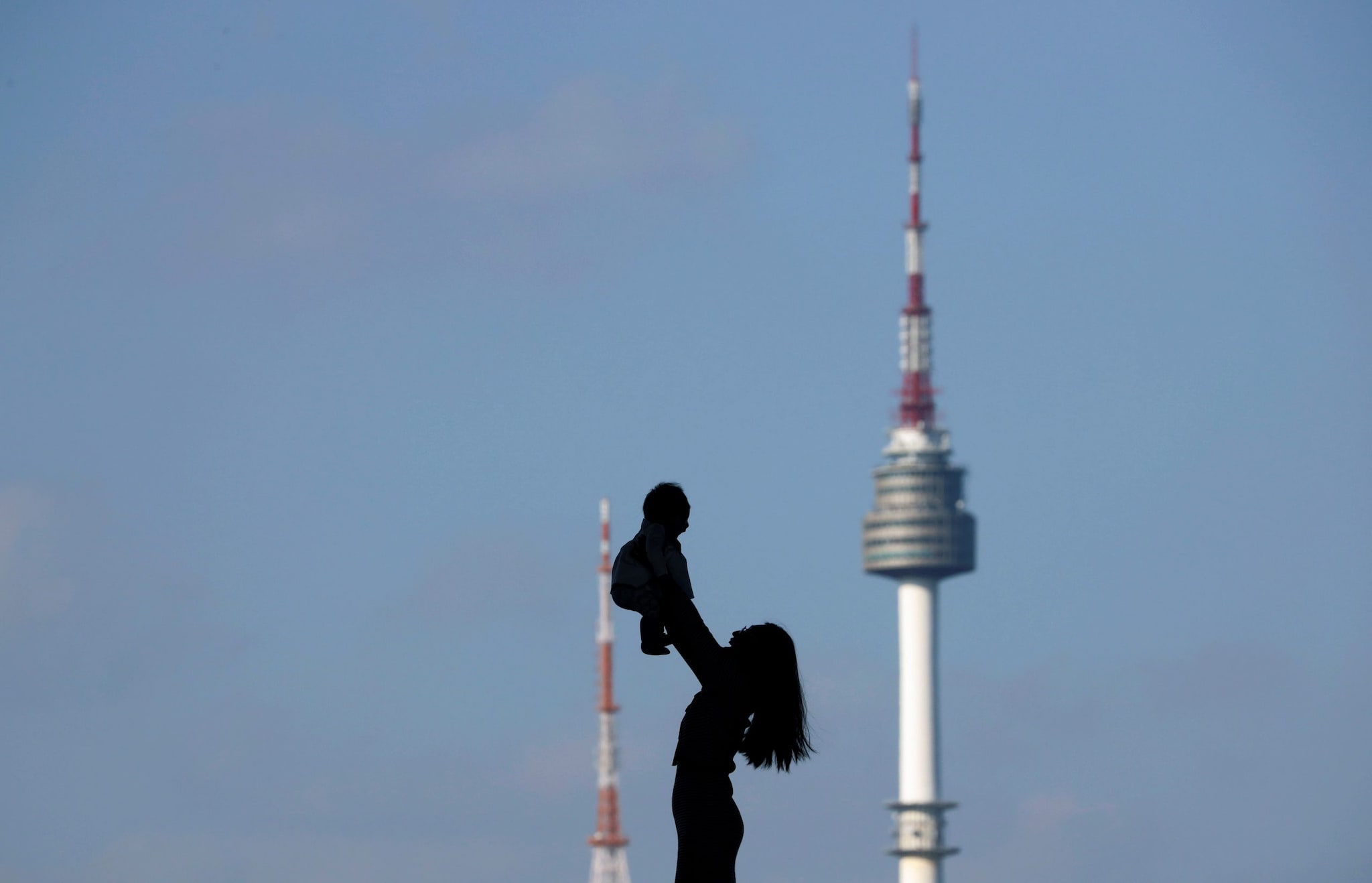
The Silence of the Seoul Night
Walk through the neon-drenched corridors of Gangnam or the quiet residential blocks of Mapo-gu at 2:00 AM, and you will encounter a specific kind of silence. It isn't the absence of noise—the hum of convenience store refrigerators and the hiss of distant taxis remain—but a structural silence. It is the sound of a generation staying awake to work, to study, and to calculate the sheer, terrifying cost of a human life.
For years, South Korea has been described as a country in a slow-motion vanishing act. The numbers were grim, then historic, then apocalyptic. In a world where a "replacement rate" of 2.1 children per woman keeps a society stable, South Korea’s figure plummeted to 0.72. Some quarters dipped even lower. It was the "demographic cliff," a term that sounds like a dry economic forecast until you realize it describes a world where there are no voices in the playgrounds and no one left to hold the hands of the elderly.
Then, something happened. A flicker of movement appeared in the data. For the first time in nearly a decade, the birthrate didn't just stop its freefall—it ticked upward.
The Calculator and the Crib
Consider Ji-won. She is thirty-two, an assistant manager at a logistics firm, and a hypothetical mirror of a million women currently navigating this shift. Two years ago, Ji-won’s "no-kids" stance wasn't a rebellion; it was a mathematical necessity. She lived in a studio apartment where the drying rack for her clothes took up half the floor space. Her commute was a ninety-minute odyssey in a crowded subway car. Her "career track" felt more like a tightrope.
In Ji-won’s world, a baby wasn't a bundle of joy. It was a $300,000 liability. It was the "mommy track" that led to a dead-end desk. It was the end of sleep and the beginning of a lifelong debt to the private tutoring academies known as hagwons.
But the tide is shifting because the environment is being forced to change. The government, long criticized for throwing money at the problem without fixing the culture, finally began to pull different levers. They moved past the simple "baby bonuses"—one-time cash splashes that parents saw as little more than a month's worth of diapers—and began addressing the structural rot.
The Pivot Toward Parent-Centric Reality
The recent rise in births is the result of a desperate, necessary softening of the Korean workplace. We are seeing the impact of expanded parental leave that fathers are actually taking. For decades, a man taking paternity leave was seen as a professional suicide mission. Now, with more robust legal protections and a shifting social consciousness, the "brave" father is becoming the "standard" father.
Tax incentives for companies that support flexible work hours are no longer just corporate CSR fluff. They are survival mechanisms. When Ji-won’s firm introduced a "work-from-home" policy for parents of toddlers, the math changed. The $300,000 liability began to look, if only slightly, more like a life she could actually lead.
The numbers bear this out. Marriage registrations, which stalled entirely during the pandemic years, saw a sudden 10% surge as the world reopened. Those delayed weddings are now translating into the first wave of "rebound" births. It turns out that people didn't stop wanting families; they simply refused to bring children into a burning building. Now that the fire department—the state—is finally showing up with more than a garden hose, the residents are beginning to return.
The Invisible Stakes of a Ghost Nation
Why does a 0.1 increase in a birthrate matter to someone sitting in London, New York, or Sydney? Because South Korea is the canary in the global coal mine. The pressures felt in Seoul—hyper-competition, astronomical housing costs, and the crushing weight of "success"—are the same pressures being felt everywhere, just condensed into a high-pressure cooker.
If South Korea can figure out how to make life livable enough for a young couple to choose a child over a promotion, they provide a blueprint for the rest of the developed world. This isn't just about filling classrooms. It's about the social contract. It’s about the silent agreement that the future is worth investing in.
When a society stops having children, it isn't just a labor shortage. It’s a crisis of hope. It means the youth have looked at the world their elders built and decided it wasn't worth passing on. The recent uptick in births is a fragile, beautiful sign that the hope is being reclaimed.
The Long Road to the Playground
We must be careful. One year of growth does not a trend make. The structural issues remain daunting. Housing in Seoul is still a fortress that many young couples cannot storm. The hagwon culture still drains the bank accounts and the spirits of parents who feel they must buy their child’s future at the cost of their own present.
However, the psychological barrier has been breached. The narrative of "inevitable extinction" has been interrupted.
Imagine Ji-won again. She is now thirty-four. She isn't in that studio apartment anymore. A government-subsidized housing program for newly married couples moved her to a suburb with a park. Her husband comes home at 5:30 PM twice a week. In the corner of their living room, where the drying rack used to be, there is a wooden crib.
It isn't a miracle. It’s a policy success. It’s a cultural softening.
The sound of that cradle rocking is the most important noise in the country. It is the sound of a nation deciding to continue. It is the sound of the silence finally breaking.
As the sun rises over the Han River, the light hits thousands of apartment windows. Behind some of them, for the first time in a long time, there is a new reason to wake up. The demographic cliff is still there, jagged and steep, but for the first time, we are seeing footsteps leading away from the edge.