The air in North London usually carries the faint, comforting scent of damp pavement and distant diesel. But on a Tuesday that should have been unremarkable, that smell was replaced by something acrid. Thick. The kind of heat that doesn't just warm the skin but sticks to the back of the throat.
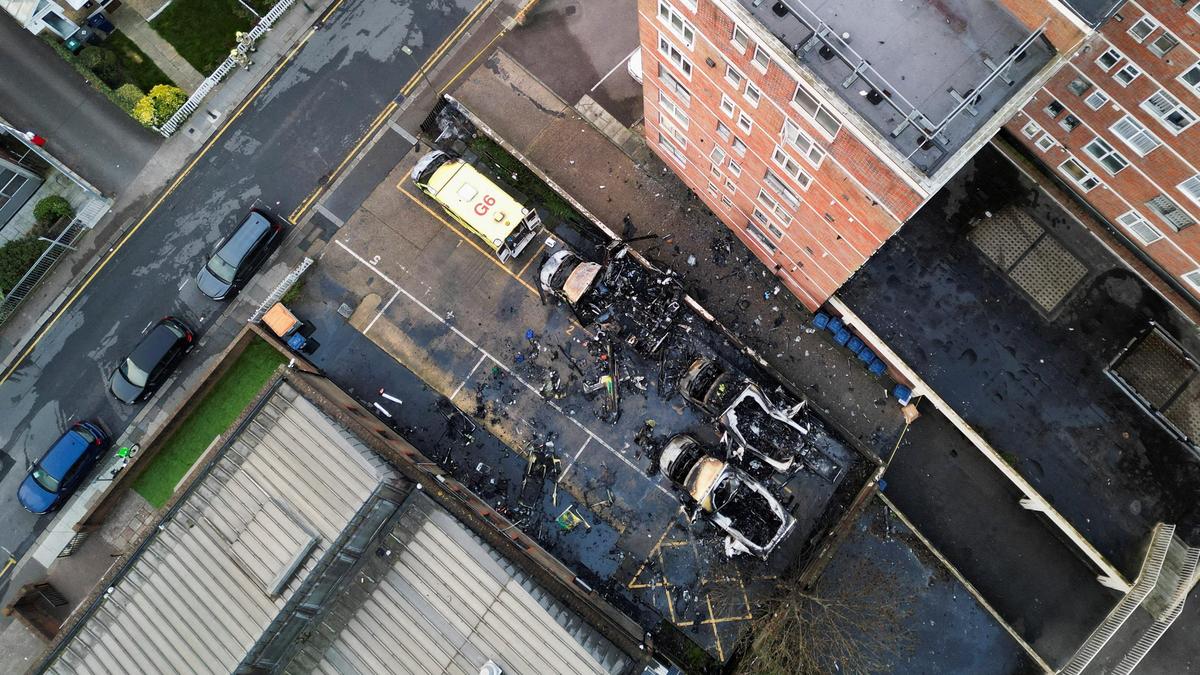
In the quiet hours before dawn, while most of the city was tucked under duvets, a flickering orange light began to dance against the brickwork of a residential street in Hackney. It wasn’t a hearth fire. It was the sound of tires popping like gunfire and safety glass crystallizing under extreme thermal stress. By the time the first responders arrived, two ambulances—vehicles built for the sole purpose of preserving life—were nothing more than hollowed-out skeletons of charred metal and melted plastic.
These weren't just any ambulances. They belonged to Hatzola.
To understand why this feels like a gut punch to the neighborhood, you have to understand what an ambulance represents in a tight-knit community. It isn't just a van with a siren. It is a promise. It’s the physical manifestation of the idea that when the world starts to blur and your chest tightens or your child stops breathing, someone who speaks your language and knows your streets will be there in minutes.
Hatzola is a voluntary emergency medical service. They don't charge. They don't check insurance. They are staffed by neighbors who drop their dinner forks or leave their own beds to sprint toward someone else’s crisis. When you set fire to a Hatzola ambulance, you aren't just destroying property. You are burning a bridge between a person in pain and the help they desperately need.
The Anatomy of a Targeted Flame
Police have labeled this a suspected hate crime. That phrase—hate crime—often feels clinical in a news report, like a checkbox on a bureaucratic form. But on the ground, it feels like a shadow. It’s the realization that someone didn't just want to cause damage; they wanted to send a message. They chose a symbol of Jewish communal care and decided it shouldn't exist.
The logistics of such an act are chillingly deliberate. An ambulance is a warehouse of life-saving technology. Inside those charred husks were defibrillators designed to shock a stopped heart back into rhythm. There were oxygen tanks, trauma kits, and pediatric masks. To douse these machines in accelerant is to make a conscious choice that those tools should never be used again.
Imagine a hypothetical volunteer named David. David isn't a professional soldier or a politician. He’s a pharmacist who spends his Tuesday nights on call. When the alarm goes off on his hip, he kisses his wife, grabs his high-vis jacket, and runs. Now, imagine David standing on the sidewalk the next morning, looking at the blackened shell of his workspace. He isn't thinking about the insurance claim. He’s thinking about the call that might come in twenty minutes—the call he now cannot answer because his mobile emergency room is a pile of soot.
A History Written in Ash
London has a long memory when it comes to the scars on its streets. This isn't the first time a community has had to watch its sanctuary or its services go up in smoke. There is a specific kind of exhaustion that settles into the bones of a marginalized group when they realize that even their acts of mercy are viewed as targets.
Anti-Semitism doesn't always look like a march or a manifesto. Sometimes it looks like a person with a jerry can in a dark alleyway, attacking a vehicle that would just as easily transport a stranger as it would a friend. It’s an attempt to shrink a community’s footprint, to make them feel that even their safety is an illusion.
The statistics tell a story of rising tension, of numbers ticking upward on a graph in a Home Office briefing. But the graph doesn't show the grandmother who is now afraid to call for help because she wonders if the ambulance will make her a target. It doesn't show the kids who walk past the scorched pavement on their way to school, learning a lesson about the world that they are far too young to digest.
The Invisible Stakes of Silence
When we see a headline about burned vehicles, it’s easy to swipe past. We tell ourselves it’s an isolated incident, a fluke of urban friction. But the real problem lies elsewhere. The damage isn't contained to the metal and the rubber. It’s a tear in the social fabric that suggests some lives are less worthy of protection than others.
Consider the ripple effect. An ambulance taken out of service in Hackney isn't just a loss for the Jewish community; it’s a loss for the entire London emergency network. When Hatzola can’t take a call, that burden shifts back to the NHS, a system already stretched to its absolute breaking point. Hate is rarely surgical. It is a blunt instrument that leaves everyone bruised.
Trust is the most expensive thing in any city, and it is the easiest thing to burn. Every time a community-led initiative is attacked, the message to the volunteers is clear: Your kindness is not welcome here. It takes an incredible amount of moral courage to look at those ashes and decide to build something new.
The Weight of the Morning After
The investigation is ongoing. Forensic teams will sift through the debris, looking for a fingerprint, a chemical signature, a lead. CCTV will be scrubbed frame by frame. But for the people living in the shadow of the smoke, the "who" is almost less important than the "why."
There is a grim irony in attacking a medical service. The person who lit the match might one day find themselves gasping for air on a London sidewalk. If they did, and a Hatzola medic was the closest person to them, that medic would still stop. They would still use their training. They would still fight to keep that heart beating. That is the fundamental difference between those who build and those who burn.
The street is quiet now. The wreckage has been towed away, leaving only a dark, greasy stain on the asphalt that the rain won't quite wash clean. Neighbors pass by, some slowing down to stare at the empty space, others hurrying along with their heads down.
The vehicles are gone, but the intent remains. The community is left with the task of replacing what was lost, not just the machines, but the sense of peace that allows a person to sleep soundly through the night. It is a heavy lift. It is a quiet, ongoing battle against a darkness that doesn't need a reason to strike, only an opportunity.
A city is defined by how it responds to the sight of its own fire. We can look at the blackened pavement as a tragedy of "them," or we can recognize it as a wound to the "us." Because when the sirens go silent in one part of the city, the silence eventually echoes through every street we call home.
The smell of smoke eventually fades, but the cold where the heat used to be remains.