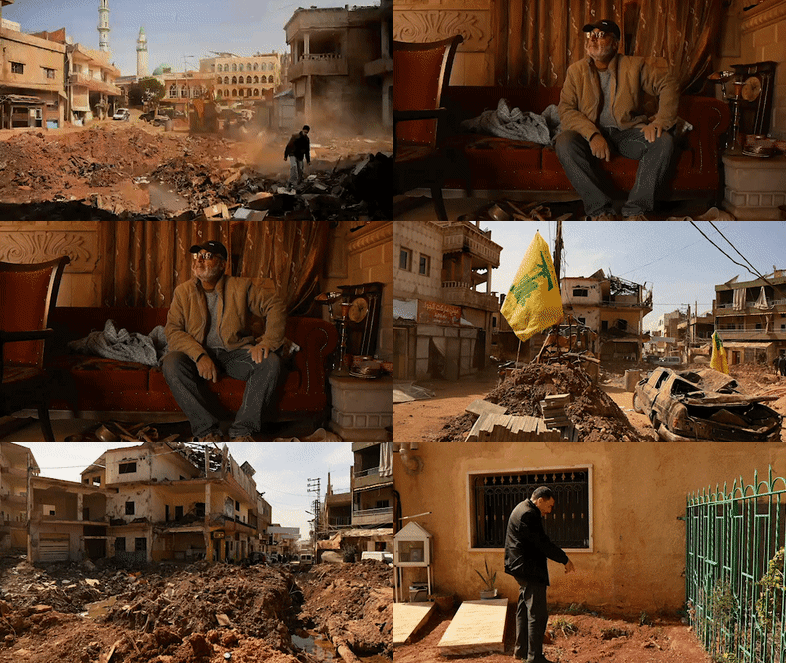
The headlines always follow the same script. "Carnage." "Town torn apart." "Senseless destruction." It is a visceral, emotional framing that treats war like a natural disaster that accidentally hit a residential block. It is also fundamentally dishonest. When you read about an Israeli raid on a "tiny Lebanese town," the narrative usually stops at the rubble. It ignores the cold, hard logic of modern asymmetric conflict: in 2026, the "town" is no longer just a place where people live. It is a weapon system.
We need to stop pretending that the geography of the Middle East functions like a 19th-century battlefield. There are no open fields where two uniformed armies meet to decide the fate of a nation. The "carnage" reported in these villages isn't a failure of precision or a lapse in morality. It is the inevitable result of a deliberate strategy that turns kitchens into rocket labs and living rooms into sniper nests.
The Infrastructure of Deception
The "lazy consensus" among journalists is that if a building looks like a house, it must be a house. I have spent years analyzing urban combat zones, and I can tell you that a facade is the cheapest piece of military equipment available.
Hezbollah and similar non-state actors do not build massive, recognizable Pentagon-style bunkers. They don't have to. They use the existing civilian infrastructure as a protective skin. When a raid "tears apart" a town, it is usually because that town was structurally integrated into a subterranean tunnel network. You cannot extract a tumor without cutting the skin.
If you find a Kornet anti-tank missile under a nursery bed—which happens with staggering frequency—that room is no longer a nursery. It is a hardened military position. The tragedy isn't that the building was hit; the tragedy is the cynical calculation that placed a high-value target inside a family’s home to begin with.
Why "Proportionality" is a Misunderstood Metric
The most common critique leveled against these raids is that the response is "disproportionate." People look at a cratered street and compare it to the size of the original threat. This is a fundamental misunderstanding of military necessity.
In the law of armed conflict, proportionality isn't about making sure both sides suffer equally. It is a calculation of whether the incidental loss of civilian life is excessive in relation to the concrete and direct military advantage anticipated.
- The Scenario: If a single house contains a command-and-control node that directs drone swarms against civilian centers, that house is a legitimate target.
- The Reality: If that node is linked to twenty other houses via tunnels, the entire block becomes a single military complex.
When you see a town in ruins, you aren't seeing "overkill." You are seeing the physical manifestation of the effort required to dismantle a decentralized, subterranean fortress. The idea that you can conduct "surgical" strikes against an enemy that has sewn its nervous system into the plumbing of a village is a fantasy sold by people who have never stood in a breach.
The Civilian Shield as a PR Asset
We have to address the "human shield" argument with more nuance than the talking heads provide. It isn't always about a soldier literally holding a child in front of them. It is about the strategic utility of suffering.
For a group like Hezbollah, a destroyed town is more valuable than an intact one. An intact town is just a place where people live. A destroyed town is a global news event. It is a tool for diplomatic leverage. It is a recruitment engine. When the media focuses exclusively on the "carnage" without documenting the specific military hardware recovered from those same ruins, they are effectively acting as the logistics wing of the insurgency.
I've seen it firsthand: the shock of the locals is often genuine, but the presence of the militants is a known, quiet reality they were forced to live with. To claim the town was "peaceful" until the raid began is to ignore the years of intimidation and military buildup that occurred under the cover of night.
The Cost of the "Clean War" Delusion
The public has been conditioned by Hollywood and high-tech PR to believe in the "clean war." We want to believe that we can hit a button, delete the "bad guy," and leave the flower pot on his balcony standing.
This delusion is dangerous. It leads to a cycle of perpetual conflict because it prevents the total dismantling of the enemy's capability. If you only hit the "obvious" targets, you leave the infrastructure intact for the next round. "Mowing the grass" is a failed strategy. To actually end a threat, you have to dig up the roots. And the roots are in the basements, the schools, and the mosques of these "tiny towns."
The Uncomfortable Math of Urban Raids
Let's look at the physics. If an insurgent fires an RPG from a window, that window is now a point of origin. To neutralise it, a tank or a jet isn't going to use a sniper rifle. It’s going to use a round designed to collapse the structure to ensure the threat is neutralized and doesn't just move to the next room.
- Structure Integrity: Modern concrete buildings are surprisingly resilient. You often need high-caliber ordnance to stop a reinforced position.
- Collateral Reality: In a town where houses are built wall-to-wall, the kinetic energy of a single strike will inevitably damage the neighbors.
- Secondary Explosions: This is the detail the "carnage" reports always miss. Half the damage in these towns isn't caused by the initial Israeli missile. It’s caused by the Hezbollah munitions stored inside the building cooking off. When a "house" explodes with the force of a munitions dump, it wasn't just a house.
Stop Asking the Wrong Questions
The media asks: "How could they do this to a town?"
The correct question is: "Why was this town allowed to become a military base?"
If you want to prevent "carnage," you don't start by criticizing the raid. You start by demanding the demilitarization of civilian zones. You start by holding the governing bodies—and the international observers who turn a blind eye—accountable for the weaponization of domestic life.
The status quo is a trap. We celebrate the "bravery" of reporters who walk through ruins, but we rarely see them ask the residents where the tunnels go. We see the tears, but we don't see the bunkers.
True expertise in this field requires admitting that there are no "clean" ways to fight an enemy that wears no uniform and hides behind its own children. It is messy, it is brutal, and it is a logistical nightmare. But calling it "senseless" is a lie. It is the most logical, calculated form of warfare in existence today.
If you aren't willing to look at the weapons manifest found in the wreckage, you have no right to comment on the wreckage itself. Stop falling for the aesthetic of tragedy and start looking at the mechanics of the conflict.
The next time you see a report about a town being "torn apart," ask yourself what was hidden inside the walls to make that destruction a military necessity. The answer is usually there, buried under the "carnage" the cameras refuse to zoom in on.
Strip away the sentimentality. War is a series of hard choices between bad options. Pretending there is a version of this where the town remains untouched is not just naive—it’s an insult to the reality of the ground.
Accept the brutality of the geometry. Clear the rubble. Find the rockets. Move on.