The wall of water and debris arrived with terrifying precision. Minutes before the catastrophic flash flood and mudslide flattened Gyirong Port on the Nepal-Tibet border, travelers like Renee, a disability support worker from the Sunshine Coast in Australia, stepped into the customs zone. By the time the torrent tore through the mountain pass, sweeping away multi-story concrete buildings and high-voltage power lines as if they were matchsticks, hundreds of foreign tourists and locals were caught in a localized apocalypse.
Days after the disaster, dozens of Australian families find themselves trapped in an agonizing limbo. With communication lines severed and entire infrastructure networks washed away across a 40-kilometer stretch of the Himalayan frontier, loved ones back home are grappling with the harsh realities of international disaster zones. For Renee's partner Shaun, an emergency nurse, and their two daughters, waiting quietly in Australia was never an option.
The Anatomy of a Himalayan Catastrophe
To understand why traditional search and rescue operations have stalled in places like Gyirong Port, one must look at the brutal geography of the region. Initial speculation pointed toward seismic activity, but data from geological surveys confirmed a more complex and terrifying mechanism: a massive collapse of glacial ice and rock high above the Lhende River valley. This sudden displacement triggered a debris-laden wall of mud that funneled through narrow mountain gorges, gaining velocity and mass with every meter it dropped.
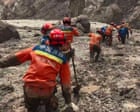
When this slurry hit the border port, it did not merely flood the area; it obliterated it. Heavy machinery, rescue dogs, and hundreds of state emergency workers deployed by Chinese and Nepali authorities faced a landscape completely rewritten by mud and stone. Bridges vanished. Access roads turned into vertical cliffs of unstable earth. In these conditions, even elite disaster response units struggle to establish a foothold, let alone comb through meters of compacted silt where buildings once stood.
For families watching from thousands of miles away, the physical distance is mirrored by an information void. Official channels move with bureaucratic caution, releasing casualty figures only after DNA verification or visual identification in makeshift morgues downstream. Yet, for relatives of the missing Australians, statistical updates offer cold comfort against the desperate urge to deploy into the field themselves.
The Cost of Desperate Journeys
When a government says an area is impenetrable, families under the weight of anticipatory grief rarely listen. Shaun, alongside daughters Lily and Ruby, launched an emergency crowdfunding effort with a singular goal: catch a flight to South Asia, bypass the red tape, and search the perimeter of the disaster zone themselves.
This impulse exposes a recurring friction point in modern international disasters. Well-meaning family members often want to boots-on-the-ground search a catastrophic impact zone where professional rescue teams are already struggling against toxic mud, secondary landslides, and unstable terrain. Emergency management professionals frequently advise against independent civilian deployment into active disaster zones, citing the very real danger that rescuers will become casualties themselves.
Yet, telling a partner of decades to stay home ignores the profound psychological toll of administrative absence. When official reports state that infrastructure has been "wiped away," the mind of a grieving relative rejects the finality until physical evidence proves otherwise. They look at satellite photographs of flattened concrete shells and search for familiar shapes, holding onto the statistical anomaly that someone might have found an air pocket or managed to scramble up a ravine before the surge hit.
The Global Echo of Fragile Borders
Beyond the immediate human tragedy of missing pilgrims and trekkers lies an uncomfortable truth about climate vulnerability in high-altitude zones. The collapse of marginal ice and unstable permafrost in the Himalayas is accelerating. Communities built in narrow river valleys to facilitate cross-border trade—such as the historic transit hub at Gyirong—sit directly in the crosshairs of accelerated glacial melting and intense monsoon extremes.
Families of the missing understand this broader context, even amid their personal anguish. Relatives have noted that if survivors like Renee could speak from the rubble, their primary focus would likely pivot away from individual rescue and toward the systemic crisis facing the local populations of Nepal and Tibet. These communities bear the brunt of environmental shifts engineered by industrial nations, yet possess the least resources to fortify their homes against mountains that refuse to stay still.
As rescue helicopters continue their low-altitude sweeps over the choked riverbeds, the window for finding survivors narrows by the hour. Back on the Sunshine Coast, packed bags sit by the door while consular officials negotiate the logistics of entry into restricted border zones. The hope is microscopic, defying the overwhelming weight of the mud, but for families bound by a lifetime of shared history, it is the only currency left to spend.