The loss of eight lives in a single localized event represents a catastrophic failure of systemic safeguards and an immediate destabilization of the regional social fabric. Analyzing the aftermath of the Louisiana mass shooting requires moving beyond the surface-level narrative of mourning to examine the structural impacts on community continuity, the psychological load on public infrastructure, and the specific variables that dictate long-term recovery or permanent decline. When an event of this magnitude occurs, the community enters a state of high-velocity grief that necessitates a precise, multi-tiered response to prevent a secondary collapse of social order.
The Triad of Community Destabilization
A mass casualty event involving children triggers three specific systemic shocks that standard emergency protocols often underestimate. These shocks operate as a feedback loop, each amplifying the severity of the others.
- Institutional Trust Erosion: The primary function of any local governance or protective agency is the assurance of physical safety. When eight individuals are killed in a single incident, the perceived contract between the citizenry and the state is severed. This leads to a withdrawal of public participation and a surge in privatized security measures, which fragments the community into isolated cells.
- Generational Demographic Depletion: The death of children is not merely a tragedy; it is a permanent loss of future human capital. For a specific neighborhood or town, the removal of an entire cohort of youth alters the school system's viability, future labor market projections, and the long-term tax base. This creates a "shadow deficit" that will manifest twenty years post-event.
- Hyper-Local Psychological Saturation: Unlike isolated incidents, a mass shooting creates a concentrated pocket of trauma. The concentration of funerals, memorials, and media presence prevents the normal "cooling" period required for psychological stabilization. The environment itself becomes a trigger, leading to high rates of domestic migration as families flee the proximity of the trauma site.
The Anatomy of the Memorial Cycle
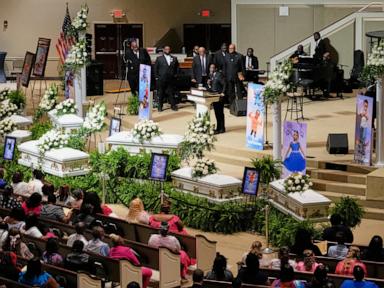
The funeral process serves as the first critical juncture in the stabilization phase. In the Louisiana context, the ritualized collective mourning serves as a mechanism for social re-integration. However, the efficiency of this ritual depends on its ability to transition from passive grief to active communal reinforcement.
The first stage involves the Validation of Loss. This is the public acknowledgment that the deaths occurred and that the victims held intrinsic value. This stage is vulnerable to "symbolic exhaustion," where the sheer volume of grief exceeds the capacity of the survivors to process it, leading to emotional numbness.
The second stage is Collective Identity Reconstruction. During the funeral services, the community attempts to redefine itself as a "survivor community" rather than a "victim community." This distinction is vital. A victim identity is passive and externally defined; a survivor identity is active and internally governed. The success of this transition dictates whether the town will experience a permanent economic and social downturn or a period of hardened resilience.
Quantitative Limitations of Crisis Intervention
Public health data suggests that the demand for mental health services following a mass casualty event follows a predictable, non-linear curve. Initial demand is artificially low due to shock and the logistical demands of funeral arrangements. Peak demand typically occurs 90 to 120 days post-incident, long after national media attention and external resource surges have dissipated.
This "Support Gap" represents a critical failure point. When external non-profits and government agencies withdraw their temporary teams, the local infrastructure is often left with a case load that exceeds its pre-incident capacity by several hundred percent. The result is a backlog of untreated Post-Traumatic Stress Disorder (PTSD) and Complicated Grief, which correlates with increased rates of substance abuse and local economic underperformance.
Structural Bottlenecks in Rural and Suburban Recovery
Louisiana's specific socio-economic profile introduces variables that complicate the standard recovery model. Areas with lower population density or fewer centralized mental health facilities face a "Resource Distance" problem.
- Financial Strain of Burial Costs: The sudden requirement to fund eight funerals simultaneously places an acute liquidity strain on low-to-middle-income families. Even with community fundraising, the administrative overhead and the speed at which funds must be deployed create friction.
- The Media Feedback Loop: Continuous coverage of the funerals provides a sense of solidarity but also extends the "event horizon." Every broadcast re-traumatizes the viewers, preventing the amygdala from exiting a state of hyper-vigilance.
- Judicial Lag: The funerals mark the end of the mourning phase but the beginning of the legal phase. The disconnect between the finality of the burial and the protracted nature of criminal proceedings creates a state of "suspended justice" that prevents total community closure.
The Causality of Social Cohesion
Social cohesion is often treated as an abstract feeling, but in post-shooting analysis, it functions as a measurable asset. High-cohesion environments recover 30% faster in terms of retail activity and school attendance than low-cohesion environments.
The funeral serves as a high-density networking event for social cohesion. It brings together disparate stakeholders—local leaders, religious organizations, families, and law enforcement—under a unified objective. The efficiency of the communication during these gatherings determines if the community will fragment over blame or unify over reform. If the discourse at these events focuses heavily on systemic failure without providing a pathway for systemic improvement, the cohesion value remains net-negative.
Prototyping the Long-Term Stabilization Model
To move beyond the immediate funeral cycle, a community must implement a persistent stabilization framework. This cannot rely on the temporary surge of "thoughts and prayers" but must be built on tangible, operational changes.
The first requirement is the establishment of a Permanent Trauma Endowment. This is a dedicated fund, ideally sequestered from general municipal budgets, designed to provide long-term mental health subsidies for affected families for a minimum of ten years. This addresses the 90-day Support Gap by ensuring that the withdrawal of federal aid does not end the availability of care.
The second requirement is Environmental Re-coding. The site of the shooting and the locations of the funerals must be transformed from sites of trauma into sites of utility or commemorative growth. Leaving a site derelict or unchanged serves as a persistent visual reminder of the failure of the security state.
The third requirement is Integrated Crisis Communications. Local leadership must transition their rhetoric from "recovery" to "evolution." Recovery implies a return to a pre-shooting state that no longer exists. Evolution acknowledges the permanent change in the community's DNA and focuses on the new, hardened structures required to navigate the future.
Strategic Execution for Civic Leaders
The immediate priority following the burial services is the transition from acute response to chronic management. Leaders must identify the "Secondary Victims"—first responders, teachers, and neighbors who were not physically injured but whose functional capacity has been degraded by the event.
Implementation must focus on the following vectors:
- Labor Retention: Providing tax incentives or direct grants to local businesses to prevent the flight of human capital.
- School System Hardening: Not just in terms of physical security, but in the infusion of social-emotional learning curricula to address the cohort of surviving children.
- Data-Driven Monitoring: Utilizing community surveys and healthcare data to track the "Trauma Decay Rate" and adjusting resource allocation accordingly.
The objective is not to forget the eight lives lost, but to ensure that their deaths do not catalyze the death of the town itself. The funeral is the final act of the tragedy; the strategic response that follows is the first act of the community's survival.