Long-duration spaceflight is a biological decay function. In a microgravity environment, the human body sheds musculoskeletal mass at an alarming, compounding rate: astronauts lose up to 1 to 2% of bone mineral density every 30 days and up to 20% of their skeletal muscle mass within a single fortnight. Without an active mechanical intervention, an astronaut transitioning from a six-month transit to a planetary surface like Mars would suffer immediate structural failure of the lower limbs and profound cardiovascular collapse upon re-entering a gravitational field.
To date, the solution on the International Space Station (ISS) has been brute force: packing the orbital habitat with massive, heavy mechanical simulators. The primary countermeasure, the Advanced Resistive Exercise Device (ARED), utilizes massive vacuum cylinders to mimic a 272 kg (600 lb) free-weight load. While functionally effective, ARED and its companion systems—the T2 treadmill and the Cycle Ergometer with Vibration Isolation and Stabilization (CEVIS)—represent an unsustainable engineering strategy for deep space exploration.
The transition from low Earth orbit (LEO) to deep space exploration introduces a severe optimization bottleneck. The massive physical envelope and payload constraints of deep space vehicles like the Orion capsule or the Lunar Gateway render legacy ISS exercise hardware completely obsolete. The engineering objective has shifted: space agencies and commercial contractors must minimize the mass, volume, and power footprints of fitness hardware while maintaining or increasing the mechanical load delivered to human tissue. This is a cold, thermodynamic calculus balancing structural mass against biological degradation.
The Physics of Orbital Atrophy: The Mechanical Deficit
On Earth, human physiology is sustained by constant, passive resistance against a 1g gravitational vector. Bone remodeling is governed by Wolff’s Law, which states that bone adapts to the mechanical loads placed upon it. When hydrostatic pressure drops and ground reaction forces disappear, osteoblast activity (bone formation) decreases while osteoclast activity (bone resorption) accelerates. The skeletal system effectively dissolves itself, dumping calcium into the bloodstream and increasing the risk of nephrolithiasis (kidney stones).
Concurrently, skeletal muscle undergoes rapid unweighting atrophy. The body selectively deconstructs high-energy-consuming type I (slow-twitch) muscle fibers, which are responsible for posture and endurance, shifting the muscular profile toward type II (fast-twitch) fibers. This structural degradation is paired with a severe cardiovascular baseline decline. Without a gravity gradient to fight, blood pools in the thoracic cavity, causing the heart to downregulate stroke volume and total blood volume. Within days, the myocardial muscle mass shrinks, creating a state of profound orthostatic intolerance.
The mechanical deficit is the core variable that space gym design must solve. To stop this decay, an astronaut requires roughly two hours of high-intensity physical loading per day. However, generating a 200 kg load in an environment where mass is weightless requires replacing gravity with alternate physical mechanisms.
The Engineering Bottleneck: Mass, Volume, and Kinetic Energy Isolation
Designing hardware for deep space transit involves solving a multi-variable optimization problem defined by three rigid engineering constraints.
The Mass-to-Orbit Ratio
The logistics of deep space transport dictate that every kilogram of payload requires a compounding volume of propellant to escape Earth's gravity well. The ISS exercise suite weighs over 1,800 kg and occupies nearly 80 square meters of operational volume. For a lunar or Martian transit vehicle, the entire exercise payload budget is typically capped at under 20 kg—a 98% mass reduction directive.
Kinetic Energy and Structural Coupling
Every action inside a spacecraft generates an equal and opposite reaction against the hull. When an astronaut runs on a treadmill or executes a heavy squat, those transient kinetic forces propagate through the spacecraft structure. Without isolation, these structural vibrations can deform solar arrays, disrupt delicate microgravity science experiments, or stress the structural welds of the pressure vessel.
On the ISS, this problem is solved via massive, passive, and active isolation platforms. The T2 treadmill, for example, relies on a 900 kg vibration isolation system hidden beneath the deck. For deep space missions, carrying a near-ton dampening system is impossible. The exercise hardware must be intrinsically self-contained or dynamically balanced to nullify outward force vectors before they reach the hull.
Thermal and Gas Dynamics
High-intensity human workouts generate a significant local surge in ambient temperature, moisture vapor, and carbon dioxide ($CO_2$). In an enclosed, unventilated space pocket, a pocket of exhaled $CO_2$ can form around an astronaut’s face, leading to hypoxia and hypercapnia. Space fitness systems must interface seamlessly with Environmental Control and Life Support Systems (ECLSS) to manage the thermal and metabolic spikes generated during a workout session.
Next-Generation Architectural Frameworks: Flywheels vs. Vacuum Cylinders
To replace the massive footprints of legacy systems, modern aerospace engineering has bifurcated into two primary architectural design pathways: inertial flywheel systems and pneumatic/elastomeric resistance arrays.
+-------------------------------------------------------------------------+
|                        SPACE GYM DESIGN MATRIX                         |
+------------------------------------+------------------------------------+
| INERTIAL FLYWHEEL SYSTEMS          | PNEUMATIC & ELASTOMERIC ARRAYS     |
+------------------------------------+------------------------------------+
| - Kinetic Energy Storage (Yo-Yo)   | - Constant Vacuum Cylinders        |
| - Force tied to user input velocity| - Stacked Torsional Elastomers     |
| - High load-to-mass ratio (~14 kg) | - Linear resistance profiles       |
+------------------------------------+------------------------------------+
Inertial Flywheel Architecture
The most mature solution for deep-space transit is the inertial flywheel, currently deployed in vehicles like NASA’s Orion capsule for the Artemis missions. This system replaces physical mass with kinetic energy storage.
An astronaut pulls a cable wound around a central shaft connected to a heavy spinning disc (the flywheel). The system operates like a high-tech yo-yo: the user accelerates the flywheel during the concentric phase (e.g., the upward motion of a squat), storing angular momentum. During the eccentric phase (the downward motion), the flywheel continues to spin, pulling the cable back in. The astronaut must actively resist this return force to slow the wheel down.
The major benefit of the flywheel is its scaling properties. The resistance profile is entirely user-dependent: the harder and faster the astronaut pulls, the more angular momentum is stored, and the higher the peak load becomes. NASA’s current deep-space flywheel assembly weighs a mere 14 kilograms (less than a standard piece of carry-on luggage) yet can generate up to 180 kg (400 lbs) of adaptive resistance. This provides a massive load-to-mass ratio improvement over legacy hardware.
Pneumatic and Elastomeric Systems
The alternative approach leverages constant-force vacuum cylinders or advanced torsional elastomers. This is the design philosophy driving the European Space Agency’s (ESA) European Enhanced Exploration Exercise Device (E4D).
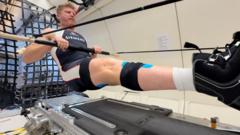
The E4D consolidates four distinct exercise modalities—resistive training, cycling, rowing, and rope pulling—into a single integrated chassis. Instead of relying purely on inertial energy, it utilizes a combination of internal pneumatic resistance and digital clutches to deliver precise, linear load profiles up to 270 kg. This allows for fine-tuning of the force profile, enabling asymmetric loading where the eccentric phase can be programmed to be heavier than the concentric phase—a feature critical for preventing muscle atrophy.
Real-Time Kinematic Analysis and Digital Feedback Loops
Moving toward deep space means removing the real-time safety net of ground control. On the ISS, flight surgeons and exercise specialists monitor workouts via real-time telemetry and video feeds. On a Martian transit mission, communication latency stretches up to 22 minutes each way, completely eliminating real-time remote coaching.
Consequently, deep space gym equipment must function as autonomous diagnostic medical platforms. The E4D architecture integrates a camera-based motion-capture system combined with real-time artificial intelligence. The system projects a digital avatar of the astronaut onto a control tablet, tracking anatomical landmarks in real time.
If the astronaut’s spine deviates during a heavy deadlift or if their posture shifts due to fatigue, the local computer identifies the mechanical variance instantly. It then prompts the user to self-correct or dynamically downregulates the machine's resistance to prevent injury. A severe injury in deep space—such as a herniated disc or a torn tendon—is a mission-threatening emergency that cannot be easily mitigated in transit.
The Long-Term Strategic Outlook
Current deep-space exercise platforms like the Orion flywheel and the E4D tech demonstrator are highly optimized, but they still represent a reactive strategy. They attempt to mitigate biological decay through time-intensive daily labor. For multi-year missions to the outer solar system, this approach hits a point of diminishing returns. Astronauts spending 15% of their waking hours purely keeping their bones from dissolving represents a severe operational bottleneck.
The long-term development pathway must move toward structural mitigation or systemic physiological alteration. This includes exploring artificial gravity through short-radius crew centrifuges, where the exercise platform itself spins to generate an inertial 1g field during training sessions. Until that engineering milestone is met, compact, high-efficiency, multi-modal flywheel and pneumatic systems remain the definitive baseline defense for keeping human crews functional in deep space.
Zero Gravity Gym Concept Video
This report from Reuters highlights how next-generation, highly compact exercise systems are designed and tested under microgravity conditions to replace massive legacy space station gym equipment.