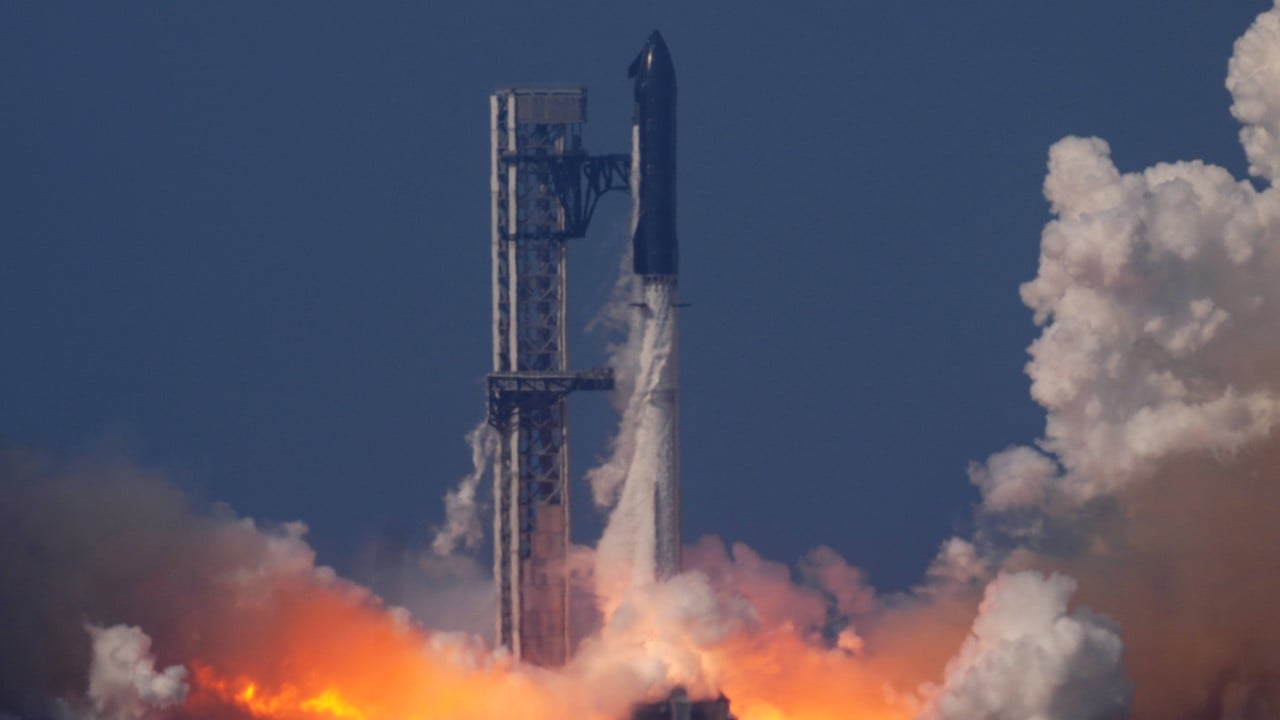
The traditional aerospace procurement model treats failure as an unacceptable financial catastrophe, resulting in decade-long development cycles and stagnant technology. SpaceX’s deployment of its largest and most heavily modified Starship configuration upends this paradigm. By treating hardware as a disposable data-gathering instrument rather than a sacred asset, the company has institutionalized an iterative loop that optimizes orbital launch capability faster than any legacy competitor. To truly understand the significance of the latest Starship test flight, one must look past the spectacular visuals of rocket launches and analyze the underlying mechanics: mass efficiency engineering, thermal protection system (TPS) durability, and the raw economics of rapid hardware iteration.
The ultimate objective of the Starship program is not merely to build a large rocket; it is to drive the marginal cost of delivering payload to Low Earth Orbit (LEO) toward the theoretical minimum of fuel and oxidizer costs. Achieving this requires mastering three tightly coupled engineering pillars.
The Core Triad of Starship Scalability
To evaluate whether a Starship test flight is a success or a failure, the vehicle's performance must be mapped against three fundamental variables.
1. Mass Fraction Optimization
A rocket's utility is governed by the Tsiolkovsky rocket equation. Because the mass of the propellant accounts for the vast majority of the vehicle's initial weight, any reduction in the dry mass of the ship yields a non-linear increase in payload capacity. The recent modifications to the Starship upper stage—specifically stripping internal unneeded structures, thinning the stainless-steel hull where loads permit, and redesigning the ring segments—are direct attempts to drive down the dry mass.
2. Thermal Protection Reliability
The transition from an orbital velocity of roughly 28,000 kilometers per hour to a stationary splashdown requires dissipating an immense amount of kinetic energy as thermal energy. Starship relies on thousands of hexagonal ceramic tiles to shield its stainless-steel skin from plasma temperatures exceeding 1,400 degrees Celsius. The critical point of vulnerability lies not in the center of these tiles, but at the junctions, expansion gaps, and attachments points. The latest iteration tests a dual-layer strategy: tougher, more resilient tile chemistry coupled with secondary ablative backings at high-stress hinge areas near the flaps.
3. Propellant Management and Ullage Control
Relighting a Raptor engine in the vacuum of space requires settled liquid propellants. During zero-gravity coast phases, liquid methane and liquid oxygen float freely within the tanks, creating gas pockets. If gas enters the turbopumps during an attempted relight, the engines suffer catastrophic cavitation and explode. SpaceX uses small hot-gas thrusters to induce a slight acceleration, pushing the liquid to the bottom of the tanks (settling the ullage) before main engine ignition.
The Micro-Economics of Rapid Iteration vs. Pure Simulation
Critics often point to the destruction of early Starship prototypes as evidence of systemic engineering flaws. This view misinterprets the fundamental economics of modern hardware development.
Traditional Aerospace Model:
[Extensive Simulation] -> [Component Testing] -> [Single High-Cost Flight] -> [Failure = Program Ruin]

SpaceX Iterative Model:
[Rapid Fabrication] -> [Full-Scale Flight] -> [Telemetry Destructive Feedback] -> [Immediate Design Fix]
In a traditional paradigm, years are spent in computational fluid dynamics (CFD) simulations and finite element analysis (FEA) trying to predict every edge-case failure mode. This approach has a steep diminishing return; simulations are only as good as their boundary assumptions.
SpaceX operates on a hardware-rich strategy. The marginal cost of manufacturing a single Starship hull at the Starbase facility is remarkably low compared to a legacy vehicle, owing to the use of commercial-grade 304L and custom stainless-steel alloys rather than exotic, expensive materials like carbon fiber or aluminum-lithium. By flying physical prototypes to the point of failure, SpaceX gathers real-world telemetry on unexpected resonant vibrations, acoustic environments, and plasma boundaries that no supercomputer can model with absolute fidelity.
The financial loss of a prototype is offset by the savings in development time. If a hardware failure reveals a structural weakness in the forward flap hinge assembly during reentry, the engineering team can implement a physical design change on the production line for the next hull within weeks, rather than spending months debating a theoretical model in a conference room.
Deconstructing the Raptor 3 Propulsion Architecture
The engine configuration of the Super Heavy booster (33 Raptor engines) and the Starship upper stage (6 Raptor engines) represents the highest concentration of mixing energy ever attempted in aerospace history. The transition toward the latest Raptor variants marks a profound shift from a complex mechanical assembly to a highly integrated, minimalist system.
The primary engineering bottleneck in previous test flights was the complexity of the external plumbing. Early Raptor variants were covered in a web of sensoring lines, hydraulic actuators, and exposed wiring harnesses. These components were highly vulnerable to the extreme acoustic vibrations and thermal back-flow generated by neighboring engines.
Raptor 1/2 Architecture: Exposed external lines -> Vulnerable to vibration/heat -> High failure rate
Raptor 3 Architecture: Internalized fluid channels -> Structurally shielded -> High reliability
The refined propulsion strategy eliminates these external failure points by routing fluid channels directly through the internal walls of the engine components via advanced 3D printing and casting techniques. This reduces the dry mass of each engine while drastically lowering the thermal shielding requirements inside the booster's engine bay. By removing external lines, the engines are inherently more resilient to the concussive pressure waves experienced during the initial seconds of liftoff, where acoustic energy reflects off the launch pad directly into the base of the vehicle.
Structural Vulnerabilities and Boundary Layer Dynamics
The most volatile phase of the Starship flight profile is the hypersonic atmospheric reentry. As the vehicle hits the upper atmosphere at a high angle of attack, a detached bow shock wave forms in front of the belly. The distance between this shock wave and the ship's skin determines the thermal load.
A critical point of failure occurs when the boundary layer transitions from laminar (smooth) to turbulent flow. Turbulent flow increases the local heat transfer coefficient by a factor of three or more. This transition is triggered by minor surface imperfections, such as:
- Misaligned thermal protection tiles.
- Gaps greater than a few millimeters between tile clusters.
- Protruding sensors or weld lines on the steel hull.
If a single tile unseats during the high-vibration launch phase, the exposed stainless steel underneath can survive for a short duration due to its relatively high melting point compared to aluminum. However, the resulting cavity disrupts the local airflow, creating a localized vortex that draws the ultra-hot plasma boundary layer down to the ship’s skin. This initiates a chain reaction where adjacent tiles lose structural support and peel away, leading to a localized hull breach. The latest vehicle design focuses heavily on tightening the tolerances of these tile placements, reducing the mechanical play allowed during thermal expansion and contraction cycles.
Operational Bottlenecks to True Reusability
Demonstrating that a Starship can survive reentry and execute a controlled landing flip is only the first step toward operational commercial viability. The ultimate constraint on the system is the refurbishment velocity.
True reusability means a vehicle can land, undergo automated inspections, be stacked back onto its booster, refueled, and launched again within hours. Currently, several operational bottlenecks prevent this reality.
Pad Infrastructure Damage Avoidance
The immense energy of 33 Raptor engines produces a kinetic hammer effect on the orbital launch mount. The water-deluge steel plate system must absorb millions of pounds of thrust energy alongside sound waves capable of tearing concrete apart. If the pad suffers even minor erosion during liftoff, the launch cadence is bottlenecked by civil engineering repairs rather than rocket readiness.
Tile Inspection and Replacement Throughput
Manually inspecting tens of thousands of individual thermal tiles after each flight is logistically impossible for a rapid-turnaround system. SpaceX must transition to an automated, drone- or camera-based machine vision system capable of scanning the entire skin of the ship in minutes, identifying microscopic cracks or structural shifts within the tile matrix instantly.
Cryogenic Propellant Loading Speeds
Starship requires thousands of tons of sub-cooled liquid methane and liquid oxygen. Loading these propellants at high speed without causing dangerous thermal shock to the vehicle’s internal plumbing requires massive, highly insulated storage farms and high-flow pumping architectures. The boiling off of propellants during extended hold windows introduces structural stress and economic waste.
The Strategic Path Forward
To achieve the payload capacities required for deep-space logistics and constellation deployment, the Starship program must execute a sequence of increasingly complex technical milestones. The immediate priority must be the flawless execution of an orbital propellant transfer.
Before Starship can journey to the Moon or Mars, it must demonstrate the ability to dock two vehicles in LEO and transfer hundreds of tons of cryogenic fluids in a microgravity environment. This process depends on solving surface-tension and thermodynamic challenges inherent to handling boiling liquids in space.
The second priority is the absolute mastery of the mechanical catch mechanism at the launch site. Eliminating heavy landing legs from both the Super Heavy booster and the Starship upper stage saves precious dry mass, shifting the structural burden of landing entirely to the launch tower's mechanical arms. This requires a level of guidance precision and real-time aerodynamic control using grid fins that leaves zero margin for error.
The data gathered from each flight indicates that while the vehicle's structural and propulsive systems are maturing rapidly, the thermal protection system remains the primary risk factor limiting rapid operational scaling. Future iterations must prove that the ceramic tile matrix can endure the thermal stresses of entry multiple times without requiring intensive human maintenance between flights. Until that metric is stabilized, the system remains an expendable rocket built at an unprecedented scale, rather than the fully reusable airliner for space it is designed to become.