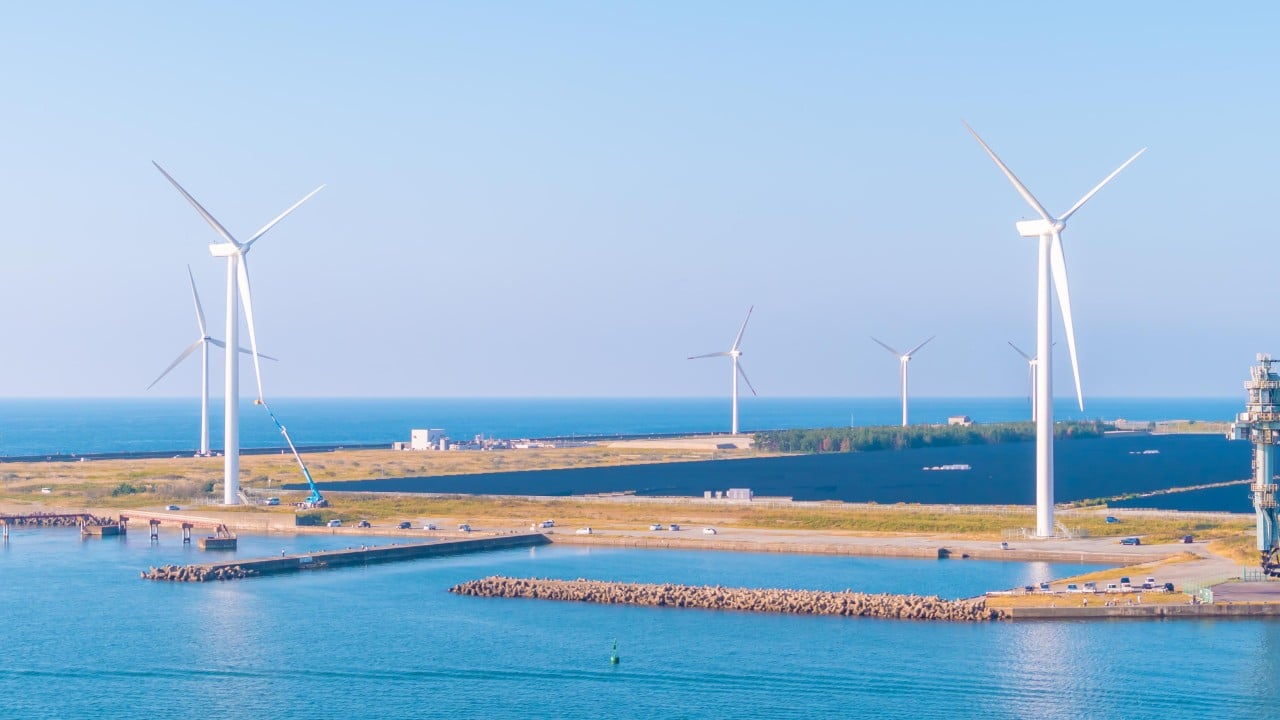
The headlines are predictable. Japan is planning the world’s largest offshore wind farm. A 2035 deadline. Carbon neutrality targets. It sounds like progress. It looks like a map of the future. It is actually a map of a massive, expensive misunderstanding of geography.
The common consensus is that Japan, an island nation with the world’s sixth-largest Exclusive Economic Zone (EEZ), is naturally suited for offshore wind. If the UK can do it in the North Sea, why can’t Japan do it in the Pacific? This comparison is lazy. It ignores the fundamental difference between a shallow, stable seabed and a literal tectonic collision zone.
The Continental Shelf Delusion
Most successful offshore wind projects—think the Hornsea projects in the UK or the Dutch coast—rely on fixed-bottom foundations. You drive a steel pile into the seabed. It’s stable. It’s relatively cheap. This is possible because the North Sea is essentially a submerged parking lot. The average depth is 90 meters.
Japan doesn't have a parking lot. It has a cliff.
The Japanese coastline drops off into the abyss almost immediately. Over 80% of Japan’s offshore wind potential is in deep water where fixed foundations are physically impossible. To hit these "world’s largest" targets, Japan must rely on floating offshore wind.
Floating wind is a different beast entirely. You aren't just building a turbine; you are building a massive, semi-submersible ship that must remain stable while a 300-ton rotor spins 150 meters in the air. The engineering complexity doesn't just double; it scales exponentially. I’ve seen energy giants burn through $50 million on pilot programs only to realize that the maintenance costs of a floating fleet in a salt-spray environment are high enough to bankrupt a small nation.
The Typhoon Tax No One Calculates
The competitor articles love to mention "renewable potential." They rarely mention the Class T turbine requirement.
Most of the world’s wind turbines are designed for IEC Class I, II, or III conditions. Japan lives in a Class T (Typhoon) reality. When a Category 4 or 5 typhoon rolls through the Pacific, the wind speeds exceed the survival limits of standard European hardware.
If you want to build in Japan, you have to over-engineer every single bolt, blade, and bearing. This adds a "Typhoon Tax" that inflates capital expenditure by 30-40% compared to Atlantic projects. The industry acts like this is a hurdle to be cleared. It isn't a hurdle; it’s a permanent, structural disadvantage. Japan is trying to build the most expensive energy source on the planet in the most hostile environment available, all while competing with the dropping costs of solar and battery storage on the mainland.
The Grid Is Broken (And No One Wants to Fix It)
Even if Japan manages to float a forest of turbines in the ocean, the power has nowhere to go.
Japan’s power grid is a relic of the post-war era. It is literally split in half. Eastern Japan (Tokyo) runs on 50Hz. Western Japan (Osaka) runs on 60Hz. This was a mistake made in the late 1800s that the country has never had the political will to fix. The frequency converter stations that link these two halves are massive bottlenecks.
The best wind is in Hokkaido and northern Tohoku. The demand is in Tokyo and Nagoya. Japan lacks the high-voltage direct current (HVDC) subsea cables needed to move that power south. Building that transmission infrastructure will cost as much as the wind farms themselves.
We are looking at a project where:
- The hardware is 40% more expensive because of typhoons.
- The foundations are floating experiments rather than proven tech.
- The grid cannot physically accept the power without a $100 billion overhaul.
The LCOE Lie
Levelized Cost of Energy (LCOE) is the metric everyone uses to prove wind is "cheap." But LCOE is a deceptive metric for offshore wind in Japan. It doesn't account for the "System LCOE"—the cost of the backup thermal plants that must stay idling for when the wind stops, or the massive battery arrays needed to stabilize a grid that already has narrow frequency tolerances.
When you factor in the integration costs, Japanese offshore wind isn't a transition strategy; it’s a luxury good.
Imagine a scenario where Japan spends 15 years and $200 billion to build this massive wind farm, only to find that the price per kilowatt-hour is triple the global average. This isn't just a possibility; it’s the current trajectory.
The Actionable Alternative: Geothermal or Bust
If Japan wanted energy independence, it would look down, not out.
Japan sits on the third-largest geothermal reserves in the world. Unlike wind, geothermal is baseload. It doesn't care if there’s a typhoon. It doesn't care if the sun is shining. It uses the same turbine technology that Japanese companies like Toshiba and Mitsubishi already lead the world in.
Why isn't it happening? Because the best geothermal sites are inside National Parks or under "Onsen" (hot spring) resorts. The political cost of telling a local hot spring owner that you need to drill nearby is higher than the political cost of wasting billions on a wind farm that might never work.
The "world's largest wind farm" is a PR win for a government that wants to look green without fighting the domestic battles required to actually be green.
Stop looking at the horizon for salvation. The ocean is not a friend to Japanese infrastructure. It is a corrosive, violent, deep-water graveyard for capital. Japan’s 2035 wind targets aren't a roadmap; they are a hallucination.
If you are an investor, stop chasing the offshore wind hype in the Pacific. The physics don't care about your ESG targets. The salt will eat your turbines, the typhoons will snap your blades, and the depth of the Pacific will swallow your margins.
Turn the drills inland. Dig deep. The heat is already there. Anything else is just spinning wheels in a storm.