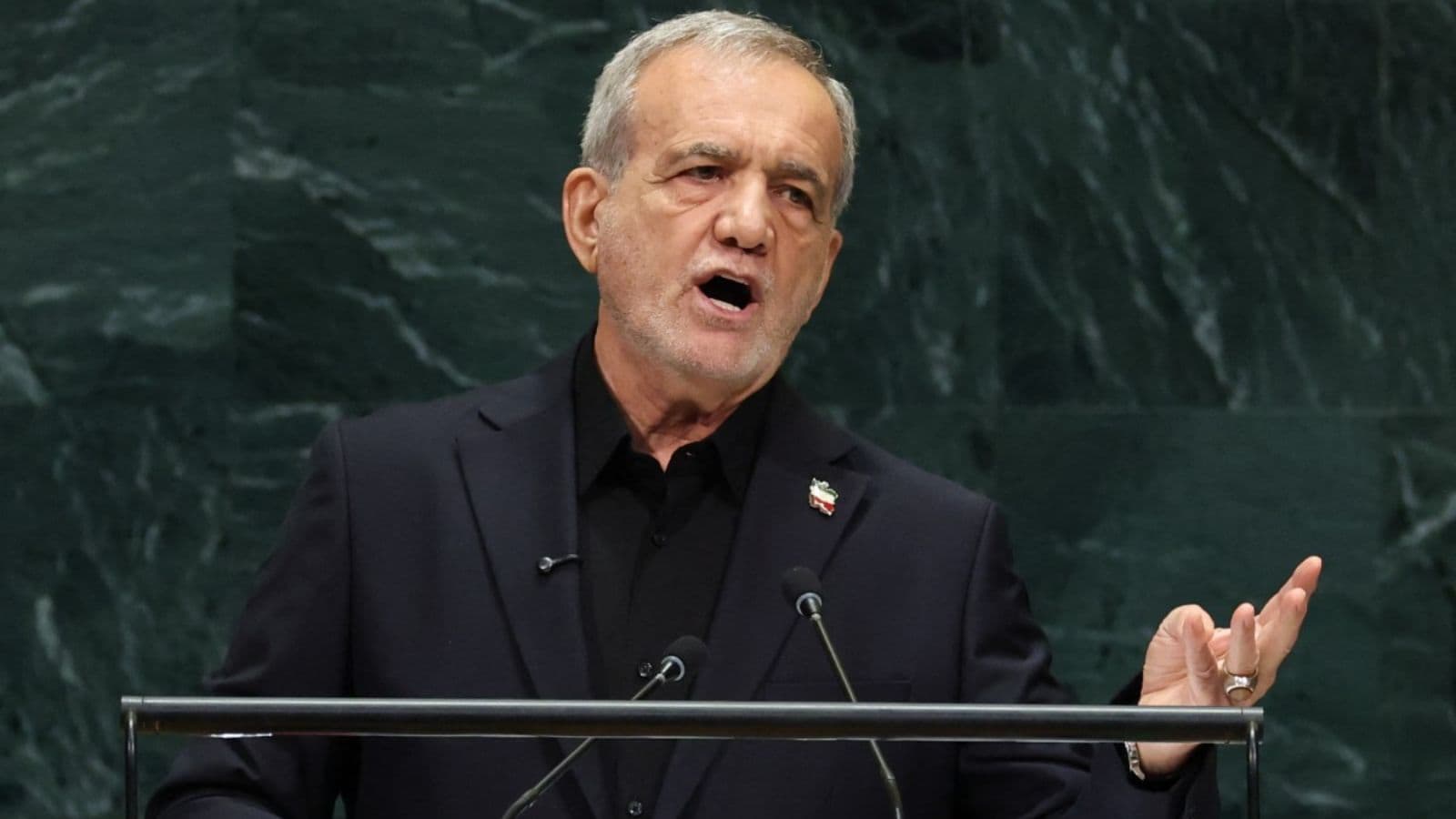
You can feel the diplomatic floor shifting under your feet when a world leader steps up to the United Nations podium and throws Washington's favorite geopolitical weapon right back in its face. That is exactly what happened when Iranian President Masoud Pezeshkian stood before the UN General Assembly.
Instead of playing the usual defensive game, he brought receipts. He held up images of children killed in bombings, pointed straight at American and Israeli-supplied weaponry, and stated flat out that Iranians have been the primary victims of state-sponsored terrorism.
If you think this was just empty rhetoric for domestic television back in Tehran, look closer. The timing tells a completely different story.
The High Stakes Clash in New York
This fiery address didn't happen in a vacuum. Just a day prior, the United States issued direct threats to completely annihilate the Islamic Republic. Tensions are higher than they have been in decades.
When Pezeshkian took the microphone, the US delegation actually walked out. They couldn't stomach sitting there while the Iranian leader flipped the script on international security norms.
He didn't shy away from the hard contradictions either. He pointed out the obvious hypocrisy of a global system where inspectors swarm Iranian facilities while nuclear stockpiles sit comfortably in Israel. He argued that Iran hasn't launched an offensive war against another country in over two hundred years, framing every recent missile launch and regional proxy maneuver purely as an act of survival against relentless economic strangulation and military intimidation.
Why This Rhetorical Pivot Matters Now
For years, Western media has painted Iranian leadership through a very narrow, monolithic lens. But Pezeshkian walks a tightrope. He has to sound tough enough to satisfy the hardline Islamic Revolutionary Guard Corps generals back home, yet pragmatic enough to signal that Tehran isn't entirely closed to diplomatic off-ramps.
By labeling US sanctions and military backing as terrorism, he shifts the entire narrative. He is speaking directly to the Global South. Many nations across Asia, Africa, and Latin America quietly resonate with anti-hegemonic messaging, even if they don't endorse Iran's domestic policies.
When he declared that his people would never bow their heads or bend the knee to economic bullying, he was tapping into a deep well of Persian national pride. Sanctions haven't crushed the regime's resolve; they've militarized its mindset.
The Nuclear Double Standard and Regional Realities
You cannot understand Tehran's current posture without looking at the double standard on non-proliferation. Pezeshkian drove this point home by contrasting international oversight.
Iran subjects itself to continuous nuclear inspections under the watchful eye of the IAEA, while neighbors and regional adversaries maintain ambiguous nuclear arsenals outside the treaty framework entirely. It's an effective talking point because it exposes real cracks in the Western-led rules-based international order.
At the same time, regional neighbors are watching nervously. Tehran has made it clear that if surrounding airspace or territory gets weaponized by hostile powers to launch operations against Iran, the response won't just be diplomatic. The entire geopolitical architecture of the Middle East is caught in a hair-trigger balance where one miscalculated drone strike could turn a cold war hot in seconds.
Where Diplomacy Goes From Here
Nobody should expect a sudden breakthrough between Washington and Tehran. The rhetoric is too hardened, the historical grievances run too deep, and domestic political pressures in both capitals make compromise look like political suicide.
Yet, windows for back-channel talks occasionally open precisely when the noise gets loudest. Pezeshkian's UN address wasn't just an angry outburst. It was a calculated positioning move. It established a baseline for whatever future negotiations might look like. Iran wants recognition, an end to suffocating financial blockades, and a seat at the table as an equal power.
Until Washington realizes that maximum pressure yields maximum defiance instead of surrender, we are simply stuck watching the same cycle play out on a more dangerous stage. The finger-pointing will continue, but the cost of a mistake keeps climbing.


