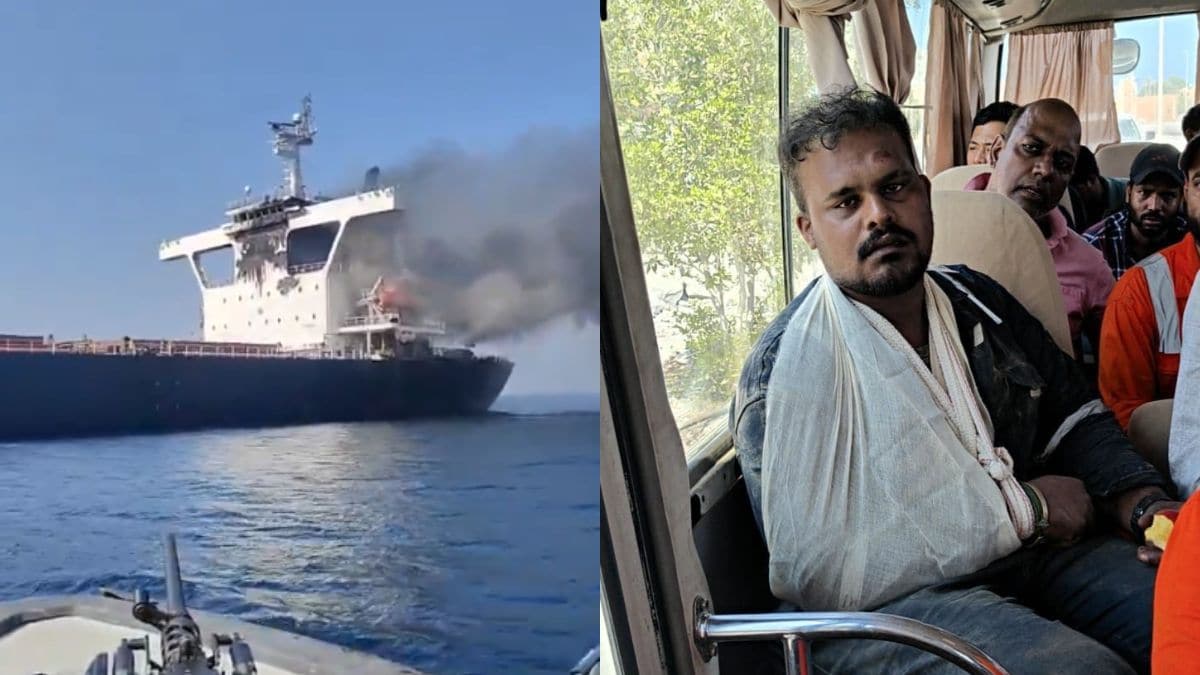
Everyone in the shipping insurance market is currently losing their minds over the wrong variable. When news broke that an Indian seafarer was killed and nineteen others were pulled from the water after torpedoes struck a commercial vessel off the coast of Oman, the immediate knee-jerk reaction from maritime analysts was predictable. They pointed fingers at regional escalation, warned of choke points in the Bab el-Mandeb strait, and started pricing risk premiums into every container moving from Singapore to Rotterdam.
They are arguing about the weapon while ignoring the rot in the foundation of modern commercial crewing. Don't miss our recent article on this related article.
I have spent the last fifteen years watching the global supply chain treat human lives as disposable variables in an optimization spreadsheet. The Lazy Consensus across maritime journals right now is that this tragedy is simply a byproduct of geopolitical crossfire. That framing lets the actual culprits off the hook. The missiles and torpedoes are flashy headlines, but the structural failure happened long before the warheads left the launcher. It happened in crewing agencies, in flag-state loopholes, and in a board-level addiction to cheap labor that leaves under-trained, unprotected crews as the primary shock absorbers of maritime conflict.
Let us strip away the defensive PR statements coming out of ship management offices and look at the brutal economic architecture of the modern merchant fleet. To read more about the history of this, The New York Times provides an excellent summary.
The Cheap Labor Shell Game No One Wants to Discuss
The global maritime trade operates on a flag of convenience model that would make a 19th-century robber baron blush. When a vessel flies the flag of a landlocked nation or a micro-state tax haven, safety regulations become negotiable suggestions rather than hard boundaries. More importantly, it allows shipowners to arbitrage labor markets down to the absolute floor.
For decades, countries like India, the Philippines, and Ukraine have provided the engine room and deck muscle for the world economy. But here is the dirty secret that maritime executives whisper over scotch at shipping conventions: the race to the bottom on crew wages directly correlates with a systemic disinvestment in defensive architecture and threat mitigation.
When you cut crewing budgets to skeleton crews—operating ultra-large container ships or bulk carriers with fewer than twenty people on board—you eliminate redundancy. Every single person on that vessel is pulling triple duty. When an asymmetric threat emerges in open or semi-enclosed waters, there is no damage control team, no dedicated security watch separate from navigation, and no margin for error.
Blaming the strike solely on hostile actors in the Middle East ignores the corporate architects who decided that saving fifty grand a month on crew size and hardening measures was worth the risk. The attack off Oman was an operational inevitability in a system designed to maximize velocity and minimize cost at the human expense.
The Myth of the Protected Commercial Lane
For years, the commercial shipping lobby sold a comforting fairy tale: international maritime law and naval patrols would keep the global commons safe. It was always a paper shield.
Navies cannot escort every bulk carrier, chemical tanker, and container ship across millions of square miles of ocean. The Western-led coalitions patrolling the Red Sea and the Gulf of Oman are treating symptoms while the disease spreads unchecked. Insurers reacted by spiking premiums, which shipowners simply passed down to consumers, turning geopolitical friction into an invisible inflation tax on every imported good on earth.
Nobody wants to admit the commercial reality. If a route becomes a war zone, you do not keep sending civilian crews through it with a shrug and a prayer. You reroute, or you stop sailing. But the global supply chain suffers from an institutional lack of imagination. Executives look at the Cape of Good Hope detour around Africa not as a permanent strategic shift, but as an annoying traffic jam they hope will clear up by next quarter.
This is where the standard analysis completely collapses. The threat environment has structurally shifted. Asymmetric actors with low-cost guidance systems and naval denial capabilities have fundamentally broken the 20th-century model of freedom of navigation.
What Actually Needs to Break
If we want to stop reading obituaries of Indian, Filipino, and Eastern European seafarers who died because they were caught in the crossfire of trade routes they do not own and profits they never see, we need a complete teardown of maritime economics.
First, flag states must be held legally and financially liable for the safety of the crews on the ships flying their colors. If a country wants to rake in registration fees, they should be on the hook for multi-million-dollar penalties when their registered vessels sail into predictable combat zones without adequate hardening or intelligence support.
Second, minimum safe manning documents need a total overhaul. The International Maritime Organization treats crew numbers as a function of automation rather than security and survival. That is a fatal delusion. Automation does not fight fires, patch hull breaches, or manage emergency evacuations under fire.
Third, shipowners need to internalize the true cost of risk. Right now, externalized human cost makes war zone transits mathematically viable for corporate ledgers. When a seafarer dies, the insurance pays out a standardized, often criminally low compensation package, the ship gets patched up in dry dock, and the next charter begins on Monday.
Change that equation. Make the financial penalty for losing a crew member in a preventable war zone catastrophic enough to make boardrooms rethink their risk models entirely.
Until the cost of human life on the high seas exceeds the cost of delay, nothing will change. The next missile is already on the rail.