Twenty-five years after the collapse of the World Trade Center towers, the operational reality of Engine 10 and Ladder 10, universally known as Ten House, presents a rare organizational study in dual-purpose mandates. Located directly adjacent to the memorial footprint in lower Manhattan, this fire station functions simultaneously as an active emergency response unit and a permanent institutional monument. The structural friction between these two roles defines the modern history of the company. When an organization absorbs an extraordinary historical shock while maintaining mandatory public-facing duties, standard operating procedures break down. The survival of organizational knowledge relies entirely on personnel continuity, a variable that is reaching its absolute expiration point.
The structural burden of Ten House stems from an asymmetric allocation of attention. Standard municipal fire companies optimize their operational parameters around response times, equipment maintenance, and shift rotations. Ten House carries those exact operational requirements while adding an unbudgeted public relations and commemorative burden. Thousands of visitors arrive daily to view the bronze relief listing the six members of the station killed on September 11, 2001, alongside the 337 other firefighters lost across the department that day. The personnel assigned to the station must pivot continuously between the mechanics of fire suppression and the emotional management of global tourism. This dual mandate creates a unique strain on institutional capacity, requiring incoming firefighters to master public diplomacy alongside hydraulic calculations and search-and-rescue protocols.
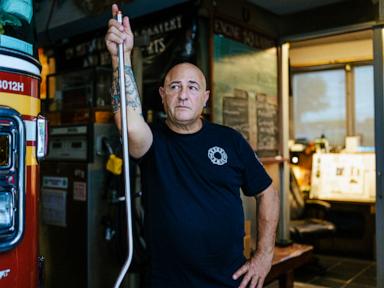
Institutional memory within high-risk operational environments degrades predictably through generational turnover. Organizations typically rely on explicit documentation to preserve operational history, but tactical intuition, cultural norms, and unwritten risk tolerances pass almost exclusively through direct mentorship. At Ten House, that chain of transmission is anchored by a single individual. Firefighter Sal Argano, assigned to the station in 2001, represents the final link to the operational baseline of that day. Every other member of the original roster has retired, transferred, or perished. Argano's presence on Engine 10 provides an unbroken line of experiential data for younger personnel who entered the fire academy years after the attacks.
The absence of firsthand experience alters the internal dynamics of tactical units. When new cohorts enter a station with no living memory of the foundational trauma, the organizational culture shifts from experiential inheritance to historical abstraction. Younger firefighters arrive with academic knowledge of the event rather than visceral conditioning. This creates an operational vulnerability. The institutional weight of Ten House is not sustained by physical artifacts or bronze plaques, but by the informal transmission of tactical caution and psychological resilience from veterans to recruits. As the cohort with direct operational memory exits the workforce, the organization faces a complete structural transition into pure historiography.
The cost function of maintaining a memorial-station hybrid involves significant psychological overhead for the personnel. First responders are trained for acute crisis intervention, risk mitigation, and physical extraction. They are not traditionally selected for docent duties, crowd control, or continuous interpersonal engagement with grieving or casually curious tourists. The daily friction of managing public access through open apparatus bays introduces constant interruptions to station life. The architectural design of a firehouse assumes a controlled, secure environment where crews can decompress between runs. Ten House operates inside a fishbowl, where privacy is non-existent and the external world is permanently present at the threshold.
Managing this public interface requires explicit behavioral adaptation. Senior personnel must actively instruct junior firefighters in the art of emotional compartmentalization. A crew might transition in a matter of minutes from managing a hazardous materials run or a structural fire to posing for photographs with international visitors who view the station as sacred ground. This requires an uncommon level of emotional regulation. Failure to maintain this balance results in either hostile isolation from the public or a dilution of operational focus. The station leadership must enforce a strict cultural standard: the primary duty remains emergency response, but the secondary duty of public stewardship is mandatory for survival in this specific environment.
The economic and urban redevelopment of lower Manhattan over the past quarter-century has completely altered the tactical environment surrounding Ten House. In the immediate aftermath of 2001, the station operated on the edge of a vast, smoking industrial excavation. Today, it sits embedded within a hyper-dense, high-value commercial and memorial district. The traffic patterns, building stock, population density, and target hazards have all evolved. Engine 10 and Ladder 10 must navigate modern vehicular congestion vastly different from the post-disaster landscape of the early 2000s. The physical transformation of the surrounding blocks highlights the permanence of the station amid perpetual urban iteration.
The impending departure of the final 2001-era veteran forces a strategic reckoning regarding how high-consequence organizations preserve operational identity after the living witnesses are gone. When institutional knowledge transitions entirely into archival records, the organization loses its informal error-correction mechanisms. Books and documentaries capture the macro events, but they fail to record the micro-adjustments, the subtle cultural adjustments, and the unwritten behavioral rules that keep a unit functional under extreme stress.
To maintain institutional integrity past the threshold of living memory, high-performance units must formalize the transmission of informal culture. This requires embedding historical case studies directly into operational training, establishing structured mentorship pipelines that pair incoming recruits with veteran personnel before retirement, and designing physical spaces within stations that curate history without turning the crew into permanent museum staff. The objective is to prevent the dilution of operational standards by ensuring that history functions as an active tactical asset rather than passive background decoration.
The operational future of Ten House will test whether an institution can successfully institutionalize a culture originally sustained by human presence alone. As the last veteran prepares to clear his locker, the burden of continuity shifts to a generation that knows the foundational tragedy only as history. The durability of the station will depend on its ability to convert living memory into systematic institutional doctrine before the final direct witness steps out the bay doors for the last time.