Hydrological recovery in semi-arid urban basins is routinely misdiagnosed by surface-level metrics. When atmospheric rivers deposit historic precipitation volumes over Southern California, municipal reservoirs and shallow unconfined aquifers absorb the immediate shock, registering rapid stage recoveries. Public reporting frequently frames these rapid capacity jumps as system-wide stabilization. This assessment depends entirely on an artificial boundary separating surface water storage from deep hydrogeological formations.
The structural mechanics of groundwater replenishment in Los Angeles reveal a stark divergence between surface storage systems and deep confined aquifers. While engineered spreading grounds and natural stream beds effectively capture runoff for shallow storage, deep regional aquifers respond to entirely different recharge velocities and pressure dynamics. Precipitation events that push surface reservoirs to capacity translate to only fractional recovery in deep storage strata due to thick aquitards, urbanization sealing, and delayed pressure propagation. Evaluating regional water security requires breaking down the system into its distinct mechanical layers, identifying the choke points that prevent surface abundance from reaching deep reserves, and modeling the cost function of chronic overdraft.
The Dual-System Architecture of Urban Hydrogeology
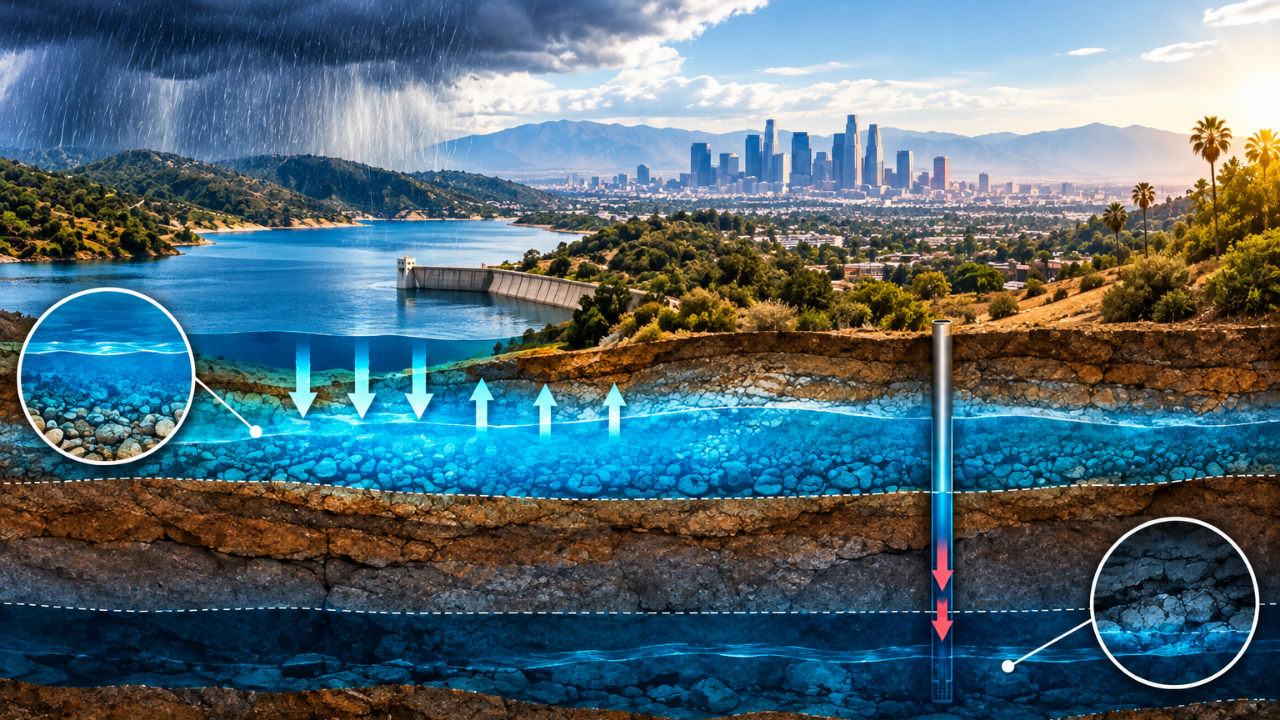
Subsurface water storage in the Los Angeles basin does not operate as a single homogeneous sponge. The basin consists of a complex stacked sequence of aquifers and aquitards, separating water-bearing sediments with layers of low-permeability clays and silts. This architecture creates a fundamental dichotomy between shallow unconfined systems and deep confined systems.
Shallow aquifers sit directly beneath the surface or below shallow stream channels. They respond rapidly to precipitation and engineered spreading operations. When water management agencies divert stormwater into spreading basins like the Rio Hondo or San Gabriel spreading grounds, percolation happens within days or weeks. The hydraulic connection between the surface and these upper zones is direct and unhindered. This explains why shallow water tables rebound visibly within months of an intense wet season.
Deep aquifers, conversely, are buried beneath hundreds of feet of impermeable or semi-permeable confining layers. These deeper formations—such as the Main San Gabriel Basin deep zones or the central basin pressure aquifers—do not drink from immediate local runoff. Recharge depends on slow, multi-year vertical leakage through aquitards or lateral underflow from distant mountain fronts. The travel time for a single drop of water from a surface storm to migrate through these dense confining layers is measured not in days, but in decades.
Urbanization compounds this physical barrier by altering surface permeability. Impervious surfaces—concrete, asphalt, and structural foundations—cover a massive percentage of the Los Angeles basin. This surface sealing prevents diffuse natural recharge across the urban plain. Precipitation is immediately captured by storm drain networks and channeled directly into concrete-lined flood control channels like the Los Angeles River, routing potential recharge water straight to the Pacific Ocean before it can engage with the soil profile.
Engineered capture mitigates this loss partially, but municipal spreading grounds can only process a fraction of total runoff during extreme atmospheric river events. The physical capacity of spreading basins is constrained by land availability, silt accumulation, and the infiltration rates of underlying soils. Once spreading grounds hit maximum intake velocity, excess water must be bypassed, rendering surface management systems incapable of forcing high-volume recharge into deep strata during short storm windows.
The Mechanics of Asymmetric Recovery
The observation that deep groundwater recovers at a fraction of the rate seen in surface reservoirs and shallow aquifers is rooted in fluid dynamics and pressure head mechanics. When an unconfined aquifer is depleted, the water table drops, creating physical empty space in the sediment matrix. Refilling this space is primarily a function of gravity drainage and local infiltration volume.
Deep confined aquifers operate under pressure. Water in these formations is under compressive stress from the weight of overlying confining layers. When extractions exceed natural or artificial recharge over decades, the pressure head drops significantly. Pumping water out of a confined aquifer is efficient; forcing water back in against that pressure gradient, or through dense clay confining layers, is remarkably inefficient.
The low recovery rate of deep storage—historically tracking around twenty-five percent of surface-level or shallow gains during major recharge cycles—stems from three distinct physical constraints:
- Vertical Hydraulic Resistance: Confining layers possess extremely low vertical hydraulic conductivity. Water moves through clay at microscopic velocities, creating a massive bottleneck between surface abundance and deep storage capacity.
- Storage Coefficient Disparities: Unconfined aquifers have high specific yield, meaning they store and release large volumes of water per unit change in water table elevation. Confined aquifers rely on the elastic storage of the aquifer skeleton and water compressibility, yielding vastly smaller storage changes for equivalent pressure adjustments.
- Historical Deficit Momentum: Deep aquifers have accumulated structural deficits over a century of continuous industrial and municipal over-pumping. A single high-precipitation year introduces a temporary volume bump that is instantly dwarfed by the cumulative multi-year withdrawal debt stored in the deeper regional geometry.
These constraints mean that surface reservoir spillovers and shallow water table spikes are poor proxies for true basin-wide recovery. Treating a shallow aquifer rebound as proof of system resilience creates a false sense of security, masking the structural depletion happening thousands of feet below.
Economic and Structural Externalities of Chronic Overdraft
Failing to achieve deep aquifer recovery while celebrating surface storage milestones introduces severe long-term externalities. Water stored in surface reservoirs is subject to high evaporation rates in the Southern California climate, losing millions of acre-feet annually to the atmosphere. Deep groundwater, by contrast, is naturally protected from evaporation, making it the ultimate strategic reserve for multi-year drought mitigation. Leaving deep aquifers under-replenished strips the regional infrastructure of its most resilient buffer.
Furthermore, chronic overdraft of deep confined aquifers triggers irreversible physical compaction of the clay layers. When water pressure within a confined aquifer drops past historical lows, the water acts less as a structural support mechanism, and the clay layers compress under the weight of the earth above. This compaction permanently destroys pore space. Once an aquifer compacts, its maximum storage capacity is permanently reduced; even if water were somehow forced back into the system, the underground reservoir is physically smaller than it was a century ago.
Subsidence is a direct secondary consequence of this compaction. As land surface elevations drop, municipal infrastructure, sewer lines, foundations, and coastal flood defenses suffer structural stress. In coastal basins of Southern California, persistent overdraft of deep aquifers also reverses the natural seaward hydraulic gradient, drawing saline ocean water inland and contaminating freshwater well fields with saltwater intrusion.
The economic cost function of this imbalance is heavily skewed toward short-term extraction savings and long-term capital remediation costs. Pumping water from deep reserves is currently subsidized by the inherited capacity of the basin, but as levels drop, energy costs for extraction escalate linearly. Deeper pumping requires higher-horsepower pumps, increased electrical demand, and advanced water treatment to handle mineral concentrations or localized contamination pulled in by shifting hydrological gradients.
Strategic Operational Shifts for Basin Equilibrium
Bridging the recovery gap between surface inflows and deep storage requires moving away from passive reliance on natural infiltration. Because natural vertical recharge through thick confining layers is too slow to match modern urban extraction rates, water agencies must implement active, engineered pressure-injection strategies.
Direct injection wells bypass the low-permeability confining layers entirely. By pumping highly treated recycled water or captured storm runoff directly into deep aquifer zones under pressure, operators can artificially force water into formations that would otherwise take centuries to recharge naturally. This requires capital-intensive infrastructure upgrades—advanced purification facilities that meet stringent drinking water standards prior to injection, and dedicated networks of deep injection wells strategically placed to rebuild pressure heads where overdraft is most severe.
Conjunctive use management must also evolve past simple accounting. Surface reservoirs, shallow spreading grounds, and deep injection networks need to be operated as a unified, automated hydraulic grid. During wet years, surface water must be aggressively prioritized for direct injection into deep storage rather than simply filling surface lakes where evaporation claims the asset. This shifts the storage profile from high-loss surface storage to zero-loss subterranean containment.
Regulatory frameworks must tie extraction quotas directly to deep piezometric head measurements rather than basin-wide aggregate storage estimates that lump shallow and deep water together. If shallow water tables spike due to a wet winter, extraction rights should not automatically expand if deep confined pressure remains in a structural deficit. Maintaining operational transparency regarding the twenty-five percent deep recovery ceiling forces municipal planners to account for the physical limits of subterranean hydrogeology before structural compaction causes permanent asset destruction.
Transitioning regional water management from surface-centric optimism to deep-basin engineering demands aggressive capital deployment into direct injection infrastructure and strict enforcement of pressure-based extraction limits. Surface reservoirs will continue to handle the immediate volatility of atmospheric rivers, but regional water security remains structurally insolvent until deep aquifer recharge rates match extraction velocities.