On September 26, 1991, eight scientists, researchers, and idealists locked themselves inside a giant, airtight glass greenhouse in Oracle, Arizona. They wore matching red jumpsuits that looked straight out of a retro sci-fi film. The plan was simple on paper, yet staggering in scope. They intended to stay inside for two full years, completely disconnected from the outside environment. No fresh air from outside. No outside food. No real physical contact with the world they left behind.
They called it Biosphere 2. Earth, of course, was Biosphere 1.
The goal was noble enough. Space colonization was becoming a serious topic, and scientists wanted to know if humans could build closed ecological systems capable of sustaining life on Mars or the Moon. But what started as a ambitious scientific endeavor quickly turned into a bizarre mixture of physical starvation, environmental crisis, and psychological warfare. If you think staying home during a rainy weekend is tough, try sharing a glass bubble with seven people while slowly losing your mind from low oxygen levels and constant hunger.
What Was Biosphere 2 Supposed to Be
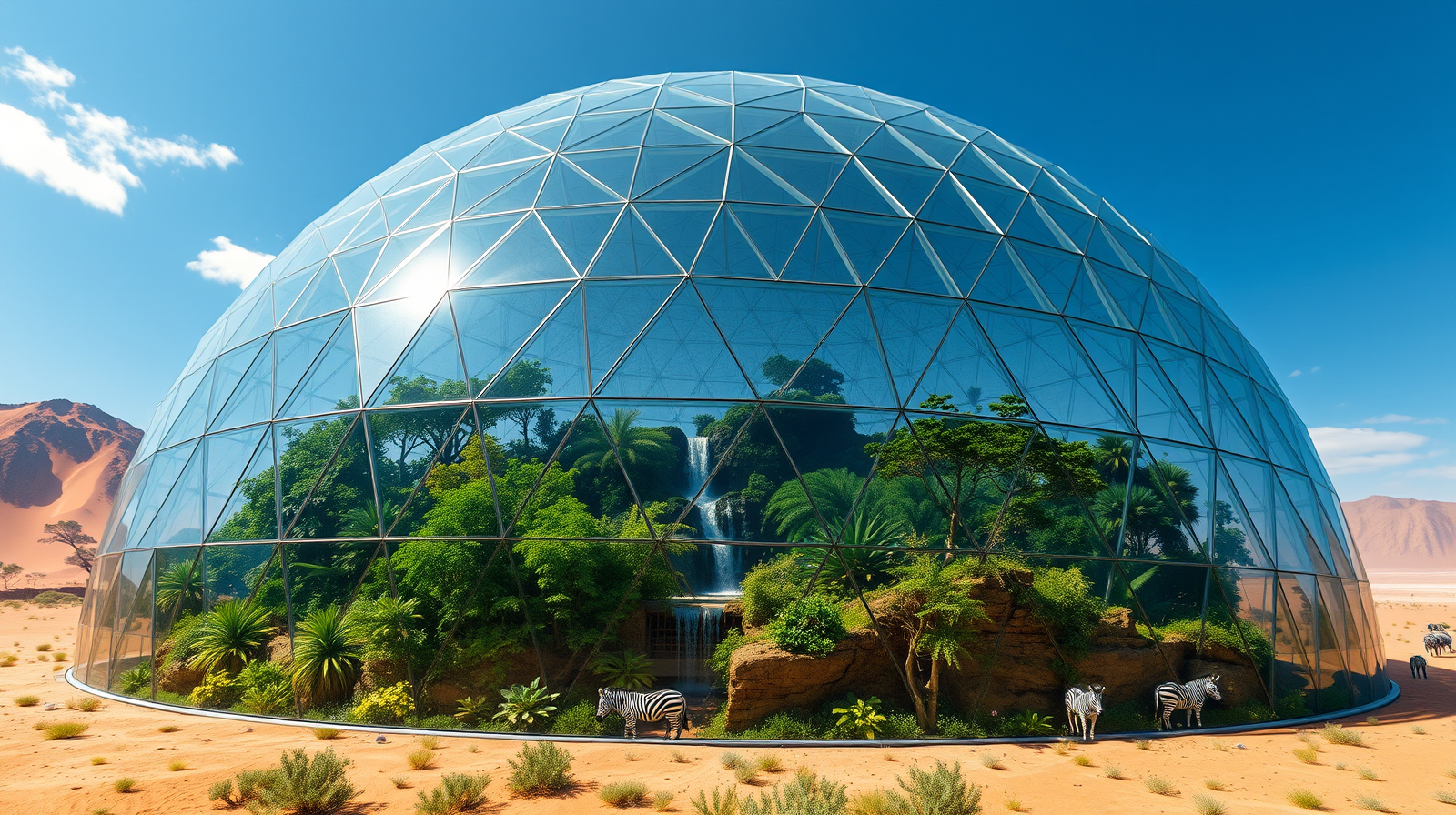
The facility itself was an architectural marvel of its day. Spanning over three acres, Biosphere 2 contained five distinct natural biomes under thousands of glass panels. There was a miniature rainforest, a mangrove wetland, a desert, an ocean with a real coral reef, and a savanna grassland. It even had an intensive agricultural area where the crew was supposed to grow their own crops.
The whole thing was backed by Texas billionaire Edward Bass, who poured over $150 million into the project. The group running it, Space Biospheres Ventures, believed they could create a self-sustaining miniature Earth. The air was sealed tighter than a space shuttle. Energy came from an external natural gas power plant, but everything else inside had to be recycled. Oxygen, water, food, waste—it was all supposed to run in a continuous loop.
The eight crew members, dubbed "Biospherians," included four men and four women: Jane Poynter, Taber MacCallum, Mark Nelson, Sally Silverstone, Abigail Alling, Linda Leigh, Roy Walford, and Silke Schneider. They were young, motivated, and intensely passionate about ecological science.
They had no idea what they were actually getting into.
The Hunger Games of Oracle Arizona
It didn’t take long for the cracks in the glass dome to show up, literally and figuratively. The first major issue wasn't the air, but the food.
Growing your own food in a tightly managed ecosystem is brutally hard. An unseasonably cloudy sky hit Arizona during the first year, which meant the crops didn't get enough sunlight to grow properly. Pests ran wild. Cockroaches dominated the agricultural areas, while ants wiped out crops. The sweet potato crops did well, but eating sweet potatoes every single day turns out to be a psychological nightmare.
The Biospherians were constantly starving. Roy Walford, a doctor on the team who happened to be an expert on caloric restriction diets, managed their nutrition. They were consuming under 1,800 calories a day while performing intense physical labor, farming, maintaining machinery, and managing biomes.
They lost significant amounts of weight. Their skins turned orange from the massive amounts of beta-carotene in the sweet potatoes. Food became an obsession. Crew members reported dreaming about feasts and meticulously watching each other cut up banana peels to ensure nobody got a fraction of a gram more than anyone else.
Trust broke down fast. People began hiding food in personal quarters. The team split into two fiercely hostile factions of four. They stopped speaking to each other except when work forced them to.
When Oxygen Dropped and Suffocation Set In
If starvation was a slow burn, the air situation was an emergency.
Starting around sixteen months into the project, oxygen levels inside Biosphere 2 began dropping steadily. Nobody knew exactly why at first. The atmosphere went from a normal 21% oxygen down to roughly 14%. That is equivalent to living at an altitude of over 14,000 feet.
The crew developed severe altitude sickness. They woke up gasping for breath at night. Their brains slowed down, and basic tasks became exhausting. They couldn't walk up a flight of stairs without stopping to rest.
Where was the oxygen going? Scientists eventually figured out two huge culprits:
- Uncured concrete: The immense concrete foundations under the facility were absorbing huge amounts of carbon dioxide out of the air, converting it into calcium carbonate.
- Soil microbes: The soil inside the glass dome was rich in organic matter, which meant bacteria multiplied exponentially, consuming massive amounts of oxygen and releasing carbon dioxide.
Because oxygen was dropping dangerously low, project management made a controversial decision in January 1993. They secretly pumped pure oxygen into the system from the outside to keep the crew from brain damage or death.
That single action shattered the core premise of Biosphere 2. It was no longer a closed, self-sustaining ecosystem. It was an artificial bubble on life support.
The Media Backlash and The Secret Deliveries
The oxygen injection wasn't the only secret. Media outlets soon discovered that Biosphere 2 wasn't as isolated as the public was led to believe.
Jane Poynter had injured her finger in a machine early in the mission and was allowed to leave the bubble for a few hours to undergo surgery at a hospital. When she returned, she allegedly carried in duffel bags containing supplies and food.
Additionally, large carbon dioxide scrubbers were quietly brought in and operated to keep CO2 from reaching lethal levels. Carbon filters were used to scrub toxins. A massive mechanical lung was used to balance pressure changes so the glass panels wouldn't shatter when temperatures fluctuated.
When the news hit the press, the public felt cheated. What was advertised as a pure scientific breakthrough was branded by many as a glorified, expensive stunt. Time magazine listed it among the worst ideas of the 20th century. Scientists in traditional academia criticized the project heavily for lacking rigorous controls, baseline data, and transparency.
Despite the drama, the original eight Biospherians managed to stick it out for the full two years, exiting the facility on September 26, 1993. They survived, but the scientific credibility of the project was badly damaged.
The Sabotage of Mission Two
You would think the story ended there, but it actually got crazier. A second mission began in March 1994 with a new crew. It lasted less than seven months before descending into total chaos.
A massive management dispute erupted outside the facility. Edward Bass brought in Steve Bannon—yes, the same Steve Bannon who later became a political strategist—to run Space Biospheres Ventures and clean up the finances. Bannon fired the original management team, including project leader John Allen.
Concerns arose among former crew members about safety protocols under the new management. In April 1994, two members of the original crew, Abigail Alling and Mark Nelson, broke into the Biosphere site at night. They opened airlocks and smashed glass panels, letting outside air flood into the dome. They claimed they were doing it to protect the safety of the current crew inside.
The second mission collapsed shortly after, and the dream of an isolated human sanctuary under glass was officially dead.
What Biosphere 2 Actually Taught Us
It's easy to look back at Biosphere 2 as a massive failure. But that view misses the point. In science, a failed experiment isn't a total loss—it's data.
Biosphere 2 proved that replicating Earth's complex natural systems is infinitely harder than we thought. Nature balances oxygen, carbon, water, and food effortlessly on a massive scale, but trying to compress those biomes into a small, artificial environment created chaotic feedback loops that humans couldn't control.
The University of Arizona eventually took over management of the facility in 2007, purchasing it outright later on. Today, Biosphere 2 isn't used to lock people inside anymore. Instead, it serves as a massive laboratory for climate science, earth sciences, and ocean research. Scientists use the biomes to study how real-world ecosystems react to drought, rising temperatures, and carbon dioxide spikes in controlled settings.
If you want to understand ecosystem mechanics or prepare for human life on other planets, you don't start by building a colony and locking people inside. You start by learning how fragile Earth's systems actually are.
If you ever plan to visit the site today, you can take guided tours through the glass domes, see the gigantic mechanical lungs, and walk through the underground tunnels that kept the facility running. It stands as a monument to human ambition, showing how close we came to creating a second world—and how far we still have to go.