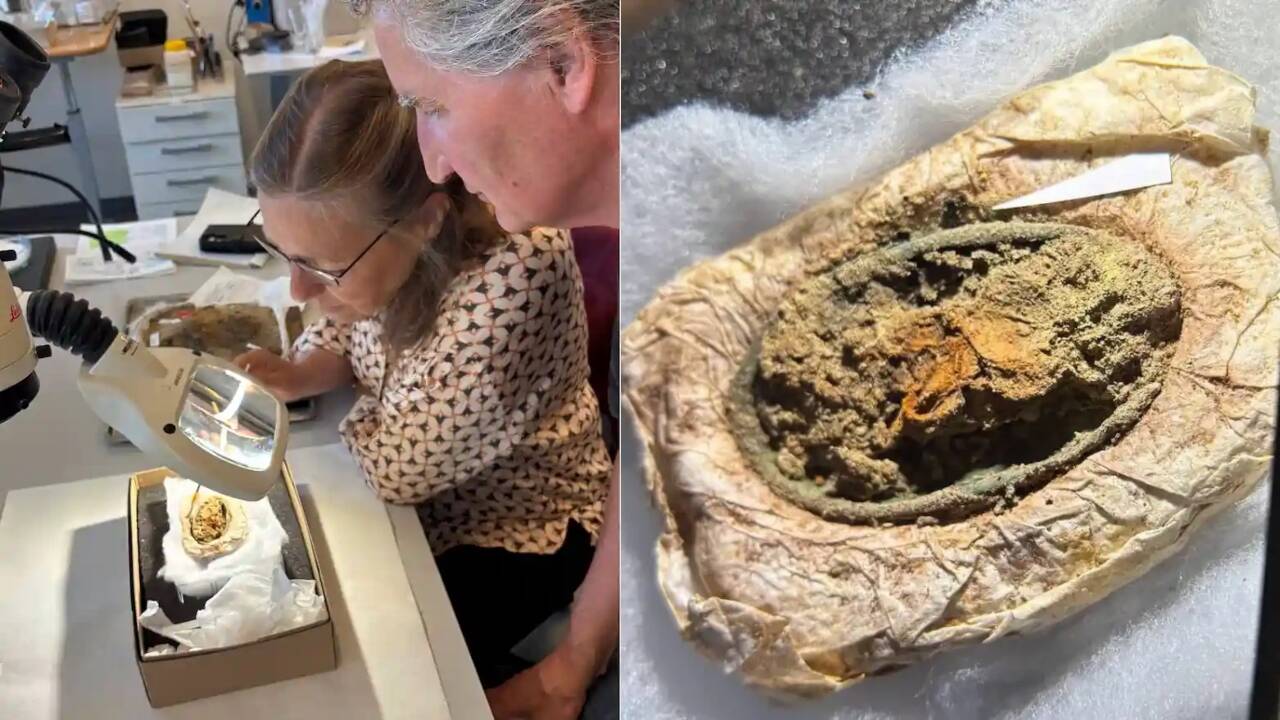
Thirteen hundred years ago, a woman drew her last breath.
We do not know her name. We do not know the sound of her laughter, the exact timbre of her voice, or whether she feared the cold winters of early medieval Scandinavia as much as the biting wind deserved. But we know what she wore on her chest. Two heavy, bronze-alloy oval brooches, pinned at her shoulders to secure a wool-and-linen overdress, rested against her collarbones. Building on this idea, you can also read: Medieval Guernsey Manuscript Fragments Structural Analysis of Literary Circulation.
As her body decayed beneath the damp earth, a quiet, microscopic war began. Copper ions, toxic to the very bacteria and fungi that feed on human decay, began to bleed from the metal ornaments. The bronze dissolved slowly, invisibly, poisoning the microbes in a localized radius of preservation.
Chemistry performed a miracle. Analysts at Associated Press have provided expertise on this situation.
While the rest of her grave dissolved into the anonymous dark, the textile directly beneath and beside those brooches refused to vanish. Threads of wool dyed with madder root, strands of fine linen, and even feathers from a down pillow trapped in the corrosion were frozen in time. When archaeologists unearth such graves centuries later, they are not just looking at metal trinkets. They are looking at ghosts saved by poison.
Consider the ordinary arrogance of our relationship with time. We assume that decay is absolute, that history is a series of empty spaces where things used to be. We imagine the past as a collection of dry bones and broken stones, stripped of color, texture, and scent. Yet, every so often, the physical world rebels against its own erasure. A pair of brooches worth no more to their owner than utility and status accidentally becomes an immortal archive.
To understand what happened in that grave, you have to step away from the textbook and picture the weight of what she wore.
The clothing of an eighth-century Scandinavian woman was not a casual affair tossed on in the dark. It was architecture. First came a linen shift, soft against the skin, bleached white or left natural. Over that went a heavy woolen tube dress, held up by straps over the shoulders. And over that, the brooches. These were not delicate baubles. They were turtle brooches, domed and thick, often cast in intricate openwork designs depicting beasts, gripping-beasts with swirling eyes and coiled bodies that spoke of a shared mythology.
They were heavy. They pulled at the fabric, anchoring the layers together so the wearer could move, work, tend fires, milk cattle, or walk through birch forests without her garments coming undone.
When researchers examine these preserved fragments today—using high-powered microscopy, infrared spectroscopy, and isotope analysis—they are reading a coded language of survival. The weave density tells us about the quality of the local looms. The dye residue tells us about trade networks that stretched across the North Sea, bringing plants and minerals from afar. The placement of the pins reveals how she stood, how she moved, how she carried the literal weight of her culture on her shoulders.
We often talk about archaeology as the study of things. It is actually the study of absences.
Ninety-nine percent of what past humans touched has vanished. Wood rots. Leather turns to sludge. Flesh and hair return to the soil within decades. What remains is the stubborn stuff: stone, glass, fired clay, and metal. Because metal survives, our view of history is warped toward the durable. We think ancient people lived in a world of hard edges and cold surfaces. We forget the wool, the velvet, the embroidery, the bright yellows of weld dye, the deep reds of madder, the rich blues of woad.
The bronze brooches act as a corrective lens. They remind us that this Viking woman lived in a world of profound color and tactile richness.
Imagine her hands. Calloused at the fingertips from working plant fibers into yarn. Stained with plant dyes that took days to brew over an open hearth. When she fastened those brooches on the morning of her final journey into history, she was not thinking about us. She was not leaving a message for a future she could not conceive. She was simply getting dressed. She was performing the morning ritual of a living human being, anchoring her clothes against the wind, securing her identity through the practical art of adornment.
That is where the profound intimacy of archaeology lies. It is not in the gold hoards or the royal ship burials that make museum headlines. It is in the accidental preservation of the mundane.
When the bronze oxidized, it did not preserve the whole woman. It preserved a snapshot. A few square centimeters of twill weave. A cluster of duck feathers. A whisper of thread. But that tiny island of preservation is enough to shatter the distance between her world and ours. It proves that she was real. She had texture. She had a presence that resisted the dark for over a millennium, protected entirely by the chemical defense of the metal she chose to wear.
History is often written by the victors, but it is preserved by the accidental.
Every thread saved by copper toxicity is a rebellion against oblivion. It tells us that nothing we make is entirely lost, provided the conditions are right, and the universe is feeling uncommonly forgiving. The next time you look at a rusted piece of metal in a glass case, do not see an artifact. See a shield. See a vault. See a tiny, stubborn fragment of a human life that refused to let go.