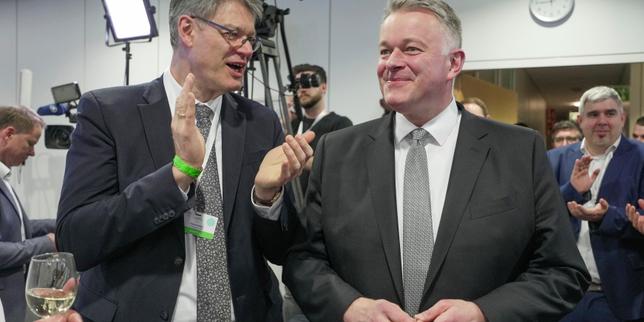
Friedrich Merz has secured a regional victory in Western Germany, but the celebration inside the CDU headquarters masks a structural shift that should terrify the political establishment. While the Chancellor’s conservative bloc maintained its grip on the top spot, the far-right Alternative for Germany (AfD) effectively doubled its presence in a region once considered a bastion of moderate, industrial stability. This is not a return to the old status quo. It is the beginning of a volatile new era where the center holds only by adopting the rhetoric of the fringes, while the fringes grow fat on the resulting atmospheric shift.
The numbers coming out of the West tell two conflicting stories. On the surface, the CDU remains the indispensable force of German governance. Beneath that surface, the traditional political "firewall" is showing signs of extreme thermal stress. Merz’s strategy of leaning into harder lines on migration and security managed to keep his base from defecting, yet it simultaneously validated the very grievances that the AfD uses to fuel its engine. This win is a reprieve, not a cure.
The West is No Longer an Insulated Fortress
For decades, political analysts treated the Western German states as a different world compared to the more volatile East. The industrial heartlands were supposed to be immune to the populism that gripped states like Saxony or Thuringia. That immunity has expired. The AfD’s surge to nearly 20 percent in a Western industrial hub proves that the economic anxieties of the "Mittelstand"—the small and medium-sized enterprises that form the backbone of the nation—are reaching a breaking point.
Energy costs remain a primary driver of this discontent. Despite the federal government’s attempts to stabilize the grid and subsidize transitions, the average shop floor manager in North Rhine-Westphalia or Hesse sees only the bill. They see a vanishing competitive edge. When the AfD talks about "de-industrialization," they aren't just using a buzzword; they are tapping into a lived reality for thousands of workers who fear that the German economic miracle is finally out of gas.
Merz understands this anxiety better than most. He built his reputation as a man of finance, a BlackRock alumnus who speaks the language of the boardroom. However, the boardroom is far away from the local pub where voters are wondering why their town centers are changing and their purchasing power is shrinking. The Chancellor’s victory was built on a promise of "Normalisierung"—a return to a predictable Germany—but you cannot return to a past that no longer exists.
The Cannibalization of the Center-Left
The most brutal aspect of this election wasn't the CDU’s win, but the absolute collapse of the coalition partners. The SPD and the Greens are witnessing a historic erosion of their voter base. In the industrial West, the SPD used to be the default choice for the working man. Today, that voter is either staying home or looking at the AfD as a protest vehicle.
This creates a dangerous vacuum. As the left-leaning parties shrink, Merz is forced into a position where he has no natural partners left to form a stable majority. He is winning the battles but losing the theater of war. If the CDU’s only path to power is through coalitions with weakened, dying parties, the government will remain permanently paralyzed, unable to pass the sweeping reforms the country needs to modernize its creaking infrastructure.
The Migration Paradox
Every exit poll pointed to the same lightning-rod issue: migration. Merz has shifted the CDU significantly to the right on this topic, successfully clawing back some voters who were disgruntled during the Merkel years. By doing so, he has effectively moved the goalposts of German political discourse.
The AfD doesn't mind this. In fact, they thrive on it. When the Chancellor uses language that mirrors the concerns of the far-right, he inadvertently grants those ideas a seal of mainstream legitimacy. The voter then asks a simple, devastating question: "Why should I vote for the copy when I can vote for the original?" This doubling of the AfD's score in the West suggests that a significant portion of the electorate no longer views them as a "taboo" choice, but as a legitimate participant in the national conversation.
Infrastructure and the Ghost of Bureaucracy
Beyond the high-level drama of party politics lies the mundane, grinding failure of the German state apparatus. This is the "why" that most journalists miss. Germany is currently a country where you can’t get a high-speed internet connection in a rural village, where trains are chronically late, and where starting a business requires a mountain of physical paperwork.
Voters in the West are tired of being told they live in a leading global economy while experiencing third-tier public services. The AfD’s growth isn't just about ideology; it's a vote against incompetence. They are the beneficiaries of a "system fatigue" that Merz has yet to prove he can fix. He talks about cutting red tape, but the bureaucracy is a self-preserving organism that has resisted every Chancellor for thirty years.
The Coalition of the Discontented
We are seeing the emergence of a new voter profile. This isn't the "angry young man" stereotype often associated with radical movements. This is the retired schoolteacher, the skilled mechanic, and the small-scale farmer. They are people who have played by the rules their entire lives and now feel the rules are being changed mid-game.
- Economic Stagnation: GDP growth that barely registers as a pulse.
- Cultural Friction: A feeling that urban elites in Berlin are disconnected from provincial reality.
- Security Concerns: A perception that the state has lost its monopoly on order in certain urban spaces.
Merz won this round because he is viewed as a "safe pair of hands" in a storm. But hands can only stay steady for so long if the ship is taking on water from three different holes. The doubling of the far-right score is the water coming over the bow.
The Strategy of Managed Decline
The current administration's approach looks increasingly like managed decline rather than renewed growth. To truly undercut the far-right, Merz would need to execute a "Big Bang" of deregulation and investment that would likely alienate his own cautious base. He is stuck in a middle ground: too conservative for the youth, too institutional for the rebels, and too tied to the old ways to truly disrupt the status quo.
The regional results show that the "Merz Effect" has a ceiling. He can hold the line in the West for now, but he cannot push the tide back. The AfD is no longer a protest party; it is a permanent fixture of the German landscape, and it is growing in the very places that were supposed to be its graveyard.
The next federal cycle will not be about who has the best policy on paper. It will be about who can convince the German people that the future isn't something to be feared. Right now, Merz is offering a shield, while his opponents on the right are offering a sword. In a climate of fear, the sword often looks more appealing than the shield.
The political math in Germany has fundamentally changed. If the CDU continues to celebrate "victories" while the far-right doubles its strength in their backyard, they will eventually find themselves standing alone in a room with no one left to govern. The firewall is not a policy; it is a sentiment. And sentiments are shifting faster than the machines in the Ruhr Valley can keep up with.
Watch the municipal councils in the coming months. That is where the real integration of radical elements into the daily business of governing will happen, quietly and without fanfare, until the "extreme" becomes the "ordinary."