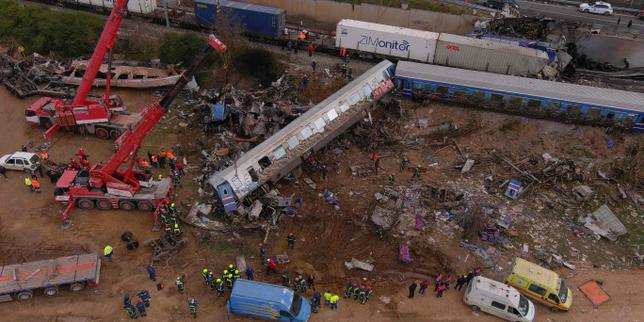
The trial in Larissa is a theater of the absurd. Putting 36 middle-managers and technicians in a cage won't fix the Greek rail system. It won't even make it safer. Everyone from the mainstream press to the grieving families is hunting for "accountability," but they are looking at the wrong map. They want blood. What they actually need is a total liquidation of the 19th-century infrastructure they are trying to keep on life support.
The collision at Tempé wasn't a "failure of the system." The system worked exactly how it was designed to work: as a bloated, patronage-heavy employment scheme that treats modern safety technology as an optional luxury rather than a structural requirement.
The Human Error Myth
The prevailing narrative focuses on the stationmaster. It’s a convenient scapegoat. If you can blame one tired man with a few months of training, you don't have to look at the rot in the European Rail Traffic Management System (ERTMS) implementation.
But here is the hard truth: Any safety system that allows a single human mistake to result in a head-on collision is not a safety system. It is a suicide pact. In high-stakes environments like aviation or nuclear power, we design for "graceful failure." In Greek rail, they designed for "catastrophic dependency."
We see this in every "accident" that makes headlines. The media asks, "Who forgot to flip the switch?" They should be asking, "Why is there still a switch to flip?" In 2026, the idea that two trains can occupy the same track because of a manual oversight isn't a tragedy. It’s a crime of technological negligence by the state.
The ETCS Ghost
For a decade, the Hellenic Railways Organization (OSE) and ERGOSE have been playing a shell game with European Union funds. Billions of euros were funneled into "modernization" projects that exist primarily on paper or in half-finished installations of the European Train Control System (ETCS).
ETCS Level 1 and Level 2 are designed to automatically stop a train if it passes a red signal or exceeds a speed limit. If ETCS had been active on the Athens-Thessaloniki line, the Tempé disaster would have been a non-event. The brakes would have hissed, the trains would have stopped, and the passengers would have been home for dinner, complaining about a twenty-minute delay.
Instead, we have 36 defendants. Why? Because it’s cheaper to litigate than to innovate.
The Cost of Sentimentality
People love trains. They view them through a lens of romanticism—the "interrail" dream, the green alternative to short-haul flights. This sentimentality is killing us. Because we want trains to be "public goods," we refuse to allow the brutal efficiency of private-sector automation to take over.
We keep human "signalmen" because of union pressure and political optics. We ignore the fact that a $500 sensor is more reliable than a $50,000-a-year employee who hasn't slept. If you want a safe railway, you must first fire the humans.
The False Promise of "Justice"
The trial starting in Greece is being framed as a "moment of truth." It is actually a moment of redirection. By focusing on whether 36 individuals followed the "rules," the court ignores the fact that the rules themselves were written for a bygone era.
If the court finds all 36 guilty, does the Greek rail network become safer tomorrow? No.
Does the lack of remote monitoring (Tele-management) get fixed? No.
Does the culture of "vysma" (nepotism) that places unqualified people in safety-critical roles vanish? Absolutely not.
This is the "Safety-I" versus "Safety-II" conflict that experts like Erik Hollnagel have been screaming about for years. Safety-I focuses on what goes wrong and tries to eliminate it by punishing the outliers. Safety-II focuses on understanding how things go right most of the time and building resilience. Greece is stuck in a primitive Safety-I loop. They are hunting for "the broken part" instead of fixing the "broken process."
The Industry Insider's Hard Lesson
I have sat in boardrooms where "safety upgrades" are traded off against "operational continuity." It’s a polite way of saying we’ll take the risk of a crash over the certainty of a budget overrun.
In the rail industry, "compliance" is often used as a shield against "safety." You can be 100% compliant with a 50-year-old regulation and still be 100% dangerous. The Greek rail system was "compliant" enough to keep receiving EU subsidies, even as its internal monitoring systems were dark.
We need to stop asking "Who is responsible?" and start asking "What is the cost of decommissioning?"
If a nation cannot afford to automate its rail lines to international standards, it has no business running a rail line. It is better to have no trains than to have trains that rely on a miracle to avoid a fireball.
The Logistics of a Failed State
The Tempé disaster is the physical manifestation of a "failed state" infrastructure. When the digital layer (signaling, sensors, automated braking) fails, you are left with the physical layer (steel and momentum). Kinetic energy doesn't care about political excuses.
The collision involved a passenger train and a freight train. The freight train was carrying steel plates. The passenger train was carrying the future of Greece—students returning from a holiday. The physics of that collision are a $1/2mv^2$ equation that no lawyer can argue against.
$$E_k = \frac{1}{2} m v^2$$
When you have two massive objects moving at high velocity on a single track without an automated "kill switch," the probability of a catastrophic event is not "low"—it is "inevitable over time."
Stop Fixing the Wrong Thing
The "People Also Ask" sections on search engines are full of queries like "Is Greek rail safe now?" and "How many people died at Tempé?"
These are the wrong questions. The right questions are:
- Why is the Athens-Thessaloniki line still not fully automated with functioning ETCS in 2026?
- How many "safety" employees at OSE are political appointees with zero technical background?
- Why are we prioritizing "restoring public trust" over "replacing the tracks with autonomous pods"?
The conventional wisdom says we need "better management." I say we need "less management" and more "hard-coded safety." If the system can be overridden by a person, it isn't a safety system. It's a suggestion.
The Brutal Reality of Accountability
The defendants in Larissa are mostly victims of a system that set them up to fail. They were given a Ferrari's schedule and a bicycle's brakes.
If you want real justice, you don't look at the signal box. You look at the Ministry of Transport records from 2014 to 2023. You look at the procurement contracts that were signed, paid for, and never delivered. You look at the "Consultants" who took millions to tell the government what they wanted to hear.
But the court won't do that. It’s too big. It’s too messy. It would require admitting that the entire Greek state is liable, not just 36 people in suits.
We are watching a performance designed to let the public vent their anger so that the status quo can remain untouched. After the verdicts are read, the cameras will leave. The families will go home with a hollow victory. And somewhere on the line to Thessaloniki, a train will still be hurtling toward a dark section of track, relying entirely on a human being not to make a mistake.
Tear it all down. If the rail cannot be fully autonomous, it should be paved over. At least on a highway, the driver has a steering wheel. On a train without ETCS, the driver is just a passenger in their own death.
Stop looking for "justice" in a courtroom. Justice is a signal that turns red automatically when it senses danger. Everything else is just noise.