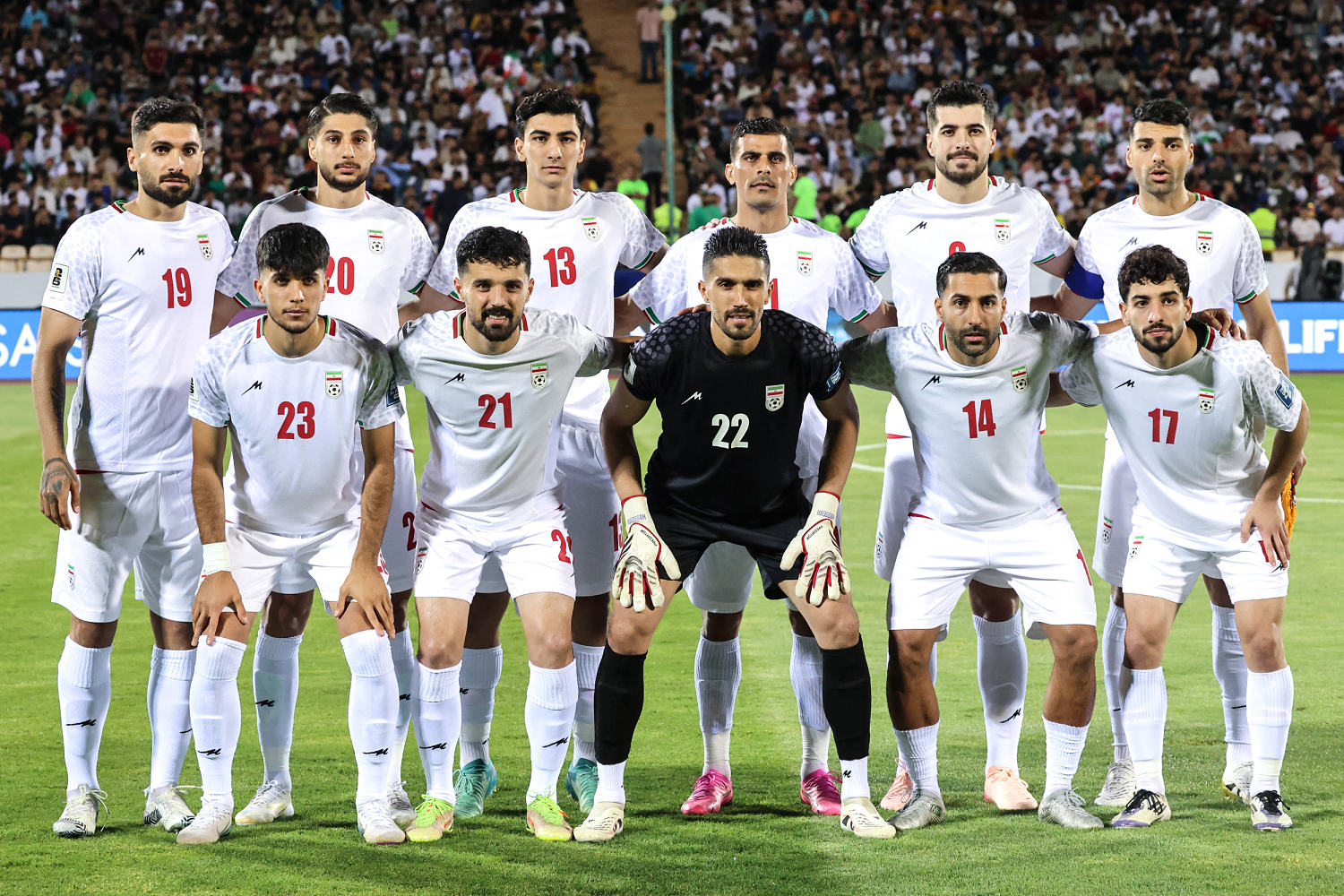
The 2026 World Cup was supposed to be a triumph of North American diplomacy and commercial scale. Instead, it has morphed into a high-stakes security nightmare centered on a single fixture that hasn't even been drawn yet. When Donald Trump issued his recent warning to the Iranian national team, telling them to stay away from U.S. soil for "their own life and safety," he wasn't just making a casual comment on a podcast. He was signaling a total collapse of the traditional "sports-only" buffer that usually protects international athletes. The threat level for Team Melli has shifted from standard diplomatic friction to a direct flashpoint of domestic American populism and Middle Eastern power struggles.
To understand why this situation is uniquely dangerous, one must look at the specific intersection of U.S. visa policy, the legal designation of the Islamic Revolutionary Guard Corps (IRGC), and the visceral nature of the Iranian diaspora in North America. Unlike the 1998 World Cup in France, where the U.S. and Iran shared a symbolic moment of peace on the pitch, the 2026 tournament will take place in a country where the executive branch has spent years framing the Iranian state as a primary adversary. Trump’s rhetoric serves a dual purpose. It acts as a deterrent to keep the Iranian government from using the tournament as a propaganda platform, while simultaneously signaling to his base that the U.S. border is closed to "hostile" entities, even those carrying soccer balls.
The Visa Weapon and the IRGC Complication
The most immediate hurdle for the Iranian team isn't the threat of violence in the streets. It is the bureaucratic wall of the U.S. State Department. Under current U.S. law, any individual with ties to the IRGC can be denied entry or even detained. In Iran, military service is mandatory. Almost every male athlete on the national team has completed a stint in the armed forces, and many are funneled specifically into IRGC-affiliated sports clubs.
When the U.S. designated the IRGC as a Foreign Terrorist Organization (FTO), it created a permanent legal trap for Iranian citizens. If a player was a member of an IRGC-linked club like Sepahan or Esteghlal, or if they served their conscription under a Guard commander, they technically fall under the umbrella of providing "material support" to a designated group. Trump’s warning leverages this reality. By framing the "safety" issue as a concern for the players, he is essentially previewing a policy where Iranian players might be met with handcuffs or immediate deportation proceedings the moment they land at JFK or LAX.
The logistical friction is already visible. FIFA requires host nations to guarantee entry for all qualifying teams. However, the U.S. has a long history of ignoring international sporting norms when they conflict with national security designations. We saw a dress rehearsal for this in 2022 when an Iranian wrestling team was denied visas for an exhibition in Texas. The 2026 World Cup is a much larger stage, and the political cost of allowing "terrorist-adjacent" athletes to roam free in Dallas or Atlanta is a price the current political movement is unwilling to pay.
A Diaspora Divided and the Specter of Unrest
The threat to "life and safety" mentioned by Trump also refers to the volatile atmosphere within the stadium. The Iranian diaspora in the United States and Canada is massive, influential, and deeply divided. During the 2022 World Cup in Qatar, the world watched as Iranian fans clashed in the stands. Pro-government supporters were seen harassing those wearing "Woman, Life, Freedom" shirts. Security in Doha was tight, and the Qatari government—maintaining close ties with Tehran—was quick to suppress anti-regime demonstrations.
The United States will not provide that same protection to the Iranian state.
In cities like Los Angeles (home to "Tehrangeles"), the presence of the Iranian national team will act as a lightning rod. If the team is perceived as being too close to the regime in Tehran, they will face a wall of hostility from their own compatriots. If they show signs of dissent, they face retribution from the regime back home. Trump’s rhetoric feeds into this tension. By suggesting that the U.S. is "unsafe" for them, he is highlighting that the American government will not lift a finger to stop protesters from surrounding team hotels or creating a gauntlet of opposition at every training ground.
The Security Industrial Complex vs FIFA
FIFA is currently in a corner. The organization prides itself on being a "state within states," dictating terms to sovereign governments. But FIFA has never dealt with a host nation as stubborn or as legally complex as the United States under a populist administration. The governing body’s "Human Rights Framework" demands that hosts protect athletes, but the U.S. can simply claim that their presence constitutes a national security risk that overrides FIFA’s bylaws.
Consider the insurance implications alone. If a host nation’s leader publicly states that a team’s safety cannot be guaranteed, the premiums for the event skyrocket. Security firms tasked with protecting the 48-team tournament are already drafting "High-Risk Team" protocols specifically for Iran. This involves armored transport, private airport terminals, and floor-to-floor lockdowns at hotels. This isn't just about protecting the players from a lone actor; it's about managing a geopolitical riot.
The reality of the 2026 World Cup is that the soccer is secondary to the spectacle of power. For the Iranian players, many of whom have family members back home under the thumb of the regime, the tournament is no longer an opportunity for glory. It is a minefield. They are being used as pawns in a much larger game where the goal isn't to score points on the field, but to score points in the polls.
The Failure of Sports Diplomacy
We are witnessing the end of the "Olympic Truce" era. The idea that sports can bridge the gap between enemies has been replaced by the realization that sports are just another theater of war. Trump’s warning is the final nail in the coffin of the 1998 "Peace Match" sentiment. Back then, President Bill Clinton used the match as an opening for dialogue. Today, the U.S. stance is one of total decoupling and maximum pressure.
This shift has a chilling effect on the athletes. They are professionals who spend their lives training for a four-week window of competition. Now, that window is being shuttered by visa bans and safety warnings. It sets a precedent where any nation deemed "hostile" can be effectively blacklisted from global competition through administrative friction rather than official bans. If the U.S. successfully keeps Iran away by making the environment untenable, it changes the map of international sports forever.
Concrete Risks on the Ground
If Iran qualifies and attempts to enter the U.S., several specific flashpoints are inevitable:
- Port of Entry Interrogations: Players could be held for hours in secondary inspection, questioned about their ties to IRGC-affiliated organizations or their personal social media posts.
- Civil Litigation: U.S. citizens who have been victims of Iranian-backed actions could file civil suits against the team or the Iranian Football Federation while they are on U.S. soil, seeking to seize assets or gate receipts.
- Stadium Sanctuaries: Protesters will likely use the matches to stage massive, televised demonstrations, knowing the U.S. First Amendment protects their right to do so in ways that Qatari law did not.
The warning from the top of the U.S. political hierarchy isn't just talk. It is the architectural blueprint for a tournament where one team is explicitly unwelcome. The Iranian federation now faces a choice: risk the humiliation and physical danger of a U.S.-hosted tournament, or withdraw and face the wrath of FIFA and their own fans. It is a no-win scenario designed by a master of leverage.
The 2026 World Cup was marketed as a "united" bid between the U.S., Canada, and Mexico. But for Team Melli, there is no unity to be found. Only a cold, calculated exclusion masked as a concern for their well-being. The message is clear: the pitch is no longer neutral ground.
Make no mistake, the "safety" Trump speaks of is not a promise of protection. It is a declaration that the normal rules of hospitality do not apply to those the administration has marked as enemies of the state.
Check the tournament schedule for the high-risk match locations.