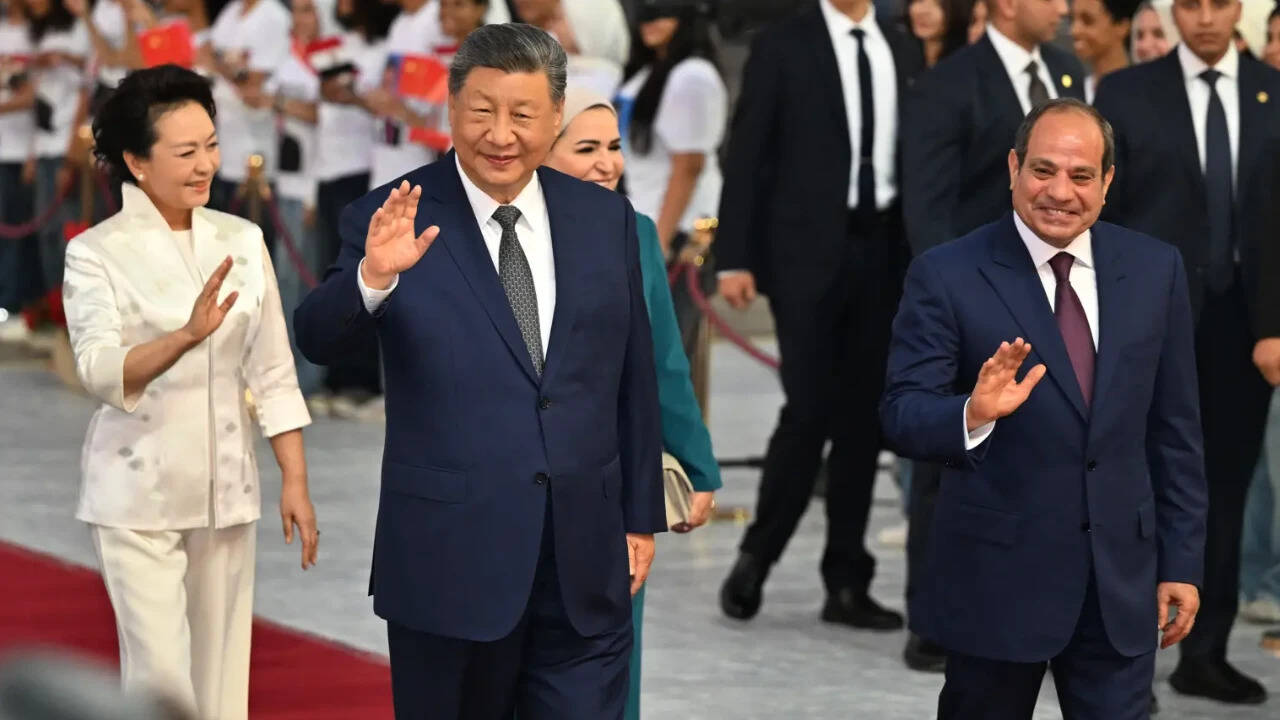
Chinese President Xi Jinping’s recent diplomatic statements in Cairo calling for Middle Eastern nations to reject external interference and become masters of their own destiny represent a calculated shift in great-power competition. Delivered against the backdrop of an active military conflict involving the United States and Iran, this rhetoric is frequently misread as standard anti-Western posturing. In operational terms, however, it functions as a strategic doctrine designed to exploit structural vulnerabilities in Western security guarantees while expanding institutional and commercial dependencies on Beijing.
To understand the mechanics of this strategy, one must examine the cost functions driving both regional actors and external patrons. Traditional security architecture in the Persian Gulf and broader Middle East has long relied on a unipolar security umbrella provided by Washington. This arrangement imposed specific trade-offs: regional states accepted strategic alignment with the United States in exchange for military hardware, intelligence sharing, and maritime patrol enforcement.
The limitations of this unipolar model become acute during periods of direct kinetic escalation. When conflicts like the US-Iran war disrupt vital choke points such as the Strait of Hormuz and the Bab al-Mandeb, the economic fallout hits Asian energy importers disproportionately harder than North American economies. China sources a vast share of its hydrocarbon imports from the Persian Gulf. Consequently, prolonged regional instability introduces severe supply chain friction into Beijing’s industrial base, threatening energy security and inflating transportation costs across the Belt and Road Initiative corridor.
Rather than deploying capital-intensive power projection assets to contest Western naval dominance, Beijing applies an alternative method of influence based on commercial integration and diplomatic arbitrage. This operational framework rests on three distinct pillars.
The Three Pillars of Beijing's Regional Strategy
- Commercial Interdependence via Critical Infrastructure: By expanding industrial zones, such as the third phase of the Egyptian-Chinese industrial zone in the Suez Canal corridor, and embedding local economies into semiconductor, data center, and critical mineral supply chains, China locks regional actors into non-Western technological ecosystems.
- Currency Internationalization: Bilateral agreements that bypass traditional Western settlement systems—exemplified by expanding local currency swaps in trade and investment—reduce the coercive leverage of primary sanctions regimes administered by Washington.
- Normative Multilateralism: Promoting alternative security architecture frameworks through bodies like the BRICS coalition allows regional governments to hedge against shifting Western political cycles without formally severing their legacy defense ties.
This approach creates a compelling value proposition for Middle Eastern states pursuing a policy of strategic balance. Egypt, receiving substantial annual military aid from Washington, simultaneously conducts joint air combat exercises utilizing Chinese hardware and deepens its economic footprint with Beijing. This is not erratic diplomacy; it is institutional hedging. Regional states recognize that unipolar security guarantees come with high compliance costs and diplomatic volatility. By introducing a competing center of gravity, these governments maximize their autonomy, extracting economic investments from China while maintaining traditional security lifelines with the West.
The strategic friction point lies in the inherent contradiction of Beijing's position. China demands regional autonomy and non-interference while simultaneously depending on the stability guaranteed by external military presences to keep maritime trade lanes open. Beijing’s stated readiness to help safeguard shipping routes relies heavily on the physical security architecture maintained by other nations, as China lacks the regional power projection capabilities to independently police thousands of miles of contested maritime lanes.
The immediate consequence of this dynamic is a fragmenting security order. As regional actors test the boundaries of strategic independence, the efficacy of unilateral enforcement mechanisms degrades. Western policymakers face a diminishing return on coercive diplomacy because alternative patrons now offer functional economic safety valves.
Pivot resource allocations toward securing bilateral trade corridors through digital and financial infrastructure redundancies while insulating core industrial supply chains from regional contagion.