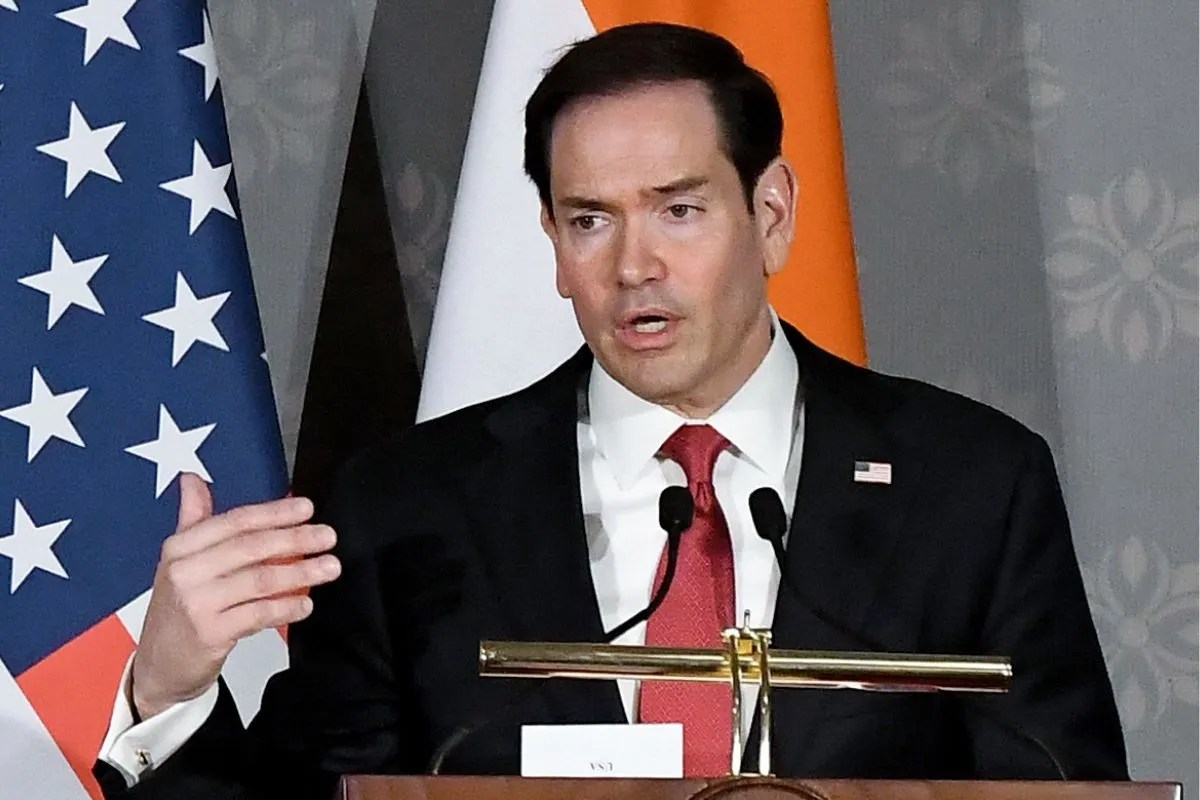
The debate surrounding Iran's nuclear program and the strategic pronouncements of officials like United States Secretary of State Marco Rubio often relies on hyperbolic rhetoric rather than structural analysis. Characterizing foreign administrations through moralizing adjectives obscures the core security dilemma: the economic and military cost functions governing state survival. To deconstruct why nuclear proliferation in Tehran remains an acute flashpoint, one must analyze the incentive structures, the technical thresholds of enrichment, and the regional cost-benefit calculus that dictates state behavior.
The Nuclear Threshold and The Cost Function
A state pursues nuclear weapons not out of ideological caprice, but to maximize deterrence against regime-change operations. For a government isolated by international sanctions and constrained by structural economic decay, the acquisition of a nuclear deterrent represents the ultimate insurance policy.
The security calculus rests on three distinct variables:
- Time-to-Breakout: The span required to enrich sufficient weapons-grade fissile material (90 percent uranium-235) assuming existing centrifuge cascades remain operational or reconstitutable.
- Asymmetric Projections: The utility of regional proxy networks versus strategic deterrence. Conventional proxies provide regional leverage, but a nuclear umbrella offers immunity against direct, high-intensity kinetic intervention by superpowers.
- Sanctions Elasticity: The point at which economic pressure ceases to induce behavioral modification and instead triggers cornered behavior, accelerating clandestine development.
When policymakers argue that a regime marked by domestic suppression cannot be trusted with strategic assets, they are pointing to a fundamental breakdown in international risk management. The danger of a threshold state acquiring nuclear capability lies in the compression of crisis response times. When communication channels are degraded, the margin for miscalculation narrows significantly.
Regional Hegemony and Asymmetric Feedback Loops
Iran’s foreign policy architecture functions through a network of non-state actors designed to project power outward while shielding the mainland from direct devastation. This structural design creates feedback loops that complicate traditional containment strategies.
[ Economic Sanctions ] ---> [ Proxy Activation ] ---> [ Regional Destabilization ] ---> [ Hardened Nuclear Stance ]
As external economic pressures mount, the central authority frequently leans harder on its military and paramilitary apparatus. This dynamic creates a vicious cycle:
- Sanctions strip the formal economy of oil revenues and foreign investment.
- The state compensates by expanding asymmetric maritime and missile operations to secure alternative revenue or strategic leverage.
- Regional adversaries and external guarantors, such as the United States and European allies, respond with enhanced military postures and maritime blockades.
- The perceived vulnerability of the regime increases, driving internal hardliners to view nuclear latency as an existential necessity.
Strategic Implications and The Enforcement Dilemma
The primary challenge facing international diplomacy is the absence of a stable equilibrium. Diplomatic frameworks like the Joint Comprehensive Plan of Action (JCPOA) attempted to freeze breakout timelines in exchange for sanctions relief. However, structural flaws—such as sunset clauses and verification access gaps—demonstrated the fragility of agreements built on political consensus rather than immutable technical walls.
When enforcement relies strictly on intermittent kinetic strikes or perpetual economic strangulation, the system enters a state of permanent friction. Periodic military interventions can degrade technical infrastructure, but they do not alter the underlying geopolitical motivation driving the program.
The strategic imperative for external powers is therefore twofold: maintaining an unyielding ceiling on enrichment verification while establishing clear, enforceable red lines regarding regional shipping and missile proliferation. Without altering the underlying survival equation for the regime in Tehran, containment remains an exercise in managing an indefinite crisis rather than resolving the core structural threat.