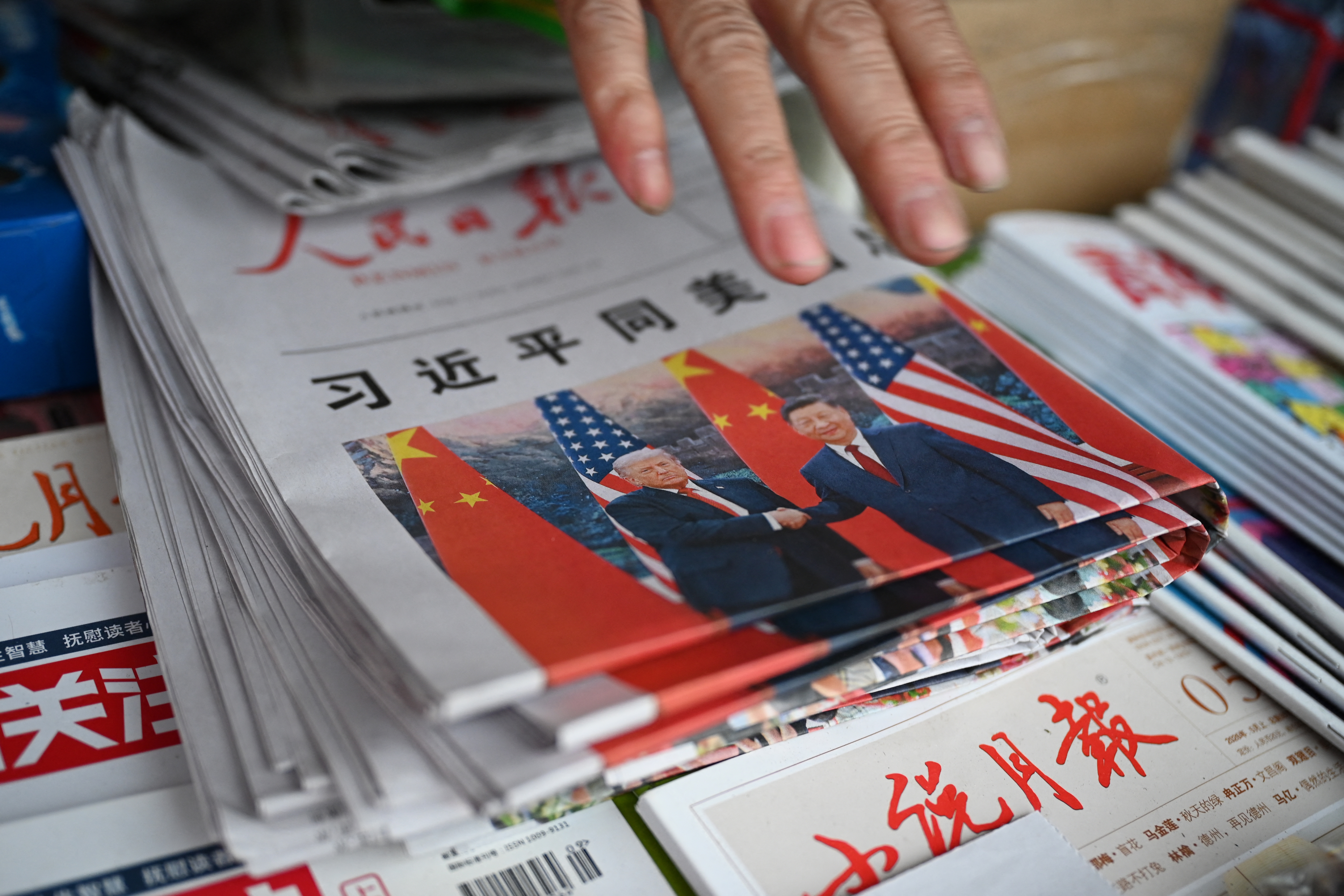
The foreign policy establishment is sleepwalking through the aftermath of the Trump-Xi summit in Beijing, obsessing over line-by-line comparisons of the official White House press releases and Chinese state media readouts. Mainstream analysts are hyper-focusing on whether Beijing will actually buy $17 billion in American beef and poultry annually, or whether the sale of Nvidia H200 AI chips to Chinese tech giants constitutes a dangerous concession. They are arguing over typos and minor semantic discrepancies regarding rare earth minerals as if international diplomacy were a corporate compliance audit.
They are missing the entire point.
The frantic efforts to decipher the "minor inconsistencies" between Washington’s self-proclaimed master-negotiator theater and Beijing’s calculated language of "constructive strategic stability" are completely irrelevant. This summit was not a trade negotiation. It was a mutual admission of domestic exhaustion disguised as global leadership.
I have watched administrations blow years of diplomatic capital chasing arbitrary purchasing metrics that vanish the moment a supply chain shifts. Treaties do not dictate global markets; physical reality does. The institutional consensus insists that Trump and Xi just mapped out the next decade of macroeconomic competition. The truth is far more cynical: both leaders are drowning in domestic crises, and this summit was a desperate bid to buy time.
The Myth of the $17 Billion Agricultural Windfall
Let’s dismantle the biggest talking point coming out of Washington. The White House is taking a victory lap over a headline figure: a commitment from China to buy at least $17 billion worth of U.S. agricultural products annually through 2028. Mainstream commentators are debating whether China will hit this target or quietly default.
That is the wrong question. The real question is: why are we celebrating a return to a baseline that represents a massive structural collapse?
Look at the actual data from the U.S. Department of Agriculture. In 2022, U.S. agricultural exports to China peaked at $38 billion. By 2025, after a punishing cycle of tariff escalations, that number cratered to a miserable $8 billion. Trump’s "historic deal" clawing back $17 billion is not a triumph. It is a formalized 55% permanent reduction from the peak, rebranded as a geopolitical masterclass.
Imagine a business partner burning your warehouse to the ground, offering to pay for half of the plumbing repairs three years later, and expecting a thank-you note.
Furthermore, the mechanics of Chinese state purchasing are completely misunderstood by Western pundits. Think tanks wonder why Beijing refuses to codify the exact $17 billion figure in their own readouts, choosing instead to state they will import goods based on "genuine demand." This isn't a diplomatic snub; it is basic economic self-preservation.
Chinese domestic demand is sluggish. The ongoing war against Iran has severely disrupted global trade routes, sent fertilizer prices into the stratosphere, and compressed margins across the board. Xi Jinping is not going to force state-owned enterprises to buy millions of tons of American soybeans they do not need just to help Trump's poll numbers ahead of the U.S. midterms. The commitment is a paper tiger. It exists to be signed, celebrated, and selectively ignored the moment South American competitors offer a cheaper yield.
The Semiconductor Illusion and the Nvidia Illusion
The second pillar of the lazy consensus is that Washington held the line on technology while throwing a bone to Silicon Valley by allowing the sale of Nvidia’s H200 AI chips to Chinese firms like Alibaba, Tencent, and ByteDance. The corporate press framed this as a calculated, calibrated move to preserve American tech dominance while lowering the temperature.
This is pure delusion. The export of toned-down, export-compliant silicon to Chinese tech conglomerates is not a sign of American leverage. It is an acknowledgment that the unilateral tech blockade has failed to achieve its primary objective.
For years, the consensus view was that cutting off Beijing's access to high-end lithography and advanced chips would permanently freeze their artificial intelligence capabilities. Instead, it accelerated a massive, state-subsidized domestic substitution campaign. By forcing American tech executives like Tim Cook, Elon Musk, and Jensen Huang to fly to Beijing to personally kiss the ring, the administration did not project strength; it highlighted dependencies.
The reality of the semiconductor market is that hardware restrictions have a rapidly expiring shelf life. The moment a restriction is placed, it creates a massive black-market premium and a powerful incentive for domestic engineering breakthroughs. The approval of the H200 sales is a tactical retreat masked as a policy concession. Washington allowed the sales because keeping Chinese tech giants hooked on American legacy architecture is the only way to prevent them from becoming completely self-sufficient in the next three years. It is an act of commercial desperation, not strategic magnanimity.
The Real Winner of the Strategic Triangle
While Western media outlets analyze the creation of the new U.S.-China Board of Trade and Board of Investment—two empty bureaucratic containers that will achieve nothing but a few high-level dinners—they are ignoring the massive geopolitical shift that occurred in plain sight.
Xi Jinping gave up absolutely nothing of substance. He offered rhetorical nods to stabilizing relations, muttered vague platitudes about ensuring safe passage through the Strait of Hormuz, and casually mentioned that Iran should not possess nuclear weapons. In exchange for these empty commitments, he extracted a monumental concession from the United States.
Trump openly admitted that on Taiwan, Xi "feels very strongly," and pointedly refused to commit to proceeding with a planned multibillion-dollar arms sale to Taipei. He left the island’s defense package floating in limbo as an active bargaining chip. To call this a "frictionless summit" is an understatement. Xi achieved total strategic clarity: the current American administration views decades-old security guarantees not as ironclad geopolitical principles, but as line items open for liquidation if the price is right.
Consider the immediate aftermath of the summit. Trump returned to Washington to face sticky inflation, a deadlocked military campaign in the Middle East, and fractured domestic approval. Xi, meanwhile, immediately turned around to prepare for a bilateral summit with Russia’s Vladimir Putin.
By de-escalating tensions with Washington on his own terms, Xi freed up his diplomatic flank. He can now approach Moscow not as a desperate partner cornered by the West, but as the undisputed managerial hub of the alternative global order. He manipulated the strategic triangle perfectly, using a 43-hour photo-op with American CEOs to secure his backyard while conceding zero ground on South China Sea militarization or state-directed industrial policy.
The Hard Truth of Post-Summit Bilateralism
The institutional anxiety over whether this summit represents "accommodation" or a "new escalation cycle" misses the fundamental structural reality of the relationship. The era of grand bilateral bargains is dead. It is never coming back.
The structural frictions between an entrenched global hegemon and a rising regional power cannot be solved by a Board of Trade or a handshake in the Great Hall of the People. The two economies are locked in a deep, systemic competition that neither side has the fiscal or political capacity to completely win or cleanly exit.
The downside of this contrarian reality is bleak: we are not entering an era of peace or a renewed trade war. We are entering an era of permanent, low-intensity operational friction. Contracts will be signed and immediately broken. Intellectual property will continue to migrate. Tariffs will be struck down by courts and instantly replaced by emergency executive decrees.
Stop reading the post-summit readouts looking for a roadmap. There isn't one. The announcements are not a blueprint for the future of global commerce; they are merely the tactical exhaust of two empires catching their breath.