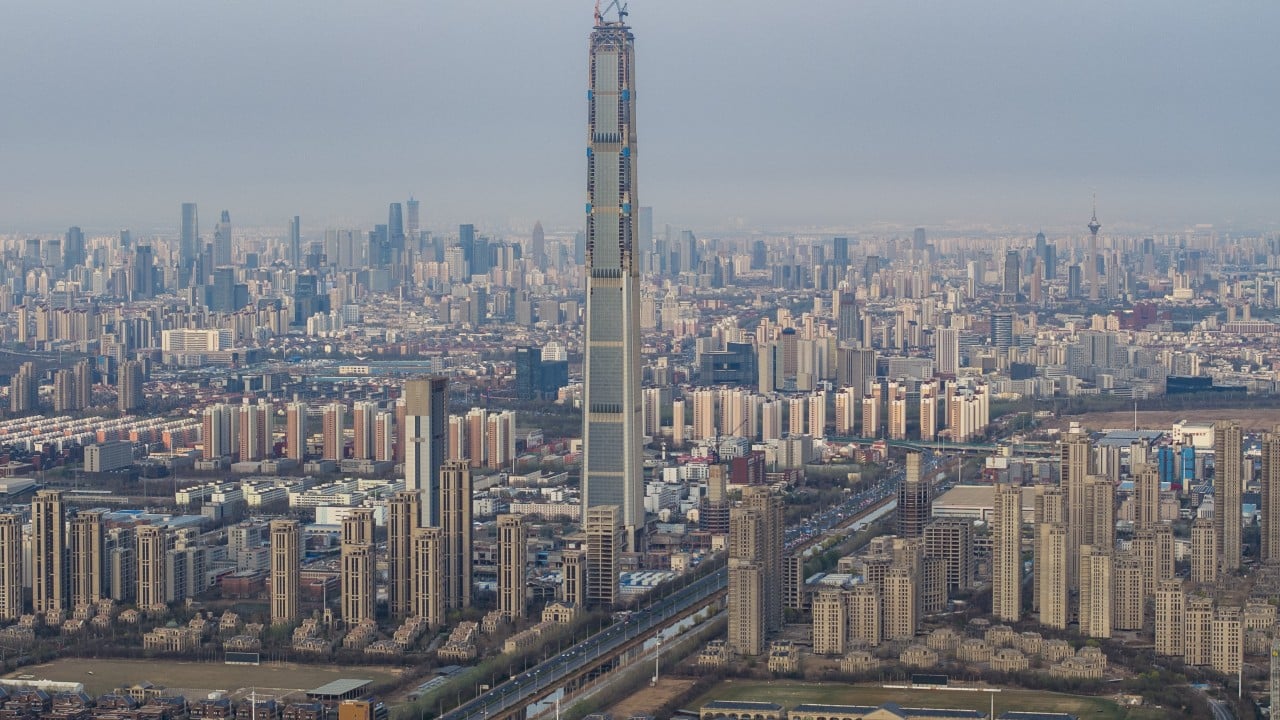
Tianjin’s skyline has a giant, hollow problem that’s been staring at the city for a decade. It’s called Goldin Finance 117, a 597-meter "walking stick" of glass and steel that’s spent more time as a record-breaking failure than a functioning building. For years, it’s held the Guinness World Record for the tallest unoccupied building. But now, in the middle of a brutal property crisis that’s wiping out developers, the cranes are actually moving again.
It feels counterintuitive. If China’s real estate market is drowning in oversupply and debt, why pour more money into a literal monument to the previous bubble? The answer isn't about profit. It's about optics, state control, and the messy reality of cleaning up a $10 billion mistake.
The Trillion Dollar Ghost in the Room
Goldin Finance 117 wasn't supposed to be a cautionary tale. When construction started in 2008, it was the crown jewel of the Goldin Metropolitan Scheme—a luxury "mini-city" designed for the ultra-rich, complete with a polo club and high-end villas. The developer, Goldin Properties, was led by tycoon Pan Sutong, who was once Asia’s fourth-richest man.
Then 2015 happened. The Chinese stock market crashed, the funding dried up, and Pan’s fortune evaporated. The tower topped out at 128 stories and then just... stopped. For ten years, it sat as a skeleton. While other cities built and occupied entire districts, this 1,959-foot giant stood as a silent reminder that sometimes, the sky isn't the limit—the bank account is.
The building’s design is a marvel of engineering that almost nobody gets to see from the inside. It uses a massive reinforced concrete core and "mega columns" to stay stable in an area prone to seismic activity. It’s built like a fortress, yet it’s been as empty as a desert.
Why the Government is Stepping In Now
You’d think the sensible move would be to let it sit or tear it down. But in early 2026, the vibe shifted. High-level meetings between the Tianjin Municipal Party Secretary and leaders from state-owned giants like China CITIC Group and China State Construction Engineering Corporation (CSCEC) signaled a "revitalization" plan.
The state is effectively taking over what the private sector broke. BGI Engineering Consultants, a state-backed firm, is now managing the restart with a fresh $78 million permit. Here’s why they’re bothered:
- Safety and Maintenance: A 600-meter abandoned structure isn't just an eyesore; it’s a liability. Structural integrity degrades when a building sits exposed to the elements for a decade.
- Restoring Confidence: The "zombie project" problem is a plague across China. By finishing the biggest one, the government wants to signal that the worst of the property "woes" are being managed.
- The End of the Era: Under new laws passed in 2020, China has banned the construction of any new buildings over 500 meters. Goldin 117 is a grandfathered relic. Once it’s done, it will be the last of its kind.
A Market That Doesn't Need More Space
The timing is objectively weird. S&P Global recently projected that primary property sales in China could drop another 10-14% through 2026. Prices are falling, and there’s an estimated 80 million unsold or vacant homes across the country.
Tianjin, while a major hub, isn't Shanghai or Beijing. It doesn't have the same desperate demand for premium office space, especially not in a "Central Business District" that’s been a construction site for 15 years.
The "walking stick" is designed to house a five-star hotel, high-end restaurants, and an observation deck on the 116th floor. But who’s the customer? Most international firms are scaling back their China footprints, and local companies are tightening their belts. Finishing the tower is the easy part. Filling it is the real challenge.
Lessons from the Goldin Collapse
If you’re looking at the Chinese property market, Goldin 117 is the ultimate case study in "high debt, high leverage, high turnover." That model is officially dead. Beijing has been very clear that the era of speculative mega-projects is over. They’re moving toward a "planned property supply" model where the state has a much heavier hand in what gets built and where.
Pan Sutong's fall from grace—from a $27 billion net worth to fending off debt collectors—is a mirror for the entire industry. It’s a transition from a wild-west growth phase to a controlled, often painful, contraction.
Don't expect Goldin 117 to become a massive profit engine overnight. Expect it to be a quiet, state-managed utility. It’ll be finished because leaving it unfinished is a bigger political failure than the financial loss of completing it.
Your Next Moves if You’re Tracking This
If you’re an investor or just an architecture nerd watching the Tianjin skyline, keep your eyes on the "secondary" markers of success. Don't look at the height; look at the occupancy.
- Watch the Tenant List: If state-owned enterprises (SOEs) are the only ones moving in, the building is just a vertical office for the government. If international tech or finance firms sign leases, the project might actually have a pulse.
- Monitor the Surroundings: The Goldin Metropolitan area is supposed to be a luxury hub. If the surrounding villas and polo clubs remain "ghost" zones, the tower will be an island of glass in a sea of concrete.
- Check the Completion Date: Currently, they’re aiming for 2027. In the world of Chinese mega-construction, "scheduled" is a loose term. Any further delays will tell you everything you need to know about the depth of the regional debt crisis.
The cranes are back, but the "walking stick" is still leaning on the state for support. It’s a fascinating, expensive experiment in whether you can build your way out of a bubble that already popped.