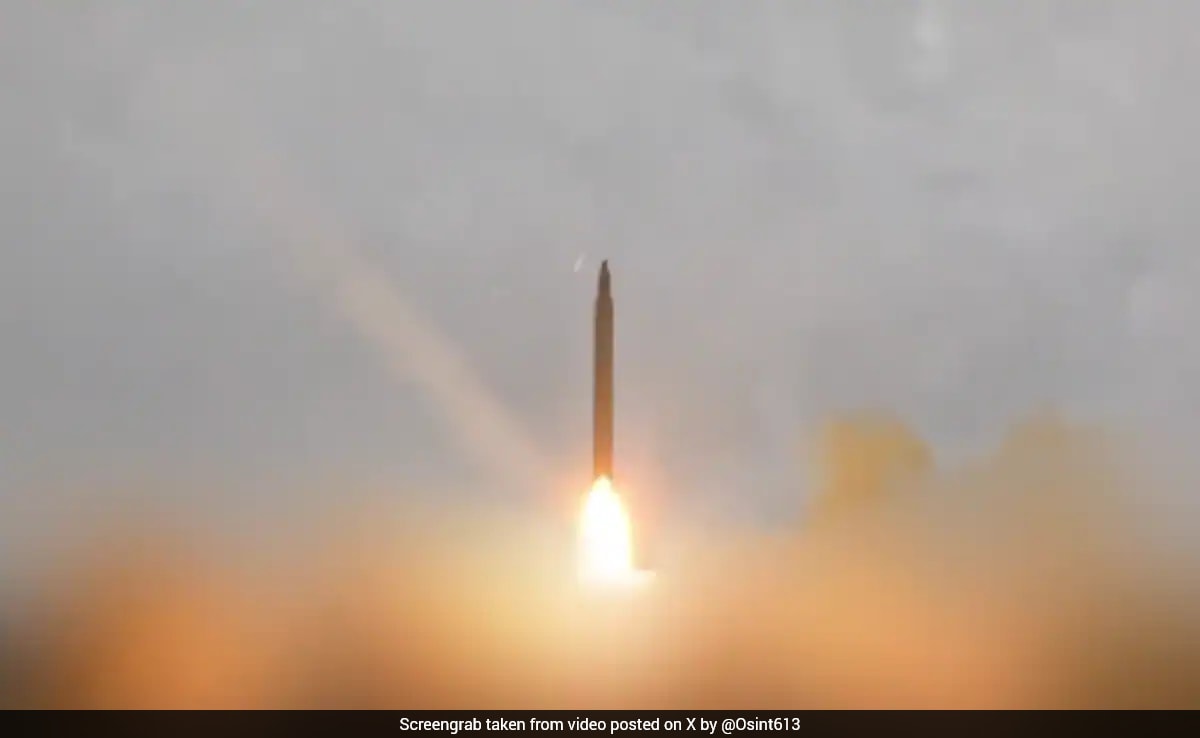
The long-standing fiction of Iran’s self-imposed 2,000-kilometer missile limit died in the early hours of March 20, 2026. When two intermediate-range ballistic missiles (IRBMs) streaked across the Indian Ocean toward the joint US-UK base at Diego Garcia, they didn’t just target a runway; they dismantled a decade of Western intelligence assumptions. This strike, covering nearly 4,000 kilometers, confirms that Tehran has moved past the era of regional containment and entered the business of intercontinental reach.
For years, Iranian officials like Foreign Minister Abbas Araghchi insisted that their arsenal was built for "regional defense," capped at a range that could hit Israel or Riyadh but spared Europe and remote US hubs. That limit was always a political choice, not a technical one. By attempting to strike Diego Garcia—a critical logistics node for B-2 bombers and the very platform used in the recent Operation Epic Fury—Tehran has signaled that no sanctuary is safe from its retaliatory reach.
The Khorramshahr Pivot
The hardware behind this escalation is not a mystery to those who have been watching the Khorramshahr series. While early variants were billed as 2,000-km systems, the underlying technology, derived from the North Korean BM-25 Musudan, was always capable of more. By lightening the warhead or refining the liquid-fuel propulsion, Iranian engineers have effectively doubled the "official" range of their most potent platform.
The missiles fired at Diego Garcia were likely Khorramshahr-4 variants. These systems utilize a high-energy liquid propellant that allows for a more compact airframe while maintaining a massive payload capacity. Unlike the solid-fuel Sejjil, which is easier to launch quickly, the liquid-fueled Khorramshahr allows for more granular control over thrust and burn time. This flexibility is what enables a missile designed for 2,000 kilometers to reach out and touch a target 4,000 kilometers away if the mission demands it.
Range vs Precision
- The 2,000-km Era: Focused on saturating regional air defenses with high-volume, medium-accuracy strikes.
- The 4,000-km Era: Targets strategic depth, forcing the US to spread its Aegis and THAAD assets across a much wider geographic footprint.
Engineering a Breakout
How does a nation under a massive air campaign, like the one led by the US and Israel since late February, manage to field unlisted capabilities? The answer lies in the Space Launch Vehicle (SLV) program. For years, the IRGC’s aerospace division has used the Ghaem-100 and Zuljanah rockets to "test" multi-stage separation and long-range guidance under the guise of a civilian space program.
A rocket that can put a satellite into orbit can, with a different nose cone and a steeper trajectory, deliver a warhead to a distant continent. The US intelligence community’s 2024 threat assessment warned that these SLVs would shorten the timeline for an ICBM. We are now seeing the fruits of that dual-use strategy. By masking military R&D as scientific progress, Tehran built an IRBM capability in plain sight while the West focused on the nuclear enrichment levels at Natanz.
The Logistics of Desperation
The strike on Diego Garcia was a failure in the kinetic sense—one missile suffered a mid-flight malfunction, and the other was reportedly intercepted by an SM-3 from a US Navy destroyer. However, the technical success is secondary to the strategic message. Iran is currently reeling from the loss of Supreme Leader Ali Khamenei and a systematic decapitation of its command structure. In this vacuum, the IRGC is attempting to prove that its "deterrence" remains intact.
To sustain this, Tehran is relying on a shadow supply chain. Despite the heavy bombardment of its domestic manufacturing sites, shipments of sodium perchlorate—a vital precursor for solid rocket fuel—have continued to flow from Chinese ports. This suggests that while the "front door" of Iranian industry is being hammered by F-35s, the "back door" remains open, allowing for the rapid assembly of hidden stockpiles.
The New Reach
The implications of a 4,000-km Iranian strike capability are profound for European security. If Diego Garcia is within range, then so is London, Paris, and Berlin. The old map of the Iranian threat, which largely focused on the "Ring of Fire" in the Middle East, is now obsolete. We are entering a phase where the IRGC can project power into the heart of NATO without needing a single ship or aircraft to leave Iranian territory.
This is not a hypothetical crisis. It is a reality born of a decade of underestimated technical ambition. The strike on Diego Garcia confirms that the "undeclared capabilities" often dismissed as propaganda by analysts are, in fact, operational hardware. The question is no longer whether Iran can hit targets at intercontinental distances, but how many of these long-reach systems they have hidden in the "Pickaxe Mountain" facilities that remain immune to conventional bunker-busters.
Would you like me to analyze the specific satellite imagery of the suspected Khorramshahr-4 launch sites in the Semnan Province?