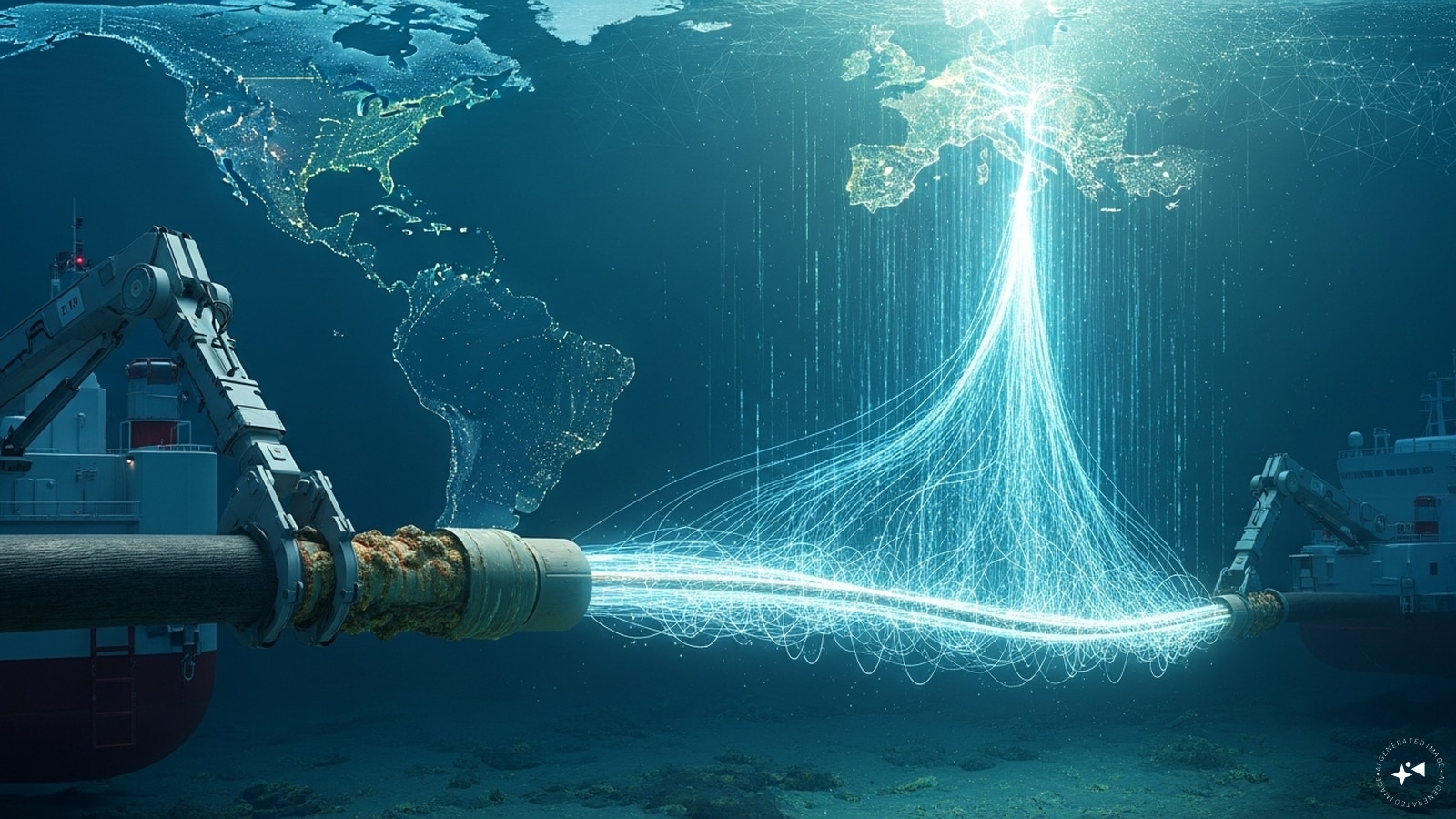
The floor of the North Atlantic is a graveyard of intentions. It is a silent, high-pressure world of absolute darkness where the skeletal remains of shipwrecks sit alongside something far more significant to your daily life: thousands of miles of dead cable. Among these, one specific relic stands as the ancestor of every text message, video call, and bank transfer you have ever made. It is TAT-8.
In 1988, when this thin line of glass and copper was lowered into the roiling grey waves, it didn't just connect New Jersey to the coastlines of Britain and France. It changed what it meant to be human. It shrunk the planet. But now, decades after the light inside it went dark, we are going back down to get it.
The recovery of TAT-8 isn’t just a salvage operation. It is an autopsy of the digital age.
The Day the World Got Small
Before 1988, talking across the ocean was an exercise in frustration and high costs. You relied on copper coaxial cables that could only handle a handful of calls at once, or satellites that introduced a maddening, one-second lag. You’d say "Hello," wait for the signal to bounce to space and back, and by the time you heard a response, the rhythm of human connection was already broken.
Then came the lasers.
Imagine a strand of glass as pure as a diamond and as thin as a human hair. Engineers realized that if they pulsed light through these fibers, they could carry data at speeds that seemed like sorcery. TAT-8 was the first of its kind—the first transatlantic fiber-optic cable.
When it went live, it didn't just increase capacity; it obliterated the old limits. It could carry 40,000 simultaneous telephone conversations. That might sound quaint in an era where a single 4K stream consumes more data, but in 1988, it was the equivalent of replacing a dirt path with a twelve-lane highway. Suddenly, the "global village" wasn't a metaphor. It was a physical reality sitting on the ocean floor.
The Loneliness of the Repeater
To understand the scale of this achievement, you have to picture the "Repeater." Because light fades as it travels through glass, engineers had to build massive, pressurized cylinders—repeaters—and splice them into the cable every 30 miles or so. These devices were designed to catch the dying light, amplify it, and scream it back into the next stretch of fiber.
Think about the stakes. These machines had to sit under two miles of salt water, enduring pressures that would crush a modern submarine like a soda can, and they had to work perfectly for 25 years without a single human hand ever touching them. If one failed, the internet of the 1980s simply died.
The people who built TAT-8 were gamblers playing with physics. They weren't just laying wire; they were stitching the nervous system of a new species. They fought through Atlantic gales and the terrifying technical reality that a single microscopic crack in the glass would render the entire $335 million project a length of very expensive junk.
The Return of the Cable Hunters
Everything eventually dies. By 2002, TAT-8 was obsolete. Newer cables, capable of carrying trillions of bits per second, made the pioneer look like a relic. The light was turned off. The repeaters went cold. For twenty years, TAT-8 sat in the silt, a ghost of the Cold War era, slowly being buried by the shifting sands of the deep.
But we aren't leaving it there.
A new breed of scavenger has emerged. These aren't pirates; they are specialized salvage crews using massive ships equipped with deep-sea grapnels and industrial winches. They are pulling the ghost back to the surface.
The motivation is rarely sentimentality. It is raw material.
TAT-8 is wrapped in an enormous amount of high-quality copper and steel, used to protect the fragile glass fibers and carry the electricity needed to power the repeaters. As the price of raw metals skyrockets, these dead cables have become underwater mines.
The process is violent and beautiful. A ship like the IT Intrepid drags a specialized hook across the seabed until it snags the line. Then, with agonizing slowness, the cable is hauled up from the abyss. As it breaks the surface, it brings with it the mud of the deep and the stories of a million forgotten phone calls.
The Ecological Gamble
There is a tension in this recovery. Some argue that these cables should stay buried. Over decades, they have become part of the benthic environment. Deep-sea creatures use them as artificial reefs. Sponges and cold-water corals grip the outer polyethylene skin, turning a telecommunications tool into a biological anchor.
However, the "leave it be" philosophy has a dark side. Modern cables are often damaged by fishing trawlers or anchors. When a new cable needs to be laid, these old "zombie" lines create a tangled web that makes modern maintenance a nightmare. Pulling up TAT-8 is a way of clearing the graveyard to make room for the living.
It is also a masterclass in recycling. The steel is melted down for construction. The copper finds its way into new electrical grids. Even the plastic casing is processed. There is something poetic about the fact that the cable which first let us hear a voice from across the sea is being melted down to perhaps power the very data centers that now host our digital lives.
The Invisible Infrastructure
We live in a wireless world, or so we tell ourselves. We talk about "The Cloud" as if our data is floating in the ether, ethereal and weightless.
This is a lie.
The internet is a physical thing. It is made of glass, copper, and grease. If you could drain the oceans, you would see a chaotic, shimmering web of cables connecting every continent, pulsing with the light of our collective desires, fears, and transactions.
TAT-8 was the first thread of that web.
When you see the grainy footage of a salvage crew hacking through a section of recovered cable on a wet deck in the middle of the Atlantic, you are looking at the umbilical cord of the modern world. It is thick, heavy, and smells of the deep. It reminds us that our digital existence is anchored in the physical earth.
The people who hauled the cable up don't see the ghosts of the conversations it once carried. They see tons of scrap metal. But for those who remember the world before the lag disappeared—before you could see your grandchildren on a screen in real-time from 5,000 miles away—the recovery of TAT-8 is like watching the demolition of a Great Wonder of the World.
We are pulling up our history, foot by grueling foot, and processing it for parts.
The cable is coming home. The Atlantic is becoming a little bit emptier, and our understanding of what it took to build this connected world is becoming a little bit clearer. We don't need the copper ghost anymore, but we should probably thank it for the silence it broke before it disappears into the furnace.
The winch turns. The cable groans. The sea gives up its secret.