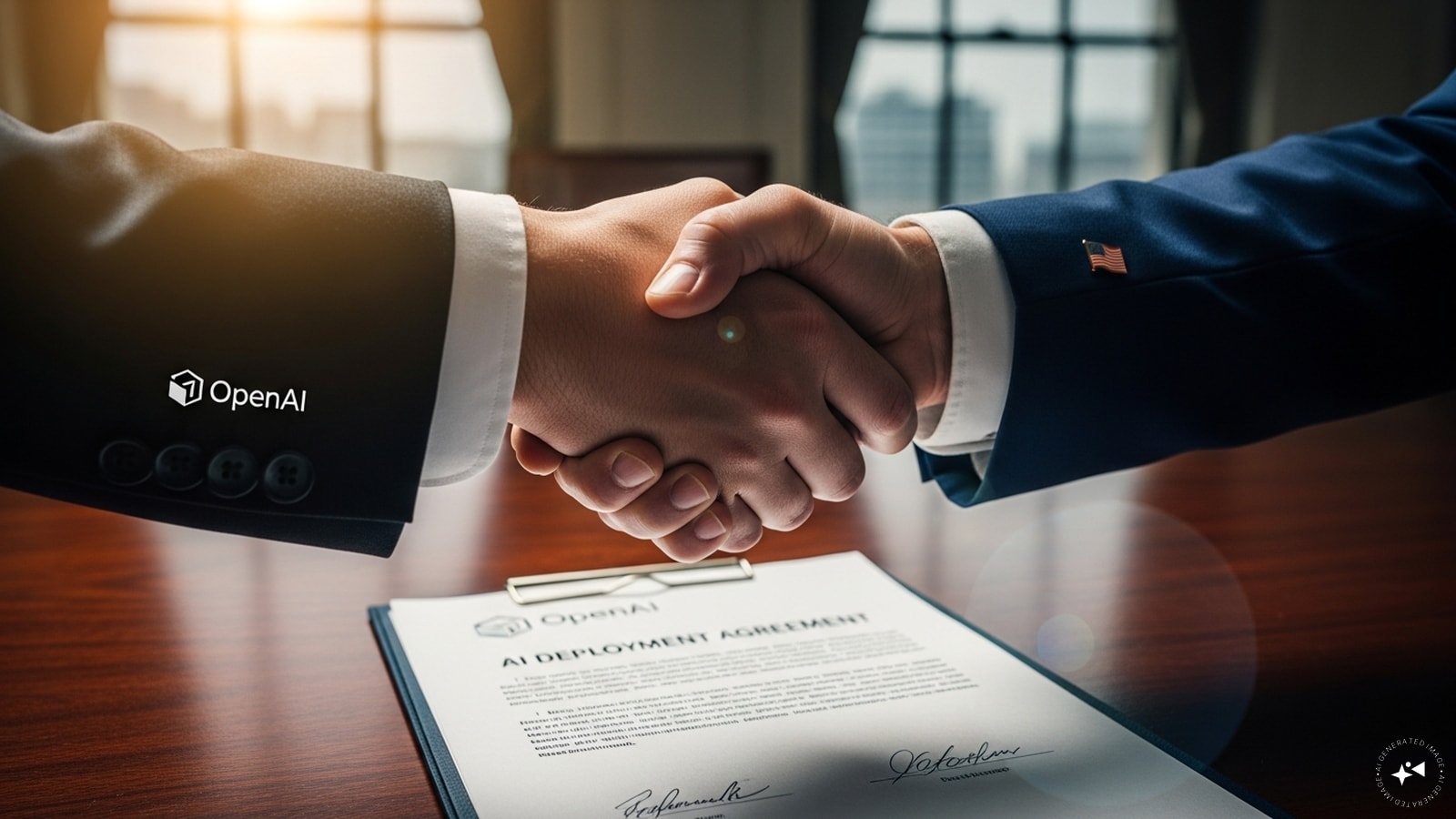
The naive consensus is that OpenAI’s deal to deploy models across the Pentagon’s classified networks is a simple procurement win. Most analysts are busy counting the contract dollars or clutching their pearls about "AI ethics." They are asking if Sam Altman sold his soul. They are missing the point entirely. This isn't about a startup getting a government contract. This is the moment the "Global Village" myth died. We are witnessing the hard pivot from Silicon Valley as a global utility to Silicon Valley as the R&D arm of the American state.
For a decade, big tech pretended to be nation-less. They built platforms for everyone, everywhere. They talked about "connecting the world" while ignoring that the world is composed of competing powers with zero interest in shared values. The Pentagon pact isn't a betrayal of OpenAI's mission; it is a brutal realization that in the age of generative intelligence, there is no such thing as a neutral model. If you aren't building the "Sovereign Stack" for your own side, you are effectively disarming. Also making waves in related news: The Logistics of Survival Structural Analysis of Ukraine Integrated Early Warning Systems.
The Myth of the Dual-Use Model
The "lazy consensus" argues that we can have one set of models for coding assistants and another for kinetic military operations. This is a technical delusion. The underlying weights of GPT-4o or any successor don't care if they are being used to debug a Python script or optimize a logistics chain for a carrier strike group.
When you deploy these models across Joint All-Domain Command and Control (JADC2) frameworks, you aren't just "using a tool." You are integrating a cognitive layer into the national defense architecture. This creates a permanent, irreversible feedback loop. The Pentagon provides the most high-stakes, "edge-case" data on earth. OpenAI provides the reasoning engine. Additional information on this are detailed by Wired.
The result isn't a "smarter" Pentagon. It is a specialized, militarized fork of American AI. If you think the "public" version of these models won't be shaped by the requirements of the classified version, you don't understand how weight-tuning works. The "Open" in OpenAI was already a joke. Now, the "AI" part is becoming a state secret.
Why the Ethics Debate is a Distraction
Every time a tech giant touches a defense contract, the same tired "Project Maven" debate resurfaces. Employees sign petitions. Activists talk about "autonomous killing machines." It’s theater.
The real danger isn't that the AI will decide to launch nukes. The real danger is Cognitive Lock-in.
I’ve seen organizations blow hundreds of millions trying to "wrap" consumer tech for specialized industries. It fails because the base model wasn't built for the specific ontology of that field. By moving into the Pentagon's classified networks—SIPRNet and JWICS—OpenAI is ensuring that the very way the military "thinks" about strategy, intelligence, and logistics will be filtered through OpenAI's specific brand of reinforcement learning from human feedback (RLHF).
We are handed a binary choice: either AI makes war "cleaner" through better targeting, or it makes it more likely through automation bias. Both are wrong. AI makes war more opaque. When a decision is made at the speed of compute, the "human in the loop" becomes a "human in the way." We aren't building a better soldier; we are building a system where the commander becomes a glorified quality assurance tester for a black-box output.
The Death of the International Market
If you are a CEO in Berlin, Riyadh, or Tokyo, how do you look at OpenAI today?
For years, the pitch was: "Trust us with your data, we are a platform."
The new reality is: "We are the primary cognitive infrastructure for the United States Department of Defense."
This deal marks the end of the American AI hegemony in the private sector abroad. It forces every other major power to build their own sovereign compute. You cannot run your national economy on a model that is functionally a subsidiary of the Pentagon. We are entering an era of Digital Mercantilism.
- France will double down on Mistral.
- China will accelerate its internal LLM development regardless of the compute cost.
- India will demand local data sovereignty that excludes US-based weights.
The "Global AI" dream is dead. It has been replaced by the "Iron Curtain of Compute."
The Technical Reality of Classified Deployment
Deploying an LLM in a "disconnected" or "air-gapped" environment is a nightmare that no one in the press is talking about. These models are famously brittle. They require massive telemetry to stay functional. They "drift" over time.
In a standard commercial environment, OpenAI can see when a model starts hallucinating and push a fix. In a classified environment, that umbilical cord is cut. The Pentagon is buying a snapshot of an intelligence that starts degrading the moment it is installed.
To solve this, OpenAI has to grant the government unprecedented access to the model's inner workings—or the government has to grant OpenAI employees unprecedented access to their most sensitive networks. There is no middle ground. This isn't a "software sale." It’s a merger.
The Problem with "Air-Gapped" Intelligence
- Hardware Constraints: Running a model with 1T+ parameters requires a massive H100/B200 cluster. You don't just "install" this on a laptop in a bunker. You have to build a classified data center that mimics the hyperscale cloud.
- Fine-tuning Paradox: To make the model useful for military intelligence, it must be fine-tuned on classified data. Once that happens, the model itself becomes a classified asset. It can never "leave" the network. The weights are now a weapon.
- Security Risks: Large Language Models are vulnerable to "prompt injection" and "data poisoning." If an adversary can influence the training data or the fine-tuning set, they can create "sleeper agents" within the military's decision-making engine.
Stop Asking About "Safety" and Start Asking About "Agency"
The "People Also Ask" section of the internet is obsessed with: "Will AI start a war?"
Wrong question.
The right question: "Who owns the agency of the American military when its decisions are derived from a proprietary algorithm?"
If the Pentagon relies on OpenAI to synthesize thousands of pages of signals intelligence (SIGINT) into a single actionable briefing, OpenAI's developers have more influence over foreign policy than the State Department. The bias of the model becomes the bias of the nation.
If the model is "aligned" to be cautious, the military becomes paralyzed by algorithmic risk-aversion. If the model is "aligned" to be assertive, we escalate by default. We are outsourcing the "gut feeling" of the commander to a probabilistic distribution of tokens.
The Counter-Intuitive Truth: This is a Weakness, Not a Strength
OpenAI's move into the Pentagon is an admission that the easy growth phase of "AI as a toy" or "AI as a chatbot" is over. The compute costs are so astronomical, and the path to AGI so expensive, that they have to run to the only entity with an infinite checkbook: the Military-Industrial Complex.
This isn't a sign of OpenAI's dominance. It’s a sign of their desperation for a "Permanent Moat." By embedding themselves in the national security infrastructure, they become "Too Big to Fail." They aren't just a tech company anymore; they are a utility. And utilities aren't known for innovation; they are known for rent-seeking and stagnation.
Actionable Reality for the C-Suite
If you are a business leader, stop waiting for "The One Model to Rule Them All."
- Diversify your Cognitive Supply Chain: If OpenAI is the Pentagon's choice, expect it to become increasingly restricted, censored, and monitored by federal authorities.
- Invest in On-Premise Small Language Models (SLMs): The real value in the next five years isn't in the massive, general-purpose models. It’s in models you own, run on your own hardware, and can air-gap yourself.
- Audit for Algorithmic Bias: If you are using models that are being "aligned" for military use, you need to understand how that affects their logic in a commercial setting.
The era of the "General Purpose AI" is ending. The era of the "Weaponized Model" has begun.
OpenAI didn't just join the Pentagon. They signaled to the rest of the world that the American tech industry is no longer a neutral partner. The lines are drawn. The weights are set. The only question left is whose side your compute is on.
Build your own stack or prepare to be a tenant in a digital garrison.