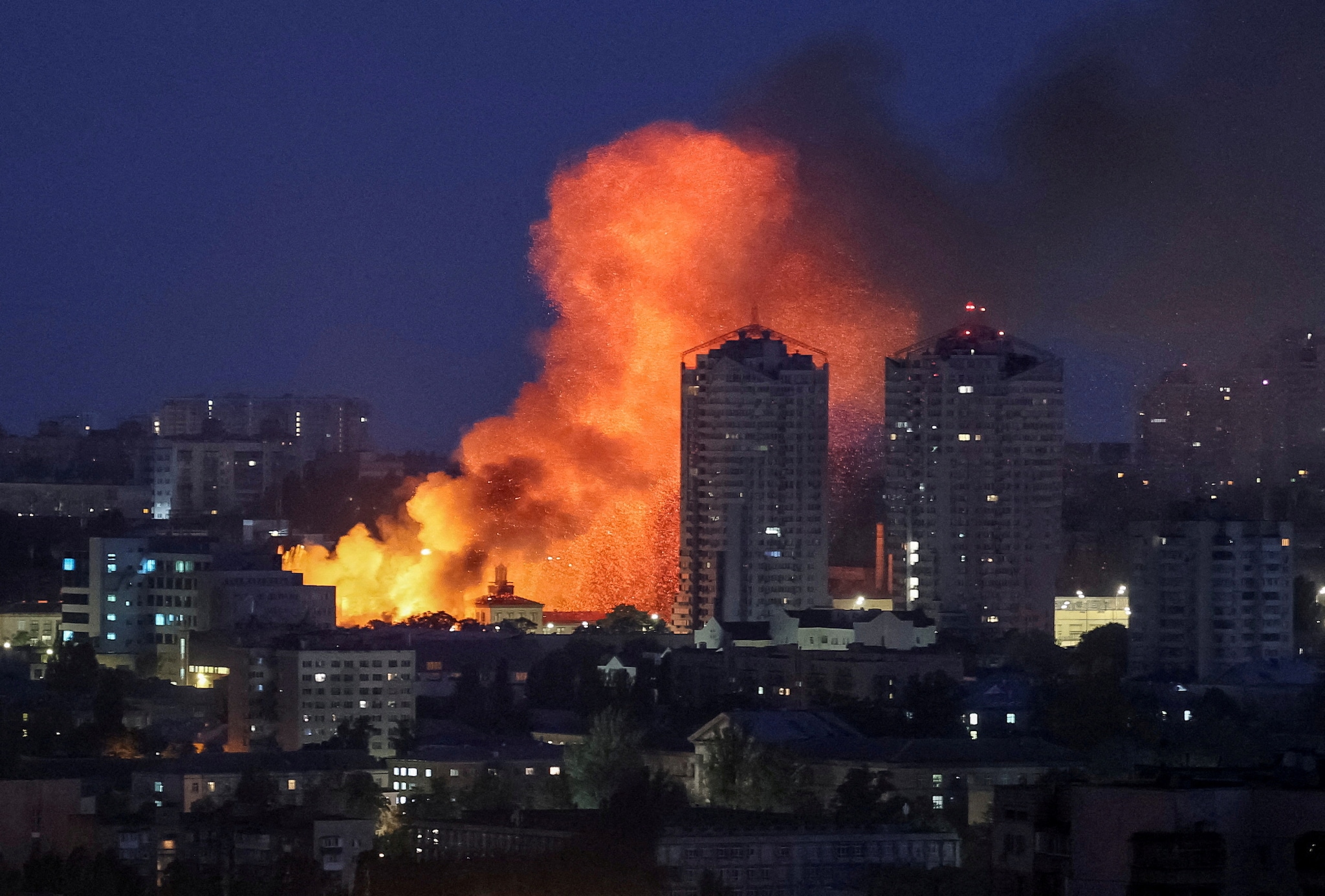
The headlines are predictable. They are almost scripted. "Russia hits Ukraine energy infrastructure." "Kyiv warns of blackouts." "Grid on the brink." Every major news outlet treats the destruction of a transformer or a turbine as a singular, catastrophic event—a chess piece taken off the board.
They are wrong. Don't forget to check out our previous article on this related article.
By focusing on the spectacular imagery of burning power plants, the media and high-level analysts are falling for the oldest trick in the book: confusing tactical damage with strategic defeat. The obsession with the "collapsing grid" narrative misses the fundamental evolution of modern energy warfare. We are not watching a 20th-century siege; we are witnessing the birth of the first truly decentralized, post-industrial energy resistance.
The Myth of the Centralized Knockout
The "lazy consensus" dictates that if you blow up enough substations, a country ceases to function. This is a relic of Cold War doctrine designed for a world that no longer exists. Analysts love to count missiles and calculate the percentage of "damaged capacity" as if the grid were a static bucket of water. If you poke enough holes, the bucket stays empty. To read more about the background of this, NPR offers an excellent summary.
In reality, the Ukrainian energy system is becoming a hydra. Every time a centralized thermal plant is neutralized, the system is forced to adapt toward a more resilient, fragmented model.
I’ve spent years analyzing high-voltage infrastructure and grid resilience. In the old world, a 750kV substation was a crown jewel. If it went down, an entire region went dark. But in 2024 and 2025, the "grid" isn't just the wires owned by the state. It is the millions of private lithium batteries, the thousands of modular gas turbines, and the industrial-scale diesel backups that don't show up on a bureaucrat’s map.
When Russia hits a major power hub, they aren't just spending a multimillion-dollar Kh-101 cruise missile to "turn off the lights." They are inadvertently accelerating the transition to a decentralized energy model that is actually harder to kill.
The Logistics of the Lie
Let’s talk about the math that the "experts" ignore.
The cost-to-damage ratio is increasingly favoring the defender. A cruise missile costs between $1 million and $13 million depending on the variant. A high-voltage transformer? Expensive, yes. Hard to replace? Certainly. But the global supply chain for mid-tier electrical components has shifted. What used to take two years to manufacture is now being bypassed by modular, mobile substations provided by allies.
- Scenario: Russia fires a $5 million missile to hit a stationary cooling tower.
- Response: The defender uses $50,000 in Western-donated parts to reroute power through a redundant, low-voltage line.
The media reports the fire. They don't report the rerouting. They don't report that the "total blackout" lasted four hours instead of four weeks because the grid's topology has been re-engineered on the fly. We are seeing "Packet Switching" applied to electricity. Much like the internet was designed to survive a nuclear strike by moving data through any available path, the Ukrainian grid is learning to move electrons through a chaotic, non-linear web.
The Battery Revolution is the Real Front Line
If you want to understand why the grid hasn't stayed dead despite years of bombardment, stop looking at the power plants. Look at the basements.
The proliferation of high-capacity energy storage systems (ESS) has fundamentally changed the social contract of energy. In a traditional war of attrition, the state provides power, and the citizen consumes it. When the state fails, the citizen revolts or flees.
That hasn't happened. Why? Because the "grid" has been privatized at the household level. Portable power stations and home-scale solar arrays have created a baseline of "survival electricity" that is immune to cruise missiles. You cannot target 500,000 individual EcoFlow units or Tesla Powerwalls with a drone swarm.
This is the nuance the "consensus" misses: Energy sovereignty is moving from the macro to the micro. The more the centralized grid is attacked, the more the population invests in independent power. Russia is essentially bombing a 1950s business model, while the population moves to a 2030s technology stack.
Why the "Energy Terror" Narrative Fails
The term "Energy Terror" is used to describe these strikes. It’s a great phrase for a press release, but it’s a poor framework for military analysis. Terror requires a psychological breaking point.
When you attack a grid, you are banking on the idea that cold and dark will lead to a collapse of will. But history shows the opposite. Infrastructure attacks tend to harden civilian resolve. More importantly, they trigger a massive influx of technical expertise.
I have seen industrial sectors in the West attempt "digital transformations" that take decades. Ukraine’s energy sector has undergone a decade’s worth of hardening and diversification in twenty-four months. They are now the global experts in high-voltage repair under fire. If you want to know how to keep a city running when its primary 330kV lines are severed, you don't call a consultant in London or D.C. You call an engineer in Kharkiv.
The Brutal Truth of Over-Optimization
The West is actually more vulnerable to these types of attacks than Ukraine is now. Our grids are "over-optimized" for efficiency and profit. We have stripped away redundancy to save on maintenance costs. Ukraine, by necessity, has stripped away efficiency for the sake of survival.
A "perfect" grid is a fragile grid. A messy, patched-together, redundant, and decentralized grid is a resilient one.
When Russia hits a power plant, they are attacking a ghost. The capacity they think they are destroying is being replaced by a shadow grid of renewables, storage, and small-scale gas generation. The "Energy Infrastructure" described in the news is a shell. The real infrastructure is the distributed intelligence of the people managing the flow.
The Wrong Questions
People always ask: "Can the grid survive another winter?"
That is the wrong question. It assumes the grid is a binary—either it works or it doesn't.
The right question is: "How much more resilient has the grid become because of these attacks?"
The answer is uncomfortable for the Kremlin. Every missile strike is a lesson in rerouting. Every destroyed transformer is an opportunity to install a modern, more efficient digital unit. Russia is effectively subsidizing the modernization of the Ukrainian grid through the most expensive and violent "stress test" in human history.
Stop Looking for the "Big Red Switch"
The fantasy of the "Big Red Switch"—the idea that one massive strike can turn off a nation—is dead.
The modern energy landscape is too fragmented. Even if you destroyed every single thermal and hydro plant, the nuclear core remains, and the distribution network is now so scarred and repaired that it has become a complex adaptive system. It doesn't follow a manual anymore.
The competitor's article focuses on the smoke. You should focus on the batteries. The smoke is a distraction; the batteries are the revolution.
War is often a catalyst for technological leaps. In this case, the leap is the total rejection of centralized vulnerability. The era of the "vulnerable grid" is ending, not because the missiles stopped flying, but because the targets stopped mattering.
Throw away your maps of the power lines. They are drawings of a world that has already been replaced by something much harder to burn.