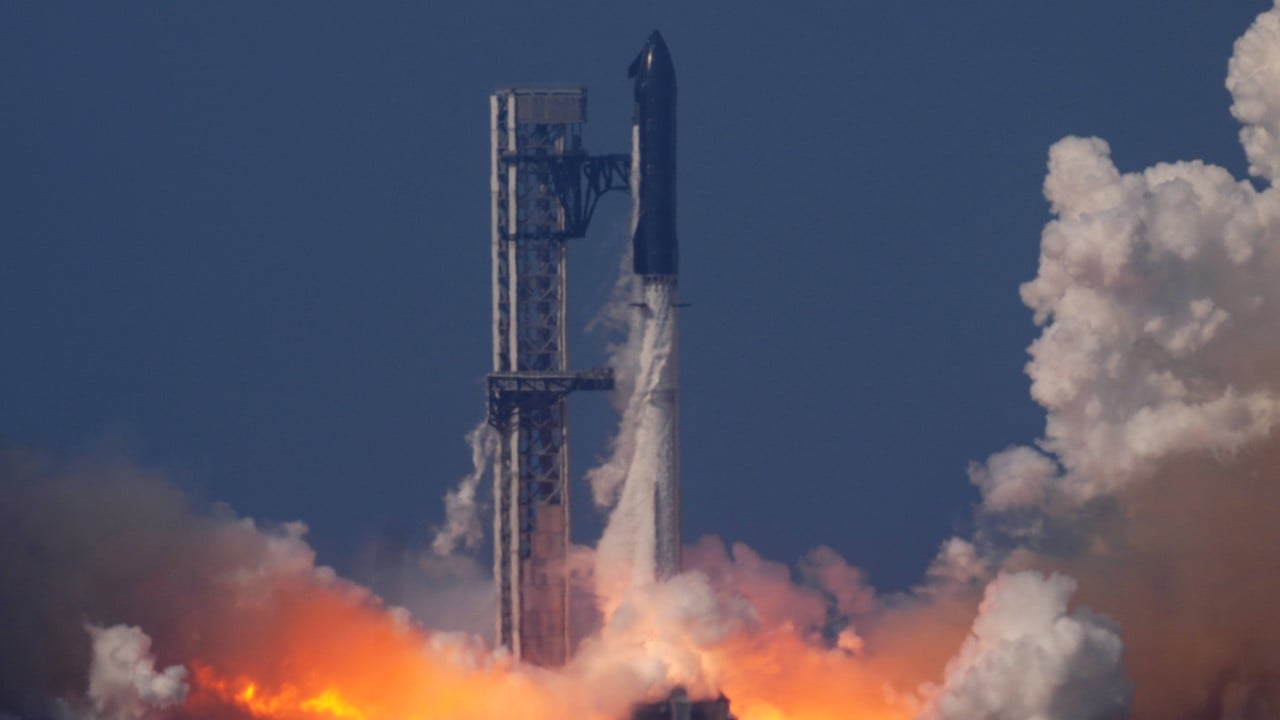
SpaceX launched its largest, most heavily redesigned mega-rocket on a high-stakes test flight from the southern coast of Texas, introducing a third-generation architecture that fundamentally alters the company's timeline for reaching the Moon.
The vehicle, designated Starship Version 3 (V3), stood an unprecedented 407 feet tall on a newly constructed launchpad at Starbase. It carried a payload of 20 mock Starlink satellites destined for deployment over the Indian Ocean. While mainstream headlines focused on the sheer scale of the machine and its increased engine thrust, the reality of this flight represents something far more critical. SpaceX is racing against a narrowing window of financial and regulatory tolerance, fundamentally altering its engineering strategy to satisfy both its federal masters and Wall Street.
To understand why this launch mattered, one must look past the spectacular smoke plumes and examine the cold mathematics of modern space flight. The previous generation of hardware, Block 2, suffered a string of brutal in-space structural failures throughout 2025. Those losses forced Elon Musk to fast-track an entirely new vehicle architecture. This is not just a routine iterative update. It is a desperate engineering pivot designed to fix deep-seated propulsive leaks and structural flaws that threatened to derail NASA’s multi-billion-dollar Artemis program.
The Flawed Legacy of Block 2
SpaceX has long championed an iterative development philosophy where vehicles are pushed to failure, data is collected from the wreckage, and the design is updated for the next build. That system worked brilliantly for the smaller Falcon 9 rocket. For a machine the size of Starship, however, the financial and temporal costs of catastrophic failures are beginning to compound.
The structural limits of the older design became painfully clear during Flight 7 in early 2025. That vehicle suffered a massive propellant leak during its initial upper-stage burn, causing a premature engine shutdown and a total loss of telemetry. The autonomous flight safety system ultimately tore the ship apart over the Atlantic. Flights 8 and 9 told a similar story of out-of-control spins, failed payload door deployments, and atmospheric disintegrations.
The underlying problem was fundamental. The older hull lacked the rigidity required to withstand the immense hydrodynamic pressures of atmospheric exit while simultaneously managing the complex plumbing of its cryogenic liquid methane and liquid oxygen tanks.
The V3 architecture addresses these structural deficiencies by lengthening the vehicle by four feet, widening internal support rings, and completely revising the avionics bay. The Raptor engines powering the booster and upper stage have been upgraded to provide higher chamber pressures and more reliable valve sealing.
The Logistics of the Moon Mission
NASA is pouring billions into SpaceX to develop the Human Landing System for the Artemis III mission, currently targeted for the end of 2027. Yet a single, successful launch of a beefed-up V3 Starship does nothing to solve the program's most glaring technical hurdle.
Orbital refueling remains the ultimate gatekeeper for deep space exploration.
A standard Starship upper stage cannot simply blast off from Earth and fly directly to the lunar surface. It burns nearly all its propellant just reaching low Earth orbit. To send an astronaut-carrying variant to the Moon, SpaceX must first launch a specialized fuel depot ship. After that, a fleet of tanker Starships must launch in rapid succession—historically estimated between 8 and 14 separate flights—to fill that depot in orbit. Only then can the lunar lander dock, fill its tanks, and depart for the Moon.
Consider the operational cadence required to pull this off. SpaceX has never launched the same class of rocket multiple times in a single week, let alone a single month. The May 2026 test flight utilized a completely separate, newly built launch infrastructure called Pad 2. The upgraded propellant farm features higher-capacity pumps designed to slash the time needed to load super-cooled liquid methane. But building two pads does not solve a ten-fold logistics bottleneck.
If a single valve fails or a pad requires weeks of refurbishment between launches, the cryogenic fuel stored in the orbital depot will begin to boil off. The entire mission chain could collapse under its own weight.
The IPO Shadow and the Shift to Expendability
The timing of the V3 debut is tied to another, more earthbound factor. The launch occurred a mere 48 hours after Musk announced plans to take SpaceX public through an initial public offering.
For over two decades, SpaceX operated as a private entity, shielded from the short-term earnings pressure of public markets. That insulation allowed the company to blow up multi-million-dollar prototypes with minimal consequence to its valuation. A public company faces a much harsher reality. Shareholders rarely tolerate spectacular mid-air explosions categorized as successful data-gathering exercises.
This shifting corporate landscape explains a striking detail about the latest test flight. Despite mastering the art of catching the Super Heavy booster with mechanical tower arms during Flight 5, SpaceX chose to recover absolutely nothing during this mission.
The first-stage booster was intentionally dropped into the Gulf of Mexico. The upper stage was directed toward a destructive, high-energy splashdown in the Indian Ocean.
Why abandon reusability on the grandest test flight to date? The answer lies in risk mitigation.
Attempting a tower catch with an unproven, heavier booster architecture carries a catastrophic downside risk. If the V3 booster drifted off-course or experienced an uncommanded engine shutdown during the final seconds of descent, it could have obliterated Pad 2 and the massive mechanical tower arms. Losing a prototype rocket is an acceptable expense. Losing a brand-new, hundreds-of-millions-of-dollars launch pad on the eve of an IPO roadshow is a financial disaster.
The Creeping Competition from Blue Origin
While SpaceX has dominated the aerospace narrative, its primary competitor is quietly positioning itself to exploit any further delays in the Starship timeline.
Jeff Bezos’s Blue Origin is developing the Blue Moon lander under a separate, parallel NASA contract. For years, Blue Origin was mocked within the industry for its slow, methodical, and arguably stagnant pace. That dynamic is shifting. Blue Origin recently paused its lucrative suborbital space tourism flights to reallocate its entire engineering workforce toward orbital hardware.
A prototype of the Blue Moon lander is scheduled for a suborbital trial run later this year. Unlike Starship, which requires a massive fleet of refueling flights, the Blue Moon architecture relies on a highly efficient liquid hydrogen propulsion system designed to minimize the number of required orbital transfers.
SpaceX is acutely aware that NASA’s loyalty is contingent on performance. If the V3 architecture continues to suffer the plumbing and structural gremlins that plagued the 2025 campaign, federal flight directors have a contractual mechanism to pivot funding toward Blue Origin.
The Dangerous Myth of Predictable Iteration
The aerospace industry loves a narrative of clean, exponential progress. The reality of the V3 test flight reveals a far messier truth. SpaceX has built the largest flying machine in human history, but in doing so, it has pushed the boundaries of material science to a point where historical precedents no longer apply.
The sheer mass of a 407-foot vehicle introduces acoustic vibrations and thermal stresses that cannot be fully modeled in a simulation. Every time the 33 Raptor engines ignite, they exert over 20 million pounds of thrust against the launch pad and the vehicle's own thrust puck. The metallurgical strain on those components is immense.
The V3 launch proved that SpaceX can build a bigger hammer. It did not prove that the hammer can reliably build a bridge to the Moon. The coming months will reveal whether this heavier, beefed-up architecture can achieve the flawless orbital insertion and rapid turn-around times required to fulfill its commercial and federal mandates, or if the sheer complexity of the system will force yet another costly ground-up redesign under the watchful, unforgiving eye of public market investors.