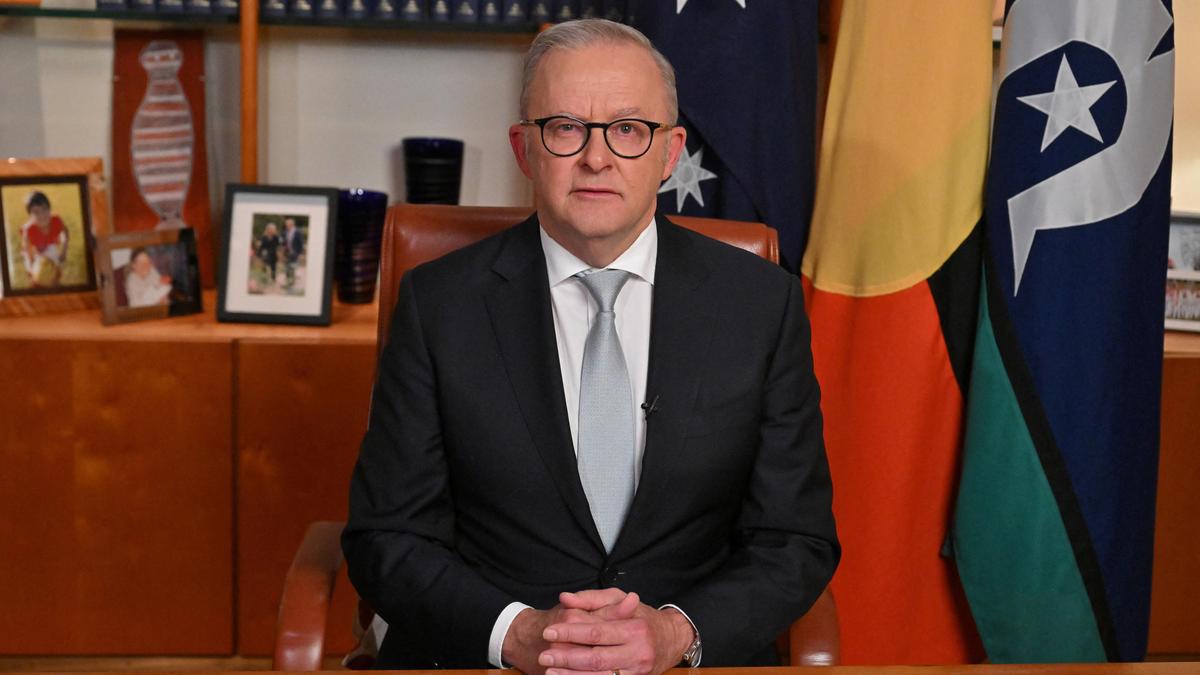
Prime Minister Anthony Albanese recently warned Australians that the economic tremors of global conflict will shake household budgets for months. His solution for the average commuter is a pivot toward public transport to dodge skyrocketing fuel prices. It sounds like sensible, kitchen-table advice. However, a deep dive into the nation’s infrastructure and the current energy market reveals a much grimmer reality. The suggestion to "hop on a bus" ignores a massive geographical and economic divide that makes fuel costs an unavoidable tax on the working class.
The shockwaves from international instability have hit Australia’s fuel pumps with a speed that local wages simply cannot match. While the government points toward the train station, millions of Australians live in "transport deserts" where the nearest reliable bus route is a twenty-minute drive away. This isn't just about convenience. It is about a fundamental failure to align urban planning with energy security.
The Mirage of Accessible Alternatives
The advice to switch to public transport assumes a level of service density that exists only in the inner-city bubbles of Sydney, Melbourne, and Brisbane. For the sprawling suburbs and regional hubs where the majority of the workforce actually resides, the choice is nonexistent. If your commute takes forty minutes by car but two hours and three transfers by rail, you aren't "choosing" to drive. You are being forced to pay a premium to keep your job.
We are seeing a widening gap between the "commuter elite" and the "suburban essential workers." Those in high-density areas can absorb the shock of fuel prices by walking or cycling. Meanwhile, the tradespeople, nurses, and logistics staff who keep the country running are tethered to their vehicles. When the Prime Minister suggests using public transport, he is addressing a segment of the population that likely already uses it, while offering no tangible relief to those who cannot.
Energy Markets and the Long Tail of Inflation
The "months" of economic shock mentioned by the leadership is an optimistic estimate. Global energy supply chains are not a faucet that can be turned back on with a flick of a wrist. Australia, despite being an energy-rich nation, remains a price-taker on the world stage for refined fuels. We export crude and import the finished product, leaving us at the mercy of shipping lanes and overseas refinery margins.
The Refinement Gap
Australia has seen a steady decline in domestic refining capacity over the last decade. This leaves the domestic market exposed to every geopolitical twitch in the Middle East or Eastern Europe. When international prices spike, the impact hits Australian bowsers within days. When they fall, the "rocket and feather" effect ensures that prices drift down slowly, keeping the pressure on household spending for as long as possible.
This lag in price reduction means that even if global tensions eased tomorrow, the inflationary pressure on food and logistics would persist. Every truck delivering groceries to a supermarket is running on expensive diesel. Those costs are passed to the consumer at the checkout, creating a secondary wave of inflation that public transport cannot solve.
The Urban Planning Debt
For thirty years, Australian cities have been built on the assumption of cheap, infinite petrol. We developed sprawling "fringe" suburbs with limited infrastructure, betting that every household would own two or three cars. That bet is now being called in. The current crisis has exposed this suburban model as a high-risk gamble.
The government’s push for public transport highlights a massive infrastructure debt. To make a meaningful dent in fuel consumption, the network would need a level of investment that hasn't been seen in generations. High-frequency rail and integrated bus networks are expensive and take decades to build. Suggesting their use today, in the middle of a price spike, is like telling a man whose house is on fire that he should have invested in a better sprinkler system years ago.
The Economic Weight of the Commute
The cost of commuting is becoming a significant portion of the total cost of living, rivaling rent and mortgages in some demographics. When fuel hits two dollars a litre, a sixty-kilometre daily round trip adds up to a staggering monthly bill. For a family on a median income, this is not a discretionary expense that can be trimmed. It is a fixed cost of participation in the workforce.
The Productivity Trap
There is also a hidden cost to the public transport shift that few analysts are discussing. If a worker is forced to add two hours to their daily travel time to save thirty dollars in fuel, the loss in productivity and personal well-being is immense. That is time taken away from family, from local spending, and from rest. The economic "savings" of the bus fare are often offset by the social and personal toll of a crumbling transport experience.
We are entering a period where "efficiency" is no longer a buzzword but a survival tactic. The government is attempting to manage expectations by framing the situation as a temporary hurdle. But for the person staring at the total on the fuel pump in a suburb with no train line, it feels like a permanent shift in their quality of life.
Dissecting the Policy Response
So far, the federal response has focused on rhetoric rather than structural change. Cutting fuel excise is a temporary fix that drains revenue from the very roads people are forced to use. It’s a band-aid on a gash. True resilience would require a radical shift in how we power our transport sector—specifically, a faster transition to electric heavy vehicles and a massive expansion of regional rail that doesn't just serve the city centers.
The current strategy relies on the hope that global markets will stabilize before the public's patience runs out. It is a reactive stance. A veteran analyst knows that hope is not a strategy. The "economic shock" isn't just about the war; it’s about the vulnerability of a nation that outsourced its energy security and ignored its urban sprawl for too long.
The Regional Squeeze
Small towns and regional centers are feeling a different kind of pain. In these areas, public transport isn't just infrequent; it is often nonexistent. Farmers and regional business owners face a double blow. They pay more to get their products to market, and they pay more just to get to the grocery store.
The Prime Minister’s call for a shift in habits rings hollow in places like Dubbo, Townsville, or the Gippsland. In these regions, the vehicle is a lifeline, not a luxury. The lack of a nuanced policy that differentiates between the needs of a Sydney CBD worker and a regional primary producer suggests a disconnect at the heart of the current administration’s economic planning.
Fixed Costs in a Fluid World
The reality is that Australia’s economy is built on movement. We are a massive landmass with a small population, and everything we eat, wear, or use travels thousands of kilometres before it reaches us. When you tax movement through high fuel prices, you tax everything.
While the rhetoric focuses on individual choices at the pump, the real story is the systemic inability to pivot. Business owners are currently looking at their ledgers and realizing that "using the bus" isn't an option for their delivery vans or their sales teams. They have two choices: raise prices or go out of business. Most are choosing the former, which ensures that the "months" of shock will likely stretch into years of higher prices across the board.
The government needs to stop treating this as a temporary weather event and start treating it as a permanent climate shift. The era of cheap energy that fueled our suburban expansion is over. Telling people to take the train is a convenient deflection from the much harder work of rebuilding a nation’s energy independence and redesigning its cities for a world where every drop of fuel is a geopolitical liability.
If you are waiting for prices to return to "normal," you are looking at the wrong map. The new normal is a high-cost, high-friction environment where the distance between your home and your job is the most important financial metric you own. The political class is asking you to change your habits because they have no immediate way to change the system.
Stop looking at the fuel gauge and start looking at the lack of tracks in your neighborhood. That is where the real crisis lies.