In a move that serves as a stinging indictment of Western military procurement, Ukraine has dispatched a specialized team of drone pilots and interceptor systems to Jordan to protect American military bases. President Volodymyr Zelenskyy confirmed the deployment following a direct, urgent request from Washington. The arrival of these experts marks a stunning reversal of the traditional teacher-student dynamic between the U.S. and its allies. For decades, the Pentagon exported "security" in the form of billion-dollar platforms. Today, the world's superpower is effectively calling for tech support from a nation currently fighting for its survival.
The core of the problem is a mathematical catastrophe that the Department of Defense can no longer ignore. Since the onset of the war in Iran and the escalating drone campaign by Russian-aligned forces, the U.S. has been forced to defend its outposts using the tools it has on hand. These tools are breathtakingly expensive. Launching a $3 million Patriot missile to swat down a $50,000 Iranian-made Shahed drone is not a sustainable strategy. It is a slow-motion bankruptcy.
The Arithmetic of Attrition
When a swarm of twenty Shahed drones approaches a base like Tower 22 or any of the dispersed outposts in Jordan, the economic victory goes to the attacker before a single explosion occurs. If the U.S. fires its interceptors, it depletes a stockpile that takes years to replenish. If it doesn't fire, it risks American lives. Ukraine, by contrast, has spent three years solving this specific puzzle with terrifying efficiency.
The "Ukrainian way" of drone defense is built on a layered architecture that prioritizes cost-per-kill. While the U.S. was refining its exquisite, high-altitude radar systems, Ukrainian engineers were in garages and state labs perfecting the "Sting" interceptor—a quadcopter capable of 300 km/h that physically rams or detonates against incoming suicide drones.
These interceptors cost roughly $2,500.
Compare that to the PAC-3 missile. The ratio is approximately 1,200 to 1. By deploying these systems to Jordan, the U.S. is not just looking for more "eyes" on the sky; it is looking for a way to stop hemorrhaging money and munitions that are desperately needed elsewhere.
The Jordan Outposts and the Visibility Gap
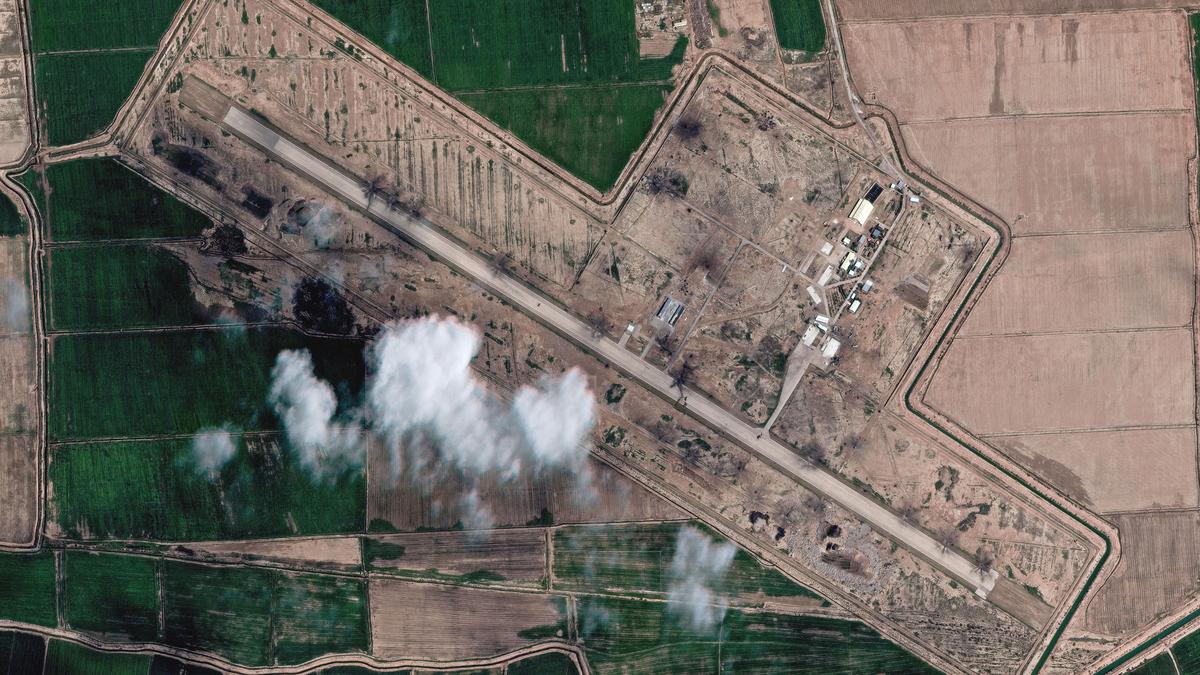
The specific vulnerability in Jordan is an open secret in defense circles. Many of these bases are located in flat, desert terrain where low-flying, slow-moving drones can exploit the "clutter" near the ground, staying beneath the horizon of traditional air defense radars. The 2024 attack on Tower 22, which killed three U.S. soldiers, proved that even the most advanced electronic warfare suites can be bypassed if the drone's flight path is sufficiently low and its guidance system is autonomous.
Ukraine’s solution involves a decentralized network of acoustic sensors and visual observers linked by a proprietary software backbone called Delta.
What Ukraine Brings to the Middle East
- Combat-Hardened Pilots: Operators who have successfully intercepted thousands of Shahed-type drones in real-world conditions.
- Low-Cost Interceptors: Systems like the Wild Hornets "Sting" and the Project Eagle "Merops" that provide a kinetic kill for less than the price of a used sedan.
- The Data Loop: A philosophy of "continuous adaptation" where software is updated weekly to counter new Iranian electronic warfare frequencies.
The Price of Admission
Zelenskyy’s decision to send these experts during a domestic crisis is not an act of charity. It is a sophisticated diplomatic trade. Kyiv is offering its "know-how" in exchange for the very things its cheap drones cannot replace: ballistic missile defense.
The logic is crystalline. If the U.S. and its Gulf partners (who are also lining up for Ukrainian tech) can defend their bases using cheap Ukrainian interceptors, it preserves the global supply of Patriot and NASAMS missiles. Those missiles can then be diverted to Kyiv to protect its cities from Russian Iskander and Zircon missiles—threats that a $2,500 quadcopter has no hope of stopping.
This isn't just a military deployment; it’s a technological barter system born of necessity.
The Failure of the Defense Industrial Complex
There is a certain irony in the fact that the U.S. military, with its $800 billion budget, must rely on a nation using 3D-printed components and open-source flight controllers. This situation highlights a systemic failure in Western defense acquisition. The "Big Prime" contractors—Lockheed Martin, Raytheon, Boeing—are designed to build masterpieces of engineering over ten-year cycles. They are not built to iterate at the speed of a software startup.
Ukraine's drone industry operates on a "fail fast" model. When the Russians change a frequency, the Ukrainians change their code by morning. This agility is exactly what is missing from the rigid structures protecting U.S. assets in the Middle East. The specialists arriving in Jordan are bringing more than just hardware; they are bringing a mindset that views the battlefield as a live-streamed data environment rather than a static theater of operations.
A New Standard for Global Security
The implications of this deployment extend far beyond the borders of Jordan. We are witnessing the birth of a new era where "expertise" is the most valuable currency, regardless of a nation's GDP. The Middle East, long a playground for Western defense sales, is now looking toward Eastern Europe for the future of warfare. Leaders in the UAE, Qatar, and Saudi Arabia have already made inquiries. They have seen the footage. They know that a swarm of $50,000 drones can paralyze a multi-billion dollar oil facility or a carrier strike group.
The Ukrainian experts in Jordan are the vanguard of this shift. They represent the first time a non-NATO power has provided the "critical path" for U.S. force protection. It is a moment of profound humility for the Pentagon, and a moment of undeniable leverage for Kyiv.
The era of the "unbeatable" high-cost defense system is over. The age of the $2,500 drone killer has arrived, and it is being written in the sand of the Jordanian desert by people who learned their craft under the fire of the largest artillery war in a generation.
Would you like me to analyze the specific technical specifications of the Ukrainian "Sting" interceptor drones versus the Iranian Shahed-136 to see where the vulnerabilities lie?