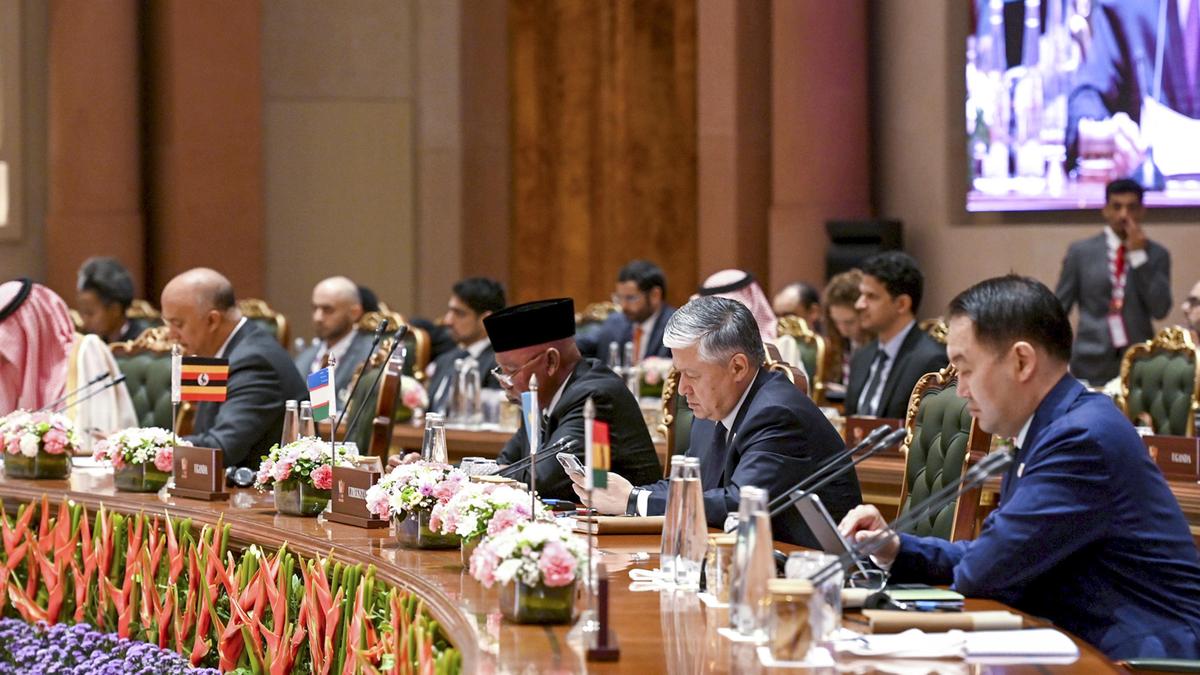
The BRICS bloc has officially moved beyond its origins as an investment acronym to become a geopolitical counterweight. By formally backing the creation of an independent State of Palestine based on 1967 borders with East Jerusalem as its capital, the expanded alliance—now including heavyweights like Saudi Arabia, Iran, and Egypt—is signaling a definitive break from the U.S.-led "peace process" that has dominated the Middle East for three decades. This is not merely a symbolic gesture. It is a calculated move to fill a diplomatic vacuum left by Western indecision and to solidify a non-Western consensus on one of the most volatile issues in modern history.
While the G7 remains entangled in the complexities of military aid and internal political divisions, BRICS is leveraging its growing membership to present a unified front. The shift is significant because it brings together nations that were historically on opposite sides of the regional divide, such as Riyadh and Tehran, under a single diplomatic banner. By demanding a sovereign Palestinian state, the bloc is positioning itself as the primary advocate for the "Global South," effectively challenging the moral and political authority of the traditional powers in Washington and Brussels.
Beyond the Rhetoric of UN Resolutions
Diplomatic statements are often dismissed as cheap talk. However, the timing of this consensus suggests a deeper strategy aimed at the structural reform of international governance. The BRICS nations are not just asking for a policy change; they are highlighting the perceived failure of the United Nations Security Council to enforce its own resolutions.
When Brazil, Russia, India, China, and South Africa first formed this group, the focus was almost entirely on trade and credit. Today, the inclusion of Middle Eastern powers has forced a pivot toward security and sovereignty. The collective weight of these nations represents nearly half of the world’s population and a massive share of global GDP. When they speak with one voice on Palestinian statehood, it forces a realignment of how "consensus" is defined in international law.
The bloc’s insistence on the 1967 borders is a direct rejection of more recent proposals that suggested land swaps or fragmented territories. By sticking to these specific parameters, BRICS is attempting to reset the clock on negotiations to a point where international law was more clearly defined, even if the ground reality has changed significantly since then.
The Economic Leverage of the New Members
Money talks louder than manifestos. The recent expansion of BRICS is the engine behind this newfound political aggression. With the United Arab Emirates and Saudi Arabia in the fold, the bloc controls a significant portion of the world’s energy supply and sovereign wealth.
This economic reality provides a safety net for countries that might otherwise fear Western sanctions or diplomatic blowback. If the West chooses to ignore the BRICS mandate, they aren't just ignoring a few developing nations; they are ignoring their own primary energy suppliers and some of the largest buyers of their debt. This interdependency makes it difficult for the U.S. to dismiss the BRICS stance as fringe or irrelevant.
Furthermore, the talk of an "independent" state includes the necessity of economic viability. The BRICS vision hints at a future where reconstruction and trade for a Palestinian state could be financed through the New Development Bank (NDB), bypassing the conditionalities often attached to IMF or World Bank loans. This offers a tangible, albeit difficult, path toward sovereignty that doesn't rely on the permission of the traditional financial centers.
The China-Russia Dynamic
Beijing and Moscow have different motivations but a shared goal: the reduction of American influence in the Levant. For China, the Palestine issue is an opportunity to showcase its "Global Security Initiative," which emphasizes mediation over military intervention. Following their successful brokerage of the Saudi-Iran detente, Chinese diplomats see the Palestinian cause as the next logical step in proving that a "Pax Sinica" can succeed where Western diplomacy stalled.
Russia, meanwhile, views the BRICS stance as a way to break out of the diplomatic isolation imposed by the West since 2022. By aligning itself with the popular sentiment of the Arab world and the broader Global South, Moscow ensures it remains a central player in global affairs. For both powers, Palestine serves as a litmus test for a multipolar world. They are betting that the moral high ground on this issue will yield long-term dividends in the form of regional alliances and trade security.
Internal Frictions and the Indian Tightrope
It would be a mistake to view BRICS as a monolith without internal tension. India presents the most complex case within the group. New Delhi has spent years cultivating a strategic partnership with Israel, particularly in defense and technology. Yet, India also maintains a historical commitment to the Palestinian cause and depends heavily on ties with the Arab world for energy and expatriate remittances.
Prime Minister Modi’s government must balance these competing interests. While India signed off on the BRICS joint statement, its approach remains more nuanced than the hardline stances of Tehran or Beijing. This internal friction is actually a source of strength for the bloc’s credibility. If a country as strategically aligned with the West as India can agree to this mandate, it suggests that the demand for a two-state solution based on 1967 borders is no longer a radical position, but the global baseline.
The Security Vacuum and the Role of Iran
The inclusion of Iran in BRICS has fundamentally altered the group’s security discussions. For years, Iran was the outsider, frequently targeted by "maximum pressure" campaigns. Now, it sits at the same table as the world’s rising economic powers. This gives the Palestinian issue a harder edge.
Tehran’s influence ensures that the discussion isn't just about borders, but about the "how" of sovereignty. While the BRICS statement focuses on diplomatic recognition, the underlying reality is that many members are skeptical that a state can be achieved through traditional negotiations alone. They are watching the shift in regional power dynamics closely. The bloc's support provides a layer of political protection for the Palestinian leadership, signaling that they have options beyond the narrow corridors of the White House.
A Challenge to the Dollar and the Diplomatic Order
The movement toward an independent Palestine is inseparable from the broader BRICS goal of "de-dollarization." By asserting a unique foreign policy, the bloc is testing its ability to operate outside the financial and political constraints of the West. If BRICS can successfully move the needle on Palestine, it proves that the U.S. dollar is not the only currency of power.
The logic is simple. If the West cannot deliver on its decades-old promise of a two-state solution, the rest of the world will stop looking to the West for leadership. This is a competition of systems. On one side is a system that has managed the status quo for thirty years without a resolution; on the other is a rising group of nations promising a return to international law and a respect for territorial integrity that they claim the current leaders have abandoned.
Concrete Steps Toward Recognition
What does this look like in practice? We are likely to see a surge in BRICS members and their allies formally recognizing the State of Palestine in international forums. This is an effort to create a "fait accompli"—a reality on the ground that cannot be ignored by the UN.
- Coordinated voting blocs in the UN General Assembly to bypass Security Council vetoes.
- Direct investment into Palestinian infrastructure through non-Western financial channels.
- Increased humanitarian and technical aid that does not pass through Western-controlled NGOs.
- Diplomatic pressure on remaining neutral nations to choose a side in the multipolar divide.
These actions aim to make the occupation diplomatically and economically "expensive." By creating a global consensus that excludes the traditional mediators, BRICS is trying to force a situation where the U.S. and its allies are the ones standing alone, rather than the Palestinians.
The Risk of Overreach
The strategy is not without its perils. The BRICS bloc risks becoming a "talking shop" if it cannot back its statements with more than just paper. There is a vast difference between agreeing on a capital in East Jerusalem and actually facilitating the governance of that city. If the bloc fails to provide a roadmap that addresses the security concerns of all parties, its declarations will eventually lose their sting.
However, the sheer scale of the alliance makes it harder to ignore than any previous regional coalition. The "why" is clear: the era of the single superpower is over. The "how" is through the slow, methodical construction of an alternative diplomatic reality. BRICS is betting that the world is ready for a different referee.
The focus now shifts to the implementation of these ideals. Nations are watching to see if the bloc will use its collective economic might to sanction those who obstruct the 1967 border mandate. If BRICS moves from statements to trade-based consequences, the geopolitical landscape will be permanently altered. The message to the West is blunt. The monopoly on Middle Eastern peace has been broken, and the new owners are already at the table. Move toward a genuine two-state solution, or watch as the rest of the world builds it without you.