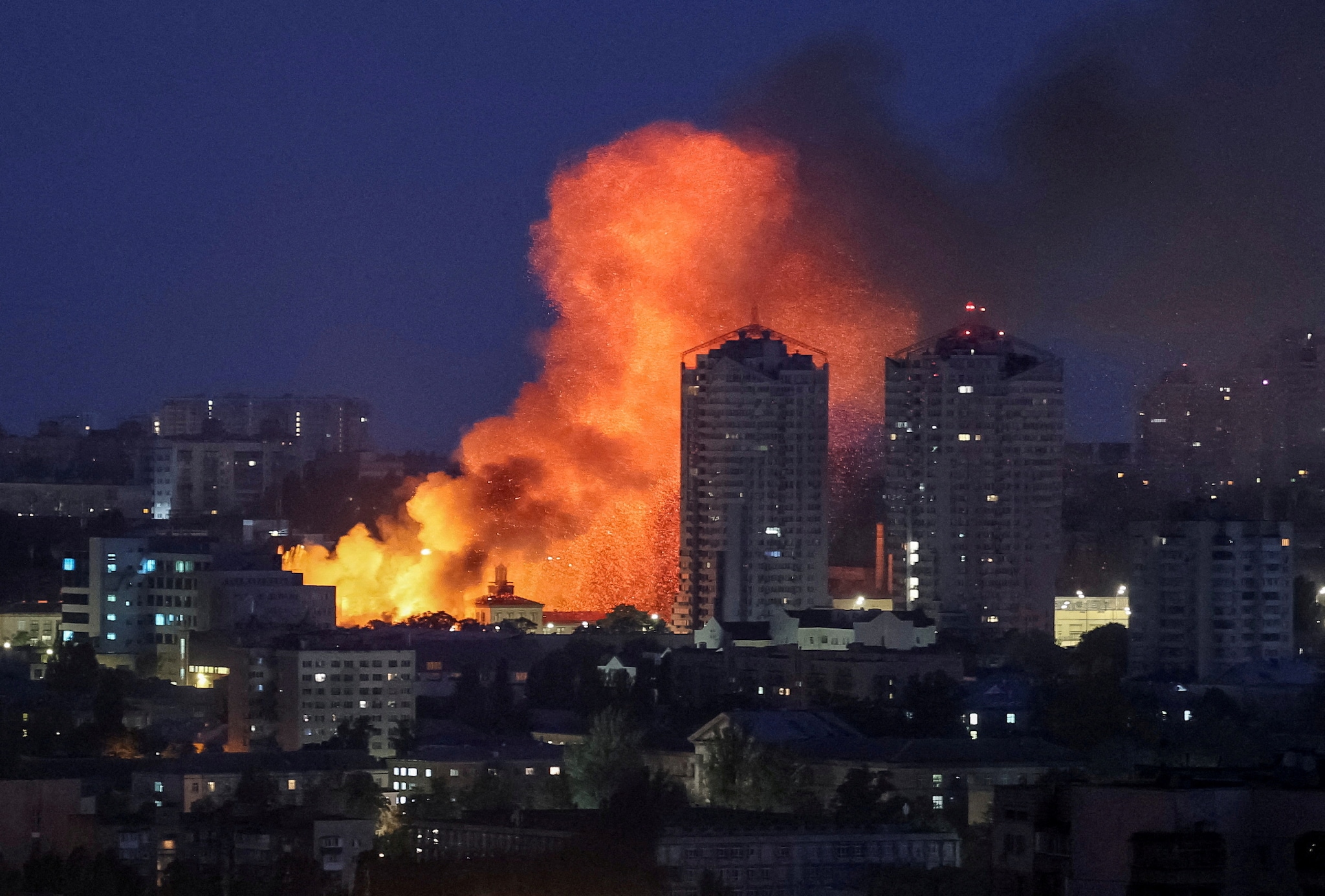
The report of 220 Ukrainian drones intercepted over Russian territory within a nine-hour window signals a fundamental shift in the economics of modern warfare. Traditional air defense systems, designed to counter high-velocity ballistic missiles and manned aircraft, are currently being forced to solve a math problem that favors the aggressor. When an interceptor missile costing $2 million is deployed to neutralize a loitering munition built for $20,000, the defender is losing the engagement regardless of whether the target is hit. This 100:1 cost-exchange ratio creates a systemic vulnerability where the defender's magazine depth is depleted faster than the attacker’s production capacity.
The Mechanics of Saturation Attacks
The objective of a large-scale drone wave is rarely the destruction of a single high-value target. Instead, these operations function as a stress test for integrated air defense systems (IADS). By deploying 220 units across a compressed timeframe, the attacker forces the IADS to manage three distinct technical bottlenecks:
- Sensor Overload: Radar systems must distinguish between small, low-altitude plastic drones and environmental clutter. A high volume of targets forces the system to prioritize tracking over engagement, increasing the "detection-to-kill" latency.
- Processor Saturation: Modern fire control computers have a finite limit on the number of simultaneous active tracks they can manage. By exceeding this limit, the attacker ensures that a percentage of the swarm remains unaddressed by automated responses.
- Kinetic Depletion: Most surface-to-air missile (SAM) batteries carry a limited number of ready-to-fire interceptors. Reloading these systems takes time—often measured in hours—during which the defended asset remains completely exposed.
The reported success rate of the Russian Ministry of Defense in downing these drones does not account for the "leakage rate." In swarm dynamics, a 95% interception rate is a failure if the remaining 5% of drones are directed at volatile infrastructure like oil refineries or ammunition depots. The precision required for a drone to cause catastrophic damage is significantly lower than the precision required for an interceptor to stop it.
The Cost Function of Layered Defense
To analyze the effectiveness of a defensive posture against massed drones, one must look at the "Layered Cost-Benefit Matrix." Russia’s defensive strategy relies on a mix of electronic warfare (EW) and kinetic interception.
Electronic Warfare (The Non-Kinetic Layer)
EW represents the most cost-effective countermeasure. By jamming GPS signals or disrupting the radio frequency link between the operator and the drone, defensive units can "soft-kill" a target without firing a shot. However, the shift toward autonomous terminal guidance—where the drone uses computer vision to identify its target in the final seconds—renders traditional jamming obsolete. If the drone no longer requires an external signal to navigate, the EW layer fails.
Point Defense Systems (The Kinetic Layer)
Systems like the Pantsir-S1 or Tor-M2 represent the last line of defense. These use a combination of autocannons and short-range missiles. The autocannon is the ideal tool for drone defense because the "cost per kill" is measured in the hundreds of dollars rather than millions. The limitation here is range. A drone must be within 2-4 kilometers for an autocannon to be effective, leaving zero margin for error.
Geographic Dispersal and the Perimeter Problem
Defending a landmass as vast as the Russian Federation against low-cost, long-range drones is a geometric impossibility. The border is too long to be fully covered by radar, and high-value targets are too numerous to be individually protected by dedicated SAM batteries. This creates "security islands."
- The Concentration Risk: If Russia concentrates its best air defenses around Moscow, it leaves energy infrastructure in the Urals or logistics hubs near the border vulnerable.
- The Intelligence Loophole: Ukrainian reconnaissance—often aided by satellite imagery and signal intelligence—identifies the gaps between these "islands." Drones are then programmed with waypoints that weave through the gaps in radar coverage.
The nine-hour window mentioned in the reports suggests a coordinated effort to find these gaps simultaneously across multiple regions (Kursk, Bryansk, Belgorod). A simultaneous strike forces the defender to choose which regions to prioritize, revealing their strategic hierarchy.
The Industrial Realities of Attrition
While the headlines focus on the number of drones "downed," the underlying metric of importance is the industrial replenishment rate.
The manufacturing of 220 drones can be distributed across dozens of small-scale workshops using off-the-shelf components, carbon fiber, and 3D-printed parts. Conversely, the manufacturing of radar arrays and high-end interceptor missiles requires a centralized industrial base, rare-earth minerals, and sophisticated microelectronics that are often subject to international sanctions.
Russia’s claim of downing 220 drones is a claim of resource consumption. If the Ukrainian side can sustain this rate of fire for weeks, the Russian air defense network will face a "thermal runaway" equivalent: the system will overheat and fail because it cannot replenish its interceptor stocks at the rate they are being expended.
Tactical Evolution: The Drone as a Decoy
A significant portion of the 220 drones were likely "blank" targets—cheap airframes with no explosives, designed specifically to be detected. The logic of the decoy is to:
- Force the defender to reveal the location of hidden radar sites.
- Waste expensive missiles on $500 airframes.
- Clear a path for a smaller number of "high-end" drones equipped with sophisticated sensors or larger warheads.
When a defender announces they have downed a high number of drones, they are often inadvertently confirming that the attacker's decoy strategy is working. The high number of kills is a metric of activity, not necessarily a metric of security.
Strategic Play: Shifting from Interception to Neutralization
For the defender to regain the advantage, the strategy must shift from "interception in flight" to "neutralization at the source." This involves a transition from a reactive posture to a proactive one.
Step 1: Deep Strike Counter-Production
The only way to win the math of drone warfare is to destroy the assembly points and the supply chain. Intercepting drones in the air is a losing game; hitting a warehouse containing 500 drones before they launch is a winning game.
Step 2: Transition to Directed Energy Weapons (DEW)
High-energy lasers and high-power microwaves offer the only path to a sustainable cost-exchange ratio. A laser "shot" costs as much as the electricity used to generate it—pennies per engagement. Until these systems are fielded in significant numbers, the defender remains trapped in a negative economic spiral.
Step 3: Automated Identification and Triage
Defenders must implement AI-driven fire control that can instantly categorize a drone as a "decoy" or a "threat" based on its flight profile and thermal signature. This allows the system to ignore the $500 decoys and save the $2 million missiles for the actual munitions.
The volume of 220 drones is a harbinger of a future where mass and low cost define the theater of operations. The side that continues to rely on high-cost, low-volume precision weapons to defend against low-cost, high-volume swarms will eventually face systemic collapse. The strategic requirement now is not better missiles, but a cheaper way to kill.