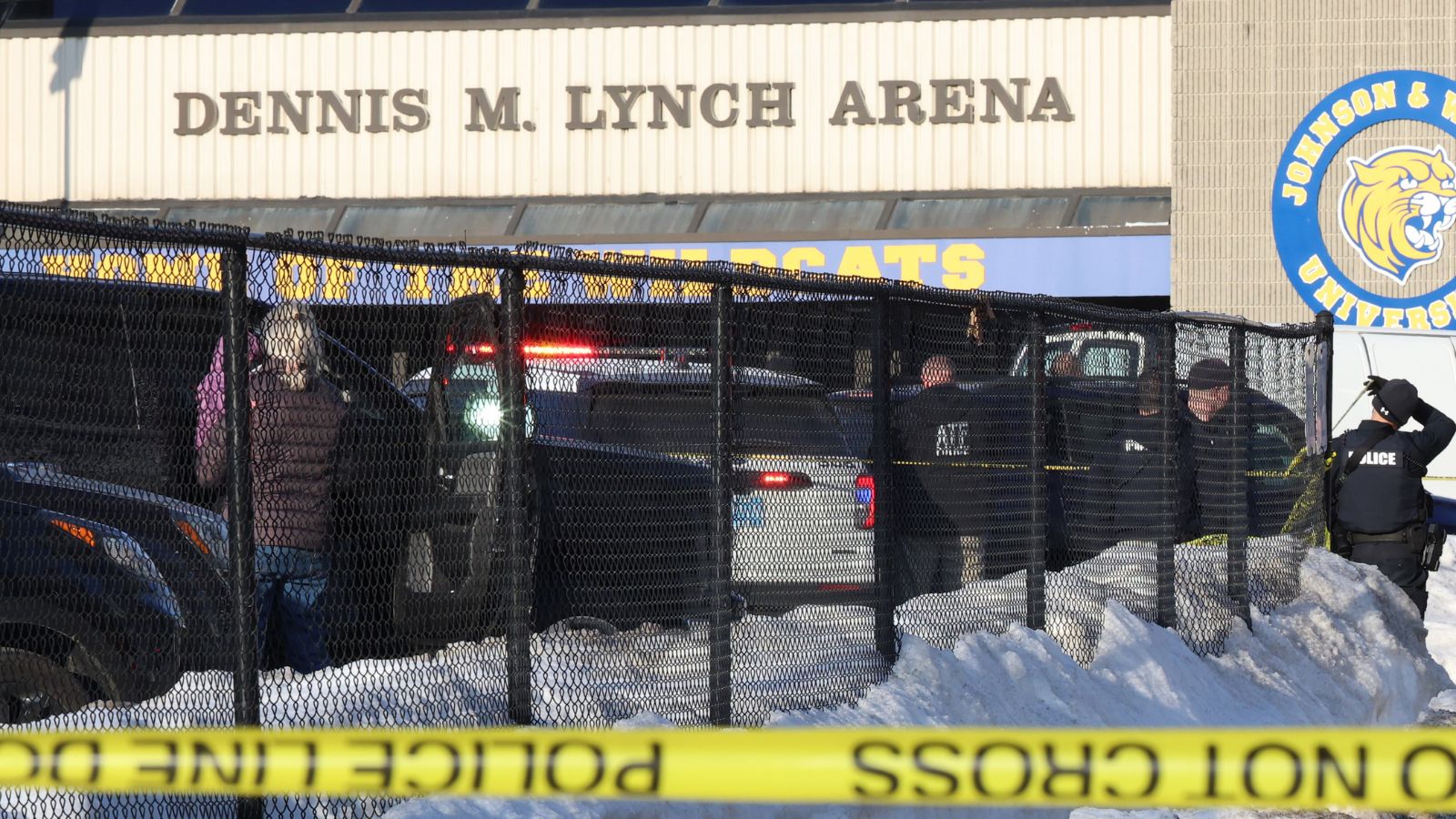
The failure of security protocols at high-density community gatherings is rarely a matter of singular intent; it is an architectural and operational breakdown. When a violent actor targets a school-sanctioned athletic event at a municipal facility, such as the Rhode Island ice rink shooting, they exploit a specific "security vacuum" created by the intersection of open-access public space and concentrated, emotionally charged crowds. To understand this event beyond the immediate tragedy requires a deconstruction of the physical security layers, the psychology of targeted violence in semi-private environments, and the systemic failure of rapid-response mitigation.
The Triad of Venue Vulnerability
Public municipal spaces—arenas, rinks, and community centers—operate under a specific set of constraints that create high-risk profiles. These variables can be categorized into three distinct pillars that define the operational landscape of such an event.
1. The Permeability of Public Infrastructure
Most municipal rinks are designed for throughput and ease of access rather than containment. Unlike professional sports stadiums, which utilize magnetometers and tiered entry points, community rinks often feature "soft" perimeters.
- Multiple Ingress Points: Service doors, locker room exits, and main lobby entrances often lack synchronized monitoring.
- Visual Obstructions: The structural requirements of ice rinks—heavy insulation, glass partitions, and specialized seating—create sightline "dead zones" where a threat can materialize before being detected by staff or law enforcement.
- Lack of Point-of-Entry Screening: The cultural expectation of a school game is one of communal trust. This expectation translates to a lack of physical screening, allowing a concealed weapon to enter the "hot zone" without friction.
2. The Psychology of Targeted Proximity
In this instance, the shooting was not a random act of mass violence but a targeted elimination of a family unit within a public forum. This distinction is critical for security modeling. Targeted violence in a crowd uses the "noise" of the event—the cheering, the whistles, and the physical cold of the rink which mandates heavy clothing—as a tactical advantage.
- Social Camouflage: A perpetrator known to the victims can blend into the social fabric of the event until the moment of engagement.
- Condensed Victim Density: Spectator stands at school games force families into tight, predictable clusters. This geographical density maximizes the lethality of a handgun while minimizing the victims' ability to execute "Run-Hide-Fight" protocols.
3. The Response Latency Gap
The interval between the first discharge and the neutralization of the threat is the primary determinant of the casualty count. In municipal settings, this gap is often widened by two factors: acoustic confusion and lack of on-site tactical presence. The echoing environment of an ice rink can cause "acoustic mirroring," where witnesses cannot immediately identify the source or direction of gunfire, leading to frozen decision-making.
Quantifying the Failure of the "Duty of Care"
Every public event carries a legal and ethical "duty of care" owed by the organizers and facility owners to the attendees. When a shooting occurs during a school-sanctioned game, the failure can be traced back to a breakdown in the Risk Mitigation Function.
$$R = P \times V \times C$$
In this risk equation:
- $P$ represents the Probability of a threat appearing.
- $V$ is the Vulnerability of the venue.
- $C$ is the Consequence of the event.
The Rhode Island incident demonstrates that while $P$ (the presence of a motivated gunman) is difficult for a facility manager to control, the $V$ (Vulnerability) was left unaddressed. High-visibility events with known interpersonal tensions require a shift from "Passive Security" (cameras that record after the fact) to "Active Deterrence" (armed presence or restricted access).
The failure to adjust the security posture based on the specific profile of the event—a high-stakes school game—indicates a reliance on a "baseline" security model that is insufficient for modern threat landscapes.
Structural Bottlenecks in Emergency Egress
A critical analytical oversight in most reporting of venue violence is the physical bottlenecking during the "Flight" phase of the incident. In the Rhode Island ice rink, the evacuation was hampered by the specialized footwear of the primary participants (skaters) and the narrow corridors typical of older New England infrastructure.
- Surface Friction Limitations: The transition from ice to rubber matting to concrete creates a physical deceleration for participants attempting to flee. This creates a "logjam" at exit points.
- The Funnel Effect: Architectural design in rinks often funnels large groups toward a single main lobby. In an active shooter scenario, this creates a secondary kill zone where the crowd becomes a singular, slow-moving target.
- Communication Silos: If the PA system is not integrated with a direct-to-police silent alarm, the time lost in manual 911 reporting (the "verification phase") can exceed 120 seconds—a lifetime in a ballistic event.
The Contagion of Domestic Spillover
We must categorize this event not just as a "shooting," but as the Public Manifestation of Domestic Lethality. Data suggests that a significant percentage of public mass shootings are extensions of domestic disputes. When a private grievance spills into a public ice rink, the venue is merely the stage for a pre-determined execution.
This creates a specific challenge for municipal policy. If security ignores the "Domestic Spillover" variable, they are blind to the most likely source of violence. Effective mitigation requires a "Threat Assessment Team" (TAT) approach, where schools and local municipalities share information regarding protective orders or known volatile domestic situations involving families tied to the athletic programs.
Strategic Mitigation Mandates
Moving forward, the management of community-level athletic venues must move away from the "Open Access" model and adopt a "Variable Security" framework.
- Implement Tiered Access Control: During school-sanctioned games, access should be restricted to a single, monitored entry point. The cost of a temporary magnetometer or a professional security guard is negligible compared to the liability and human cost of a breach.
- Acoustic Signature Detection: Facilities should invest in IoT-enabled sensors that detect the specific acoustic frequency of a gunshot and automatically trigger a lockdown of non-exit doors while simultaneously alerting local precincts.
- Rapid-Response Integration: Local law enforcement must conduct "site-specific" training. Knowing the layout of the locker rooms and the mechanical basement of a specific rink can shave minutes off the neutralization time.
The Rhode Island shooting serves as a data point in a growing trend of "Soft Target" exploitation. The transition from tragedy to prevention requires an unsentimental analysis of architectural flaws and a rigorous overhaul of the communal trust model that currently leaves families exposed in the stands.
The immediate tactical requirement for municipal leaders is the conduction of a Comprehensive Vulnerability Audit for every facility under their jurisdiction, prioritizing those that host youth and school events. This is no longer a matter of "if" a breach will occur, but "how" the infrastructure will respond when the threshold is crossed. Stop treating community centers as neutral ground; they are high-stakes environments that require professional-grade security logic.