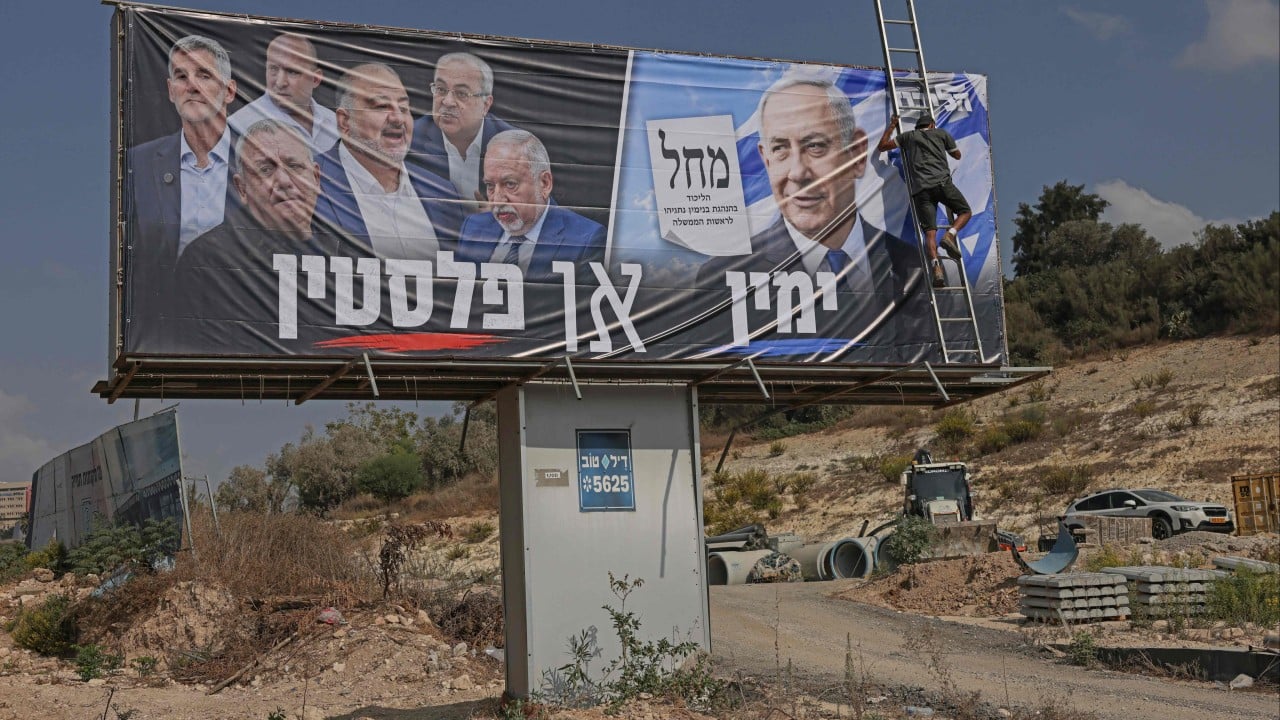
The degradation of the 2026 Israeli legislative election into personal smears, synthetic media, and physical intimidation was not an emotional breakdown of political decorum. It was a calculated response to structural gridlock. When proportional representation produces near-identical polling ceilings between competing blocs, rational political actors abandon policy persuasion—which yields diminishing marginal returns among entrenched voters—and shift capital toward turnout suppression, base mobilization, and institutional delegitimization.
Standard journalistic accounts frame the October 2026 election cycle as a sudden descent into "poor-taste jibes" and "inflammatory attacks". That framing mistakes the symptom for the disease. By analyzing the campaign through game theory, information economics, and operational security, the exact mechanics of this escalation become quantifiable. For a deeper dive into this area, we suggest: this related article.
The Game Theory of Deadlocked Blocs
In a parliamentary system governed by a 3.25% electoral threshold and a 61-seat majority requirement, campaign strategy is dictated by the elasticity of the uncommitted voter pool. Entering October 2026, polling consistently showed the bloc led by Prime Minister Benjamin Netanyahu and the opposition coalition anchored by Yashar leader Gadi Eisenkot locked in a statistical tie, with neither side securing an outright majority.
Under conditions of low voter elasticity—where ideological sorting has already hardened partisan boundaries—traditional programmatic campaigning fails to shift seat allocations. Campaigns therefore pivot to three alternative levers: For additional details on this topic, detailed coverage is available at TIME.
- Differential Turnout Engineering: Increasing the cost of voting for the opposing coalition's marginal demographics while inducing threat-driven urgency among core supporters.
- Coalition Sabotage: Driving wedges between prospective governing partners before ballots are cast, specifically targeting the viability of partnerships between Zionist opposition parties and Arab-Israeli lists such as Ra'am and the Joint List.
- Institutional Friction: Pre-emptively eroding public trust in electoral oversight bodies, judicial authorities, and law enforcement to create post-election bargaining power.
When the marginal value of a policy white paper drops to zero, the marginal return on an existential threat or a targeted personal smear rises proportionally.
The Three Vectors of Campaign Escalation
To understand how the 2026 campaign operated on the ground and online, the tactics deployed across rival camps must be segmented into three distinct operational vectors.
1. Synthetic Media and Algorithmic Saturation
The 2026 cycle marked the first Israeli general election where generative artificial intelligence functioned as a primary production engine rather than a novelty. Despite the Central Elections Committee (CEC) enacting transparency rules in July 2026 requiring explicit labeling for AI-generated or substantially altered campaign materials, compliance collapsed under the weight of decentralized distribution.
Data from an Open University of Israel tracking study revealed that roughly 13% of all election-related social media posts were AI-generated or manipulated, with Likud-aligned networks accounting for approximately one-third of that volume. Furthermore, an Israel Internet Association survey documented that 71% of voters encountered election-related synthetic content, while 25% of the electorate reported consulting large language model chatbots to guide their voting decisions.
The operational objective of these assets was visual framing rather than literal deception. Campaigns deployed synthetic imagery to bypass cognitive defenses and trigger immediate threat responses:
- Coalition Framing: Netanyahu's social media channels circulated an AI-generated image depicting Gadi Eisenkot bypassing a figure wearing an "Israeli unity" shirt to embrace Ra'am leader Mansour Abbas. Similarly, in July 2026, CEC Chair Noam Sohlberg ordered the Religious Zionist Party to remove a synthetic video simulating a meeting between an Eisenkot lookalike, Mansour Abbas, and Palestinian Authority President Mahmoud Abbas.
- Existential Catastrophism: On October 25, 2026, Netanyahu shared an AI-rendered depiction of a nuclear detonation over Tel Aviv, framing domestic policy disputes—including ultra-Orthodox military conscription exemptions—as a "smokescreen" against an unchecked Iranian threat.
- Institutional Subversion: In mid-September 2026, Religious Zionist Party leader Bezalel Smotrich distributed an AI video depicting Supreme Court President Yitzhak Amit, Justice Daphne Barak-Erez, and Attorney General Gali Baharav-Miara being physically dragged at a demonstration.
The mechanism behind this tactic is the illusory truth effect paired with affective priming. Even when a voter recognizes an image as synthetic—or when a legal threat from Yashar forces an advisor like Jonatan Urich to delete a video—the visual association between an opponent and a perceived security threat remains cached in memory.
2. Moral Binary Framing and Personalization
When policy records present liabilities—such as protracted multi-front conflict, economic strain, or unresolved hostage negotiations—campaigns convert structural accountability into binary moral combat.
A prime operational example occurred in the juxtaposition of bereaved mothers on opposing sides of the political divide. Campaign materials contrasted Likud candidate Talik Gvili, framed calmly against an Israeli flag, with Einav Zangauker, a prominent critic of the government's hostage negotiation strategy, depicted in red-tinted, agitated imagery alongside protesters under the caption "It is us or them".
This technique strips away policy complexity and forces the electorate into an in-group versus out-group loyalty test. By casting critics not as political opponents with alternative security doctrines, but as internal adversaries, campaigns neutralize the moral authority of protest movements.
3. Demographic Delegitimization and Grassroots Spillover
The third vector operates at the intersection of elite rhetoric and street-level intimidation. Political scientists distinguish between elite cueing—signals sent by party leaders—and stochastic mobilization, where supporters translate rhetorical framing into physical action without direct command-and-control orders.
Throughout the campaign and into the October 27 election day, right-wing messaging framed Arab-Israeli political participation and potential coalition backing as inherently illegitimate. Digital monitoring recorded a 400% surge in anti-Arab hate speech on social media during the election window, amplified by unsubstantiated claims of foreign-backed voting fraud in Arab municipalities—claims subsequently rejected by the Central Elections Committee.
The causal chain from digital cueing to physical friction materialized directly at polling stations on October 27, 2026:
- Targeted Harassment of Leadership: Democrats party chairman Yair Golan required an expanded security detail prior to the vote following repeated death threats; on election day, police arrested a knife-wielding individual near Golan while activists affiliated with Otzma Yehudit physically assaulted Democrats campaigners and destroyed party booths.
- Intimidation of Bereaved Families: Itay Chen, the father of a 19-year-old soldier killed during the October 7 Hamas invasion whose body was held in Gaza until November 2025, faced verbal harassment while attempting to cast his ballot.
- Intra-Sectoral Enforcement: Within the ultra-Orthodox sector in Modi'in Illit, activists for the Haredi Public Party had their campaign materials burned by dozens of Haredi youths, while candidate Eliyahu Leitner reported crowds surrounding his residence and terrorizing his children.
These incidents demonstrate that once campaign rhetoric lowers the social penalty for aggression, political operatives lose control over the escalation ladder. Grassroots actors treat polling stations not as administrative venues, but as contested territory.
The Cost Function of Negative Campaigning
Political strategists frequently miscalculate the long-term balance sheet of scorched-earth tactics because they measure success solely by short-term vote share on election day. A rigorous evaluation requires accounting for three hidden governance costs that accrue immediately after the polls close.
First, coalition formation friction increases exponentially. In a fragmented Knesset where forming a 61-seat government requires assembling diverse ideological factions, personal attacks destroy the interpersonal trust necessary for coalition negotiations. When parties spend months labeling rival leaders as traitors or security threats, pivoting to a unity government or securing external parliamentary support carries severe reputational penalties with their own base.
Second, institutional legitimacy suffers permanent erosion. When political leaders attack the Supreme Court, the Attorney General, and the Central Elections Committee during a campaign, they degrade the very referees required to validate a narrow electoral victory. Post-election claims of voting fraud—even when formally dismissed by election officials—leave a significant percentage of the public viewing the incoming government as illegitimate.
Third, security resource allocation becomes distorted. Diverting Shin Bet and Israel Police personnel to guard domestic politicians and police intra-communal polling station clashes consumes operational bandwidth needed for external counterterrorism and border security.
Limitations of Regulatory Countermeasures
Standard policy prescriptions for toxic campaigns—such as stricter disclosure laws, platform content moderation, and post-hoc fines—consistently fail against modern digital operations.
The July 2026 CEC labeling mandate illustrates the enforcement latency gap. By the time an opposition party files a petition, a judge reviews the media, and a removal order is issued, a synthetic video has already achieved peak organic velocity across encrypted messaging apps like Telegram and WhatsApp, where platform moderation cannot reach. Removing an asset 72 hours after publication does not reverse the cognitive impression made during its initial viral window.
Similarly, relying on automated platform detection to flag synthetic political speech creates an adversarial arms race. Campaigns simply alter prompts, compress video files, or use human-in-the-loop editing to bypass automated watermarks while preserving the emotional payload of the smear.
Strategic Imperatives for Campaign and Institutional Leaders
Because regulatory enforcement cannot outpace viral distribution, political actors, opposition coalitions, and election administrators must adjust their operational playbooks before the next snap election cycle—a high probability given the deadlocked arithmetic of the 26th Knesset.
- Shift Opposition Defense from Reactive Takedowns to Pre-Bunking: Filing legal injunctions against synthetic smears amplifies the targeted visual by generating secondary news cycles. Campaigns must establish rapid-response baseline verification—publishing authenticated, time-stamped schedules and raw footage—while inoculating voters beforehand against predictable coalition-smear templates rather than litigating individual deepfakes after distribution.
- Deploy Predictive Physical Security at High-Friction Polling Nodes: Law enforcement cannot treat polling stations uniformly. Security planners must map precincts where elite rhetoric overlaps with demographic fault lines—specifically mixed cities, ultra-Orthodox municipalities experiencing internal political splits, and venues frequented by high-profile opposition figures—and deploy visible, non-partisan perimeter buffers prior to opening hours.
- Establish Real-Time Electoral Audit Transparency: To neutralize pre-emptive fraud narratives targeting minority turnout, the Central Elections Committee must publish granular, precinct-level turnout and ballot-verification telemetry in real time on election day. Closing the information vacuum between poll closing and final certification removes the oxygen required for post-election delegitimization campaigns.
- Price Post-Election Coalition Optionality into Campaign Messaging: Party strategists must enforce strict red lines against personalizing attacks on potential governing partners or state institutions. In a proportional system where today's rival is tomorrow's necessary parliamentary bloc, tactical wins achieved through scorched-earth rhetoric directly translate into strategic paralysis during government formation.