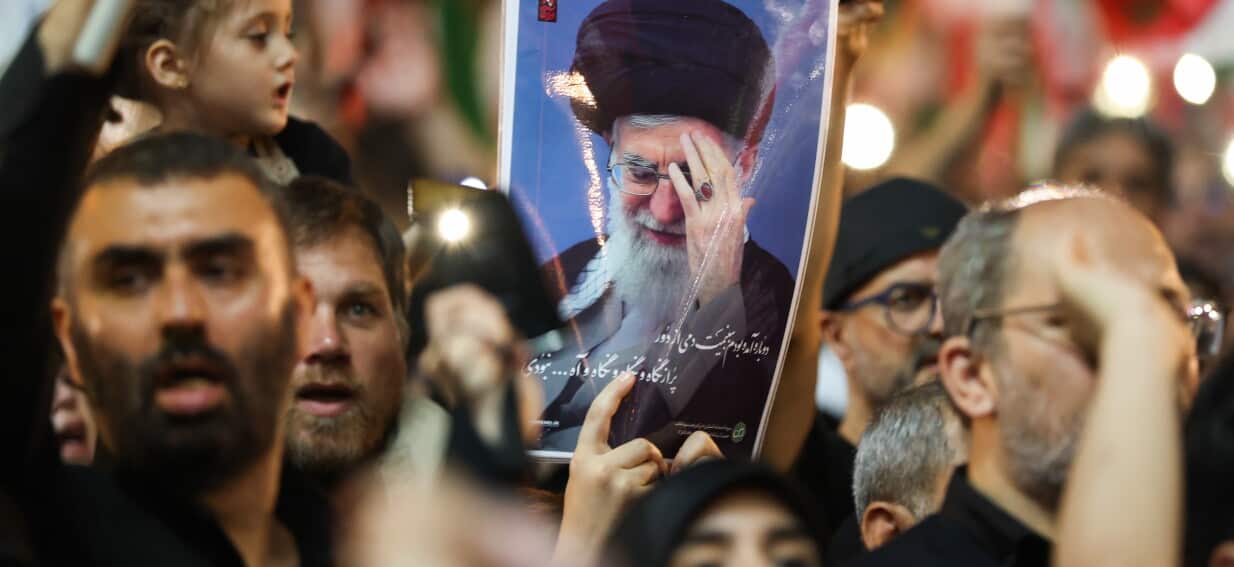
Tehran is completely paralyzed right now. You can feel the tension in the heavy summer air as millions of people pack the streets. The Islamic Republic has officially begun its massive, multi-city farewell for its late Supreme Leader, Ayatollah Ali Khamenei.
This isn't a standard state funeral. It's a calculated projection of raw political survival. Expanding on this idea, you can also read: The Weaponized Weather Fallacy Why Blaming Sanctions For Climate Failure Is A Cop Out.
Khamenei was killed back on February 28, 2026, in a devastating joint U.S.-Israeli airstrike that targeted his residence. His daughter, son-in-law, and even his 14-month-old granddaughter died in the same blast. For four long months, the regime kept his body on ice. It was simply too dangerous to host a massive public gathering while missiles were still flying. Now, taking advantage of a fragile wartime pause, the government is executing a six-day mourning marathon designed to signal to the West that the regime hasn't broken.
The Logistics of a Geopolitical Spectacle
Iranian officials claim they expect anywhere between 15 and 20 million people to flood the capital over the next few days. The sheer scale of this event is mind-boggling. Authorities have completely locked down Tehran's airspace, shut down major transit routes, and closed businesses ranging from the historic Grand Bazaar to local gyms. Observers at Al Jazeera have provided expertise on this trend.
The procession route isn't confined to a single city. It's a sprawling religious and political circuit designed to rally the Shiite world. The rituals started at the Imam Khomeini Grand Mosalla complex in Tehran, where Khamenei's casket sits draped in a red flag from the holy Hussein shrine in Karbala. From the capital, the body moves to the religious hub of Qom. Then, it crosses international borders into Iraq, traveling through the sacred Shia cities of Najaf and Karbala, before returning to Iran for final burial in his hometown of Mashhad on July 9.
Western leaders didn't get an invitation. Instead, the front rows are filled with delegates from Russia, China, Pakistan, Iraq, and Qatar. Representatives from regional militant networks like Kataib Hezbollah and Palestinian Islamic Jihad also stood by the caskets. It's a visual confirmation of Iran's current geopolitical alignment.
A Fragile Truce and the Shadow of Succession
Hosting this event required a delicate diplomatic tightrope. The funeral happens to coincide with the United States celebrating its 250th Independence Day on July 4. To pull this off without the threat of imminent bombardment, Iran and the U.S. quietly brokered a temporary, one-week de-escalation agreement in the crucial Strait of Hormuz. Formal peace talks are officially paused, but the temporary quiet gives the regime room to breathe.
The real narrative to watch during these six days isn't just the public grief. It's the visual introduction of Iran's new leadership.
A week after the assassination, the Assembly of Experts quietly elected Khamenei's son, Mojtaba Khamenei, as the new Supreme Leader. Up until now, Mojtaba has remained completely out of sight, reportedly recovering from injuries sustained in the initial February attack. State media has started plastering billboards across major highways showing the late leader standing alongside his son. The funeral organizers are using this massive gathering to cement Mojtaba's legitimacy and prove the family dynasty remains intact.
Managing the Risk of Total Chaos
Massive public funerals in Iran have a history of turning lethal. When Ayatollah Ruhollah Khomeini died in 1989, the crowds grew so aggressively frantic that the funeral descended into absolute chaos, resulting in trampled bodies and a nearly destroyed shroud. A similar tragedy occurred during the 2020 funeral of military commander Qassem Soleimani.
The current government is terrified of a repeat performance. Security forces have deployed heavily across every major intersection, not just to control the massive crowds, but to suppress any signs of domestic dissent.
Public reaction inside Iran is deeply fractured. While state television broadcasts endless loops of weeping supporters holding portraits of the late cleric, the reality on the ground is far more complicated. When the news of the assassination originally broke in February, videos leaked online showing pockets of citizens celebrating in various provinces. The regime knows that a massive, tightly controlled funeral is its best tool to rewrite the narrative and project absolute unity to a watching world.
Keep a close eye on the border crossings into Iraq over the next forty-eight hours. The movement of the casket through Najaf and Karbala will serve as a direct gauge of Iran's remaining influence over its neighbor. Watch how smoothly the state apparatus handles the crowd transitions in Qom and Mashhad. The logistical success or failure of this week will tell us exactly how stable the new government really is under Mojtaba's rule.