Infinity is not a concept you can hold in your hand. It slips between your fingers like dry sand, cold and endless. Most of us spend our lives pretending we cannot see the edges of things, comforted by the walls of our rooms, the finite hours of our days, the measurable distance between where we were born and where we will rest.
Then you walk into a room lined with mirrors.
Suddenly, there is no room. There are no walls. There is only you, repeated a million times over, stretching into an absolute void of yellow pumpkins, black polka dots, and burning crimson lights. You are small. You are infinite. You are terrifyingly alive.
That room belonged to Yayoi Kusama.
For nearly a century, she built those rooms out of her own terror. While the rest of the world chased certainty, Kusama stood at the edge of an abyss and simply began to paint what she saw.
She was ninety-seven when the brush finally slipped from her hand. Ninety-seven years of turning panic into patterns.
Picture a small child in Matsumoto, Japan, during the Second World War. The air smells of burning metal and damp earth. Inside the child's head, the world is violently loud. Flowers are talking to her. The tablecloth patterns are detaching themselves, crawling up the wallpaper, and multiplying across her skin. She tries to brush them away, but they are inside her. They are the room. They are the universe.
This is what visual hallucinations look like when they are not a metaphor.
When Kusama was a young girl, she did not know the word art. She only knew that if she covered every surface of a paper with thousands of tiny dots, the overwhelming noise in her brain quieted down for a few precious seconds. Dots became her armor. Polka dots became the skin of the cosmos.
She packed her bags in 1957 with a handful of yen and sixty silk kimonos dyed with her own designs, having burned thousands of her early paintings in a fit of youthful desperation. She crossed the Pacific to a New York City that was loud, brash, and entirely unprepared for a quiet Japanese woman in a handmade dress.
New York in the sixties was a chessboard moved by men. Andy Warhol, Claes Oldenburg, Donald Judd—they took up space with broad shoulders and loud declarations. Kusama was there first, or she was there alongside them, sewing thousands of white stuffed phalluses onto boats and furniture, creating soft sculptures that made polite society choke on its martini. She staged naked anti-war protests in front of the Statue of Liberty, painting polka dots directly onto the bodies of young draft protestors.
She was brilliant. She was relentless. And yet, the art world loved her ideas while giving the credit to the men who copied her execution.
Imagine watching someone trace your shadow and sell it as their own. Imagine doing this while your mind periodically fractures into a kaleidoscope of terror.
By the early nineteen-seventies, broken, exhausted, and deeply depleted by a Manhattan art scene that consumed her innovations while marginalizing her identity, she returned to Japan. Not to conquer. To survive.
She checked herself into a psychiatric hospital in Tokyo. She has lived across the street from it ever since.
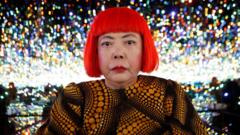
Every morning, she walks to her studio. She puts on her bright red wig—a sculptural halo of defiance against age and illness. She picks up a brush. She dots the canvas. She builds infinity.
People often ask how an artist becomes a global phenomenon in their eighties and nineties. They call it a late-career renaissance, as if the decades of silence were a vacation. They were not. They were a siege. Kusama sat in a hospital room painting the same obsessive patterns while the world outside forgot her name, remembered her name, turned her into a punchline, and finally, mercifully, bowed down before her genius.
Instagram made her a neon god. Millions of teenagers and tourists lined up for hours around the block just to spend forty-five seconds inside one of her Infinity Mirror Rooms. They took selfies against a backdrop of flashing LED lights and eternal reflections.
Some critics scoffed. They called it art for the selfie generation. They missed the entire point.
Kusama never cared about your Instagram grid. She built those rooms because she wanted you to feel what she had felt since she was a little girl in Nagano: the terrifying, beautiful dissolution of the self. When you stand in a mirror room, your ego is stripped away. You are no longer an accountant, a student, a cynic, a stranger. You are just a flicker of light bouncing between two glass planes forever.
She democratized the infinite.
Consider the sheer physical toll of it. At ninety, she was still standing for hours at a time, bent over massive canvases, applying layer after layer of acrylic paint with surgical precision. No assistants could replicate the organic tremor of her hand, the specific density of a dot placed by a woman who had stared down madness for ninety decades.
She didn't fight her demons; she gave them jobs.
When news of her passing at ninety-seven ripples through the cultural landscape, there is a strange temptation to wrap it in the neat bow of a life well-lived. Biography dictates that she was born in 1929, endured war, conquered New York, conquered psychiatric wards, and finally conquered the global museum circuit.
History loves a tidy arc. Kusama’s life was never an arc. It was a sphere.
It was a polka dot expanding outward until it touched every corner of the earth. From a neglected childhood in a conservative Japanese nursery to the frantic energy of post-war Manhattan, from the quiet sanctuary of a Tokyo psychiatric ward to the breathless lines outside Tate Modern and the Broad, she never changed her medium. She just changed the scale of her survival.
The studio in Tokyo is quiet now. The red wig rests on a stand. The brushes are cleaned and set in rows, waiting for a hand that will not return to grasp them.
Yet, walk into any major city tonight. Find a gallery, a museum, or a digital installation. Step inside a small, dark cube lined with glass and humming with golden lights.
Look down. Look up. Look all around you.
There are no walls left. There is only the light, echoing on and on, long after the painter has laid down her brush to rest inside the infinite.