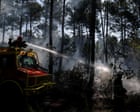
Vacation plans on the French Atlantic coast turned into a desperate scramble when regional authorities ordered nearly 4,000 people to clear out from campsites, holiday villages, and leisure parks around Lacanau. West of Bordeaux, an immense wildfire perimeter refused to stay put. Fire crews thought they had secured a fragile boundary overnight, but climbing temperatures and plunging humidity tore those hopes apart.
This crisis isn't an isolated incident. Across southwestern Europe, massive blazes in France and Spain have forced roughly 330,000 people to pack up and flee. If you've booked a peak-season escape to southern Europe, you need to know how these shifting weather patterns alter travel reality, emergency protocols, and what to expect on the ground.
The Reality of Pyrocumulonimbus and Unstoppable Fronts
When people think of forest fires, they picture manageable lines of brush burning steadily. What hit Gironde was entirely different. At its peak violence, the mega-fire generated its own terrifying weather system—a massive black thundercloud crackling with internal lightning and spinning out violent, erratic winds.
This phenomenon, known as a pyrocumulonimbus cloud, threw embers miles ahead of the main front, spawning brand-new spot fires and baffling veteran emergency responders. French President Emmanuel Macron labeled the emergency the toughest test the nation has faced since the second world war.
When fires generate their own atmosphere, traditional dousing techniques fail. Tactical firebreaks constructed by military engineers and firefighters become the only line of defense. Crews have already carved over 100 kilometers of protective breaks through the dense pine forests, yet the margin for error remains razor-thin.
Why Tourist Hotspots Are Sitting Ducks
Summer tourism brings millions to the pine-fringed Atlantic coastline of southwestern France. Campgrounds nestled under canopy shade and wooden holiday chalets look idyllic until a heatwave hits. Dry pine needles litter the ground like tinder, and holidaymakers often lack local evacuation awareness.
The precautionary order covering Lacanau Ocean and the shores of Lacanau lake targeted precisely these high-density recreational zones. Evacuations in peak tourist season cause absolute logistical chaos. Major traffic arteries like the A63 highway face partial closures, and rail lines south of Bordeaux experience heavy suspensions.
Tourists face tough choices. Some visitors choose to stay near restricted zones to salvage expensive vacation bookings, while others pack up immediately. Local officials emphasize that staying behind creates deadly hazards for emergency workers who have to divert resources to rescue stranded campers. Over 100 firefighters have already sustained injuries battling the Gironde perimeter.
The Broader European Heat Crisis
France isn't bearing this burden alone. Spain entered its fourth brutal heatwave of the summer, with blazes near Madrid and an enormous 50,000-hectare fire in Ávila forcing tens of thousands from their homes. Prime Minister Pedro Sánchez called the situation a stark expression of climate emergencies gripping the continent.
Data from the European Union's Copernicus service confirms that western Europe's record-breaking June dryness set the stage for these continuous infernos. With the continent heating at more than twice the global average rate, emergency infrastructure is stretched to its absolute limit. Neighboring EU nations have deployed extra firefighting aircraft, but ground crews warn that resources cannot scale infinitely against simultaneous mega-fires.
Practical Survival Steps for Travelers in Fire Zones
If you are currently traveling in France, Spain, or southern Europe, standard vacation planning rules no longer apply. You have to adapt quickly to minimize risk.
- Download Local Alert Apps: Keep regional emergency apps active on your phone with push notifications enabled. Monitor official feeds from local prefectures rather than relying solely on social media rumors.
- Map Your Evacuation Routes: Never assume your hotel or campsite has a casual exit strategy. Walk the perimeter, identify assembly points, and keep your vehicle fueled and pointed toward an exit road.
- Pack an Emergency Bag: Keep your passport, essential medications, chargers, and documents in a single backpack near the door. If local police knock, you won't have time to pack.
- Respect Red Zones Instantly: If authorities mandate an evacuation, leave immediately. Trying to protect property or capture footage puts trained firefighters at risk.
The smoke hanging over Bordeaux serves as a harsh warning for the future of Mediterranean and Atlantic travel. Flexibility, situational awareness, and respect for local emergency commands will define whether your next holiday stays safe.


